
There are more than a few long-running studies that have looked into the relationship between orgasm and longevity. Generally speaking, women who enjoy active sex lives in midlife and beyond have stayed healthier and lived longer.
No study has yet shown that orgasm itself is what adds the years. It may be healthier, happier and better-supported women simply have more and better sex. Studies do clearly indicate that levels of oxytocin and the endocannabinoid 2-AG surge in response to orgasm, and both are correlated to our health and well-being.
Here's more on what this research can confidently say, what it can't, and what to know about how your body works, especially in menopause.
On this page
Is pleasure good for your health?
Every time I give a talk on the endocannabinoid system, someone asks: so... is the orgasm thing real? Is pleasure good for me in a measurable, in-your-cells, add-years-to-your-life way, or is that just something we tell ourselves?
The available evidence broadly suggests the answer is yes. Consider these examples:
- Among 1,158 American women aged 57 to 85 (National Social Life, Health and Aging Project), those who found sex with their partner extremely pleasurable had about half the odds of undiagnosed or uncontrolled high blood pressure five years later.[1]
- In a small 2017 US study of 129 partnered mothers, women who reported any sexual intimacy in the past week had longer telomeres, a marker of cellular aging, than women who did not.[2]
- Among 3,195 English women over 50, those whose sex lives had slowed down over the past year were more likely to rate their own health as worse four years later.[3]
- A 2024 review of 63 studies, published in the World Health Organization's Bulletin, found that positive sexual health went with lower depression and anxiety and a better quality of life, in older adults too.[4]
- In a Welsh study of 918 men aged 45 to 59 followed for ten years, those who reported the most frequent orgasms had about half the death rate of those who reported the fewest.[5]
What did the longevity studies find?

Everyone quotes that last one, the Caerphilly cohort from Wales, published in the BMJ in 1997.[5] It's a wonderful headline, but it was only men. Sound familiar? That pattern is everywhere, and one of the reasons I'm even writing these posts ~ hardly anyone else is!
So what do we know about women? More than you'd think, once you go looking:
- Enjoyment. One of the earliest long-term aging studies followed 252 volunteers at Duke University for 25 years. For women, past enjoyment of sex was one of the three strongest predictors of how long they lived.[6]
- Heart health. In the US national study above, pleasure mattered for women and frequency did not. For older men the picture was different: men who had sex once a week or more, or who found it extremely pleasurable, were more likely to have a heart attack, heart failure or stroke.[1]
- 27 years in the Netherlands. In adults aged 55 to 84 at the start, most of them men, enjoying their sexuality was weakly linked to living longer, and the link became clear in people who said sexuality was important to them.[7]
- Middle-aged Americans. In national NHANES data on 12,598 men and women aged 20 to 59, followed for a median of 5.7 years, those who had sex at least weekly had about half the risk of dying from any cause of those having sex once a year or less.[8]
Not every study lines up. In Japan's Yamagata study of 20,969 adults aged 40 and over, followed for a median of 7.1 years, a lack of sexual interest went with a higher risk of death in men; the same link did not show up in women[9]. And in the Women's Health Initiative, dissatisfaction with sex did not predict new cardiovascular disease in postmenopausal women.[10]
Every one of these studies is observational. Nobody has randomly assigned women to more orgasms and then watched their health, so we can't rule out that good health, good relationships and low stress are what make good sex possible in the first place.
Women's cardiovascular health can benefit from a rewarding sexual relationship.
What happens in your body at orgasm?
This is where science nerd girlfriend gets excited about the chemistry ~ stay with me.
Around orgasm, two of your body's feel-good signaling systems light up.
The first is oxytocin, the hormone famous for labor, breastfeeding and bonding. In 1987, researchers measured it continuously in 13 women and 9 men during self-stimulation: it rose during arousal and was significantly higher at orgasm than at the start.[11]
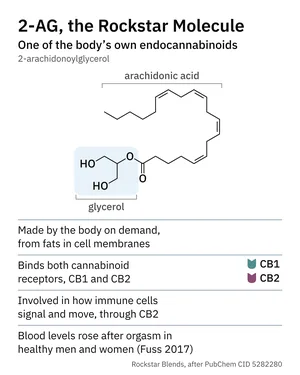
The second is your endocannabinoid system, the network of receptors and messenger molecules your body uses to keep everything in balance, and the same system tied to the rewards of eating, exercise and social contact.
In 2017, a team in Hamburg ran two lab studies, measuring endocannabinoids in the blood of healthy men and women before and after masturbation to orgasm, and found a significant rise in 2-AG (2-arachidonoylglycerol), one of your body's own endocannabinoids, the one you might have heard me call the Rockstar Molecule.
In a second study they compared orgasm with a control session, and the rise showed up only with orgasm. Anandamide, the other famous endocannabinoid, didn't change.[12] The authors' own hypothesis is that 2-AG is part of the reward of sex and orgasm.
Here's the twist. During arousal alone, without climax, one endocannabinoid goes down.
In a study of 21 women watching an erotic film, anandamide fell over the film, and fell most in the women who became most aroused, both physically and by their own rating. 2-AG didn't drop on average, but it fell more in the women who said they felt more turned-on.[13] Some of the older material online, my own notes included, had this backwards.
So the rough shape, from two different studies, is this: blood anandamide eases off as arousal builds, and 2-AG rises after orgasm.
Two more things happen in women at orgasm. Prolactin rose substantially after orgasm in a study of 10 women and was still raised an hour later.[14] And vaginal stimulation raises pain thresholds, most of all with orgasm: in the second of two studies of 10 women each, self-stimulation to orgasm raised the threshold for tolerating pain by 74.6% and for detecting it by 106.7%, while the sense of touch stayed the same.[15]
Oxytocin and the endocannabinoid system appear to work as partners. In mice, scientists at UC Irvine showed that oxytocin drives the release of anandamide in the brain's reward center, and that cannabinoid receptor activity was needed for social contact to feel rewarding.[16] It's a mouse study about bonding, not about orgasm, and a gorgeous clue about how the "love hormone" and your inner cannabinoid system may talk to each other.
What about your immune system? The study behind the popular immune claim is real and small: 11 young men, in whom orgasm raised the number of natural killer cells in blood drawn 5 and 45 minutes afterwards, compared with a session without sex.[17] Nobody has run it in women, or in women at menopause, and no one has repeated the 2017 endocannabinoid measurement in women at midlife.
Why does it matter in perimenopause and menopause?

For so many of the women I work with, midlife is exactly when pleasure quietly slips off the to-do list. Hot flashes, broken sleep, vaginal dryness, a libido that seems to have left without a forwarding address... sex can start to feel like one more thing that hurts, or one more thing you're failing at. Because no one talks about it, women assume that's just how it goes now.
Here's a finding I love sharing. The Study of Women's Health Across the Nation followed 2,936 American women from their mid-forties for ten years. Women who reported any kind of sexual activity weekly, including touching, oral sex and self-stimulation, not only intercourse, were 28% less likely to reach natural menopause at any given point than women who reported it less than monthly.[18] The authors offer an evolutionary explanation, not a proven mechanism, and it's a striking reminder that sexual activity and reproductive biology are in conversation.
I've written about how estrogen and the endocannabinoid system are intertwined in my post on chronic pain in midlife, and about tissue comfort in the topicals section of the menopause toolkit. If painful sex is part of your story right now, raise it with your clinician. It is common in menopause, and it is not something you have to put up with.[19]
Notice, too, that in the women's longevity and heart studies it was enjoyment and quality that showed up, not a number on a calendar.[6][1] In a one-time survey of 1,235 women aged 60 to 89 in the Women's Health Initiative, sexual activity was lower at older ages, but sexual satisfaction was not, and it went with feeling that they were aging well.[20] That's not a performance target. It's permission to make pleasure, in whatever form is right for you, partnered or solo, a real part of how you take care of yourself.
What about cannabis and orgasm?
You knew I'd get here. In a survey of 373 women at a university gynecology practice, the women who used marijuana before sex, most of them by smoking it, had about twice the odds of reporting satisfying orgasms, and most said it raised their sex drive and eased pain.[21] A separate online survey of 216 men and women who had combined cannabis and sex found that about four in ten said sex was simply better and another quarter said it was sometimes better; 65.7% of those who answered reported more intense orgasms, and only 10 people said it was worse.[22]
These are self-report surveys of people who chose to use cannabis, and in the clinic survey it was mostly smoked, acting on the brain. And the arousal research above is a reminder that "more cannabinoids, more pleasure" is far too simple. Dose, timing and route all matter, and no published study has yet measured cannabis and orgasm in women at menopause.
One more piece of the plant story: beta-caryophyllene, a terpene found in many spice and food plants and a major component of cannabis, binds directly to the CB2 receptor in laboratory studies.[23] It's one reason I'm so passionate about full-spectrum formulation rather than isolated single molecules. More on it in our entry on copaiba.
How strong is the evidence?
Here is every study in this post, sorted by what kind of study it was and how much weight it can carry.
| Finding | Who was studied | What kind of study | Evidence |
|---|---|---|---|
| Oxytocin rises during arousal and is higher at orgasm | 13 women, 9 men[11] | Lab measurement | Moderate |
| 2-AG rises after orgasm, not after a control session | Healthy men and women[12] | Lab, including a randomized crossover | Moderate |
| Prolactin stays raised an hour after orgasm | 10 women[14] | Lab, with a control session | Moderate |
| Vaginal stimulation, most of all to orgasm, raises pain thresholds | Two studies of 10 women[15] | Lab, with controls | Moderate |
| Enjoying sex goes with longer life and heart health in women | 252 volunteers over 25 years; 2,204 adults aged 57 to 85[6][1] | Long-term cohorts | Moderate |
| Sexual satisfaction and new cardiovascular disease in postmenopausal women | Women's Health Initiative[10] | Long-term cohort | Not shown |
| More frequent sex goes with lower mortality | 918 men; 12,598 adults aged 20 to 59[5][8] | Long-term cohorts | Moderate |
| Oxytocin drives endocannabinoid reward | Mice[16] | Animal study | Moderate |
| Cannabis before sex and better orgasms | 373 women; 216 adults[21][22] | Self-report surveys | Directional |
| Sexual intimacy and longer telomeres | 129 mothers, one week[2] | Cross-sectional | Directional |
| Orgasm and natural killer cells | 11 men[17] | Lab, with a control session | Moderate |
| Beta-caryophyllene binds CB2 | Cells and mice[23] | Laboratory | Directional |
| Endocannabinoids at orgasm in women at menopause | No published study yet | Not studied | |
| Topical full-spectrum hemp and sexual function at menopause | No published study yet | Not studied |
The studies I'd love to see run:
- Measure 2-AG and oxytocin around orgasm in peri- and postmenopausal women.
- Repeat the immune work in women, not only 11 young men.
- Follow women through menopause and test whether improving sexual comfort and pleasure changes cardiovascular or aging markers, rather than only observing who already has good sex.
- Test topical full-spectrum hemp on validated sexual-function measures in menopausal women.
What I tell the women I work with.
Your pleasure is not frivolous!
It is not a luxury you've aged out of, and it is not something to be embarrassed to ask your doctor about. The science on orgasm and longevity is young and mostly observational, and the wider research on sexual health points the same way for mood and quality of life.[4]
The biology of that moment, the oxytocin and the rise of the Rockstar Molecule, is real, measurable and kind of miraculous.
Nobody can promise you that more orgasms will add years to your life, but I believe better future research will confirm my theory that orgasm and 2-AG production is the greatest longevity cocktail we can make for ourselves. Cheers!
Frequently Asked Questions.
How often do you need to orgasm for a health benefit?
Does masturbation count, or only sex with a partner?
What is 2-AG?
2-AG (2-arachidonoylglycerol) is one of the body's two best-known endocannabinoids, the messengers of the endocannabinoid system. I call it the Rockstar Molecule. Blood levels of 2-AG rose after masturbation to orgasm in healthy men and women, and not after a control session.[12]
Does oxytocin go up when a woman has an orgasm?
Yes. In a 1987 study that drew blood continuously from 13 women and 9 men, oxytocin rose during arousal and was significantly higher at orgasm than at the start.[11]
Does having sex delay menopause?
In one large US study of 2,936 women followed for ten years, those who reported sexual activity weekly were 28% less likely to reach natural menopause at a given point than women who reported it less than monthly.[18] It's an association, not proof that sex delays menopause.
Does orgasm boost your immune system?
One small study found more natural killer cells in the blood after orgasm, in 11 young men, compared with a session without sex.[17] Nobody has studied it in women yet.
Is a hemp oil the same as using cannabis before sex?
What if sex has become painful after menopause?
It's common, and in most cases it can be managed,[19] so it's worth raising with your clinician; you don't have to put up with it. The topicals section of the menopause toolkit sorts the options by the evidence.
References.
- [1] Liu H, Waite LJ, Shen S, Wang DH. Is sex good for your health? A national study on partnered sexuality and cardiovascular risk among older men and women. J Health Soc Behav. 2016;57(3):276-96. ↩
- [2] Cabeza de Baca T, Epel ES, Robles TF, et al. Sexual intimacy in couples is associated with longer telomere length. Psychoneuroendocrinology. 2017;81:46-51. ↩
- [3] Jackson SE, Yang L, Koyanagi A, et al. Declines in sexual activity and function predict incident health problems in older adults: prospective findings from the English Longitudinal Study of Ageing. Arch Sex Behav. 2020;49(3):929-40. ↩
- [4] Vasconcelos P, Carrito ML, Quinta-Gomes AL, et al. Associations between sexual health and well-being: a systematic review. Bull World Health Organ. 2024;102(12):873-887D. ↩
- [5] Davey Smith G, Frankel S, Yarnell J. Sex and death: are they related? Findings from the Caerphilly cohort study. BMJ. 1997;315(7123):1641-4. ↩
- [6] Palmore EB. Predictors of the longevity difference: a 25-year follow-up. Gerontologist. 1982;22(6):513-8. ↩
- [7] Beerepoot S, Luesken SWM, Huisman M, Deeg DJH. Enjoyment of sexuality and longevity in late midlife and older adults: the Longitudinal Ageing Study Amsterdam. J Appl Gerontol. 2022;41(6):1615-24. ↩
- [8] Cao C, Yang L, Xu T, et al. Trends in sexual activity and associations with all-cause and cause-specific mortality among US adults. J Sex Med. 2020;17(10):1903-13. ↩
- [9] Sakurada K, Konta T, Murakami N, et al. Association between lack of sexual interest and all-cause mortality in a Japanese general population: the Yamagata prospective observational study. PLoS One. 2022;17(12):e0277967. ↩
- [10] McCall-Hosenfeld JS, Freund KM, Legault C, et al. Sexual satisfaction and cardiovascular disease: the Women's Health Initiative. Am J Med. 2008;121(4):295-301. ↩
- [11] Carmichael MS, Humbert R, Dixen J, et al. Plasma oxytocin increases in the human sexual response. J Clin Endocrinol Metab. 1987;64(1):27-31. ↩
- [12] Fuss J, Bindila L, Wiedemann K, et al. Masturbation to orgasm stimulates the release of the endocannabinoid 2-arachidonoylglycerol in humans. J Sex Med. 2017;14(11):1372-9. ↩
- [13] Klein C, Hill MN, Chang SC, Hillard CJ, Gorzalka BB. Circulating endocannabinoid concentrations and sexual arousal in women. J Sex Med. 2012;9(6):1588-601. ↩
- [14] Exton MS, Bindert A, Krüger T, et al. Cardiovascular and endocrine alterations after masturbation-induced orgasm in women. Psychosom Med. 1999;61(3):280-9. ↩
- [15] Whipple B, Komisaruk BR. Elevation of pain threshold by vaginal stimulation in women. Pain. 1985;21(4):357-67. ↩
- [16] Wei D, Lee D, Cox CD, et al. Endocannabinoid signaling mediates oxytocin-driven social reward. Proc Natl Acad Sci U S A. 2015;112(45):14084-9. ↩
- [17] Haake P, Krueger TH, Goebel MU, et al. Effects of sexual arousal on lymphocyte subset circulation and cytokine production in man. Neuroimmunomodulation. 2004;11(5):293-8. ↩
- [18] Arnot M, Mace R. Sexual frequency is associated with age of natural menopause: results from the Study of Women's Health Across the Nation. R Soc Open Sci. 2020;7(1):191020. ↩
- [19] The NAMS 2020 GSM Position Statement Editorial Panel. The 2020 genitourinary syndrome of menopause position statement of The North American Menopause Society. Menopause. 2020;27(9):976-92. ↩
- [20] Thompson WK, Charo L, Vahia IV, et al. Association between higher levels of sexual function, activity, and satisfaction and self-rated successful aging in older postmenopausal women. J Am Geriatr Soc. 2011;59(8):1503-8. ↩
- [21] Lynn BK, López JD, Miller C, et al. The relationship between marijuana use prior to sex and sexual function in women. Sex Med. 2019;7(2):192-7. ↩
- [22] Wiebe E, Just A. How cannabis alters sexual experience: a survey of men and women. J Sex Med. 2019;16(11):1758-62. ↩
- [23] Gertsch J, Leonti M, Raduner S, et al. Beta-caryophyllene is a dietary cannabinoid. Proc Natl Acad Sci U S A. 2008;105(26):9099-104. ↩
- [24] Liu H, Waite LJ, Shen S, Wang DH. Policy brief: does sex affect cardiovascular risk for older men and older women? J Health Soc Behav. 2016;57(3):275.