
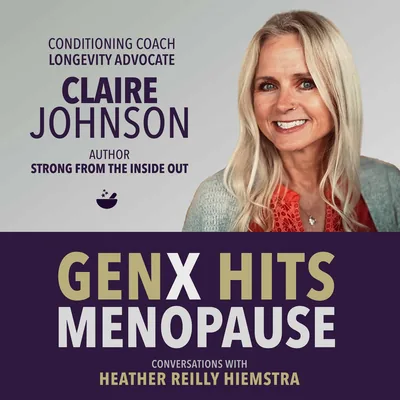
In “Strong From the Inside Out | Muscle, Menopause, and Metabolic Defense”, host Heather Reilly Hiemstra sits down with Claire S. Johnson — a strength and conditioning coach, speaker, and longevity advocate with more than 25 years of experience helping women thrive through menopause and beyond — for a conversation about Muscle as Metabolic Organ, Bone Density Down to the Marrow, Creatine and the Menopausal Brain, Protein, Fiber, and the Intermittent Fasting Trade-off and How to Actually Start — and Not Quit.
On this page
Heather Reilly Hiemstra sits down with strength coach and longevity advocate Claire S. Johnson for the conversation about skeletal muscle that this show should have had a long time ago. Muscle isn’t vanity — it’s the organ that manages insulin, loads the spine, and keeps midlife women out of the walker lane. As estrogen drops and muscle mass quietly walks out the door, Claire makes the case that the weight room is the most underrated piece of women’s health infrastructure in menopause.
If your energy, cognition, or body composition feel like they’re slipping no matter what you do, this one is for you — because Claire has spent 25 years helping women build the strength that keeps hormone shifts from becoming health crises.
Conversations include:
- Muscle as Metabolic Organ Skeletal muscle isn’t decoration — it’s where insulin goes to work. Claire breaks down exactly how strength training fights insulin resistance, why that prediabetes window matters in perimenopause, and why the two-pound baby rattles aren’t going to get the job done.
- Bone Density Down to the Marrow Strength training doesn’t just sit on top of the skeleton — it benefits women “down to the marrow of the bones,” Claire says. She explains why progressive loading is non-negotiable for menopausal women, and why farmer carries and goblet squats are worth their weight.
- Creatine and the Menopausal Brain That wired-and-tired, forgetting-your-own-exit cognitive fog? Claire calls creatine one of the fastest-acting supplements available — sharp cognitive effect within 30 minutes — and explains why it belongs in the morning routine alongside whatever else you’re doing for hormone support.
- Protein, Fiber, and the Intermittent Fasting Trade-off A menopause specialist’s research shifted Claire’s thinking: if a fasting window is shrinking your time to hit greater than one gram of protein per pound of body weight, the protein and fiber goals win. Body composition is the metric — not the scale, not BMI.
- How to Actually Start — and Not Quit Claire’s framework for getting back to the weight room: seek one session of instruction before you load bad movement patterns, ask trainers the right screening questions, and remember that exercise has no cancellation policy. You can start at 70. You can start at 80. It’s always there.
Tune in and build the muscle your hormones used to help you keep — because “strong from the inside out” is both Claire’s book and the only strategy that gets you to Disney with your grandkids, the 5K finish line, and the star on top of the tree.
About Claire S. Johnson
Claire S. Johnson is a strength and conditioning coach, speaker, and longevity advocate with more than 25 years of experience helping women thrive through menopause and beyond. She is the creator of the ClaireFoJo Experience and author of the upcoming book Strong From The Inside Out.
Claire works out of a wellness center adjoining a hospital — a daily reminder of what sedentary aging looks like, and the motivation behind everything she teaches. A colon cancer survivor and mother who strength-trained through perimenopause, Claire brings hard-won personal credibility to every protocol she prescribes.
She is passionate about changing the cultural script that tells Gen X women to keep pushing through — and replacing it with a practical, progressive approach to muscle-building that works at any age, any fitness level, and any starting point.
Episode Highlights
Skeletal Muscle and Insulin Resistance
“There are a lot of reasons, but I think the main one is it helps you with your insulin. It is a huge organ. I mean, there’s muscles attached to all of our bones, and it’s very helpful in managing that. And we have, we all know, we have so much chronic disease going on, which all begins with insulin resistance. And that insulin resistance, you know, it’s important for people to know that lays in your body for a long time. Chronic disease doesn’t just pop up one day. it’s something that’s been brewing for a long time. And strength training really helps to alleviate that because it helps the insulin get into your muscles and the muscle gives it a place to go.”
Bone Density Starts With Heavy Lifting
“Strength training will literally benefit you down to the marrow of your bones. Provided, you know, you’re lifting enough for it to be challenging. That’s something I struggle with a little bit, you know, women oftentimes are using just really, you know, those little, I call them baby rattles. The little two pound dumbbells are not going to get you where you’re trying to go. You need to pick up something that’s heavy. And then you’ll see over time, functionally, you’ll just get better. When you’re a tote and your laundry basket from your laundry room back to your main bedroom, you’ll just heed that thing up like, you know, lickety split. If you’re sitting in a bar stool and you need to scooch up to the bar, you can do it in one fatal swoop, you know? So just functional practical things like that. I like for women to be thinking like that because a lot of times people don’t understand how it applies in daily life. But, you know, if you want to, you know, tote your grandkids and make it through a day at Disney, you know, you need that functional strength. You need that skeletal muscle.”
Creatine for Menopause Brain Fog
“That cognition that you feel slipping away from you as you’re trying to function throughout your day, you know, you get on some creatine and it just goes away instantly. I mean, that is for me one of the fastest acting supplements I think that’s available to us. And it’s just an easy one. I just want women to know, you know, anyone listening to this show, you do not have to suffer alone. There are a lot of options nowadays for dealing with perimenopause and menopause, but creatin is an easy one. You can get a bag of creatin for about 35 bucks and take a scoop of that, you know, in the morning with some water or whatever, put it in your green juice, if you’re doing that, and, and you’re, you’re brand new in 30 minutes.”
No Age Limit on Building Muscle
“There’s no lines, no waiting, people. You can start at 70. You can start at 80. You can start at any time. It’s there for you. I tell my clients all the time when they get off track or whatever, I say listen, you know, exercise is here for you. It’s always here for you. If you leave it for a while, it’s always here for you to come and pick it back up, you know, literally pick it back up.”
Farmer Carries for Spine and Core
“Farmer carries load the spine, which, you know, in women, we know menopausal women. That’s huge. Our spines are turned chalk dust by the day. You know, so you want to be bearing load on both sides of your body. And then because you’re bearing load, then it’s firing your entire core to keep that balance while you walk. And it’s also a huge neurological demand to have to balance and maneuver all that down the street. But I mean, that is a simple, you know, move that you can do that, you know, really gives you a lot of bang for your book.”
Share this episode
Know someone who needs this conversation right now? Send them this episode — and tag us @genxhitsmenopause so we can amplify right back.
FAQs
Why is skeletal muscle so important during menopause beyond just appearance?
Skeletal muscle is a major metabolic organ that determines where insulin goes — without enough muscle, glucose has nowhere to land and prediabetes quietly tips into type 2 diabetes. Claire Johnson explains that as estrogen drops in menopause, muscle mass decreases alongside it, removing the body’s primary defense against insulin resistance. Strength training also loads the spine and benefits women “down to the marrow of the bones,” directly countering the bone density loss that accelerates in menopause. If you’re only doing yoga and light stretching, Claire’s bottom line is clear: you need to be lifting heavy enough to make it challenging.
Does creatine actually help with menopause brain fog and cognitive decline?
Yes — Claire Johnson calls creatine one of the fastest-acting supplements available for menopausal cognitive symptoms, describing a sharp clearing effect that she notices within about 30 minutes. She started using it during the wired-and-tired postpartum phase before her 43rd birthday and has relied on it since for the memory slips and mental looping that accompany perimenopause. A bag of creatine runs about $35, can be taken any time of day without disrupting sleep, and stacks easily into a morning drink. Claire uses both a powder (ORA Organic) and gummies from Organifi depending on what she has on hand.
How much protein do menopausal women need to maintain muscle mass?
Claire Johnson cites research from a menopause specialist recommending greater than one gram of protein per pound of body weight per day to support muscle maintenance during menopause. She flags intermittent fasting as a potential problem here — if a restricted eating window makes it difficult to hit that protein target, she and the specialist agree that protein and fiber goals should take priority over the fasting schedule. Whole food protein sources are preferable because the body recognizes real foods more readily than synthetic alternatives. Track your window and your grams together; if they’re in conflict, open the window.
What is a farmer carry and why do strength coaches recommend it for menopausal women specifically?
A farmer carry — walking while holding a weighted object in one or both hands — loads the spine, fires the entire core, and creates a significant neurological demand for balance, making it one of the highest-return movements for menopausal women facing bone density loss. Claire Johnson points out that holding weight on one side forces the opposite oblique to stabilize the spine, while the legs work continuously through the full range of motion. You don’t need gym equipment — detergent bottles or handled weights work fine, as Heather demonstrates walking to the end of her street and back. Claire calls the research on this single movement “mind-blowing” for how much functional strength it builds.
How should a menopausal woman who hasn’t lifted weights in years actually get started without getting injured?
Claire Johnson’s rule is mobility before strength — never load a bad movement pattern, and never start without at least one session of proper instruction. She recommends interviewing trainers directly, asking whether they have experience with clients who may have spinal degeneration or structural imbalances from menopause-related bone loss. A gym orientation to the weight room is enough to get started and doesn’t require a long-term financial commitment. If the gym feels intimidating, five push-ups in the morning and air squats after dinner are legitimate entry points — because as Claire says, exercise has no cancellation policy and you can begin building muscle at 70, 80, or any age.