
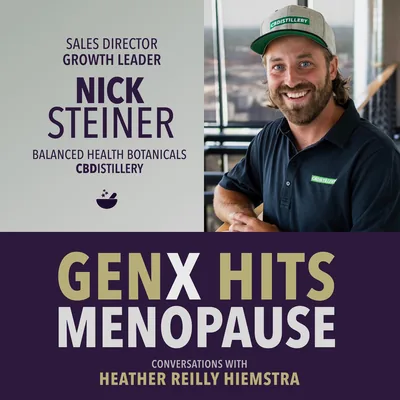
In “Don’t Panic! OneHemp and 2026 Federal Hemp Law Changes”, host Heather Reilly Hiemstra sits down with Nick Steiner — Director of Independent Retail Sales at Balanced Health Botanicals, the parent company of CBDistillery — one of the leading hemp brands in the country — for a conversation about What HR 6500 Actually Says, The Cannabinoids the Farm Bill Forgot, Topicals vs. Ingestibles: Different Lanes, Your Body, Your Cannabinoid Profile and From a Closet to Capitol Hill.
On this page
Heather Reilly Hiemstra sits down with Nick Steiner — Director of Independent Retail Sales at Balanced Health Botanicals — to decode the federal regulation threatening to reshape the full spectrum hemp industry. HR 6500 would cap THC at 0.4 milligrams per container, a limit that would effectively wipe out most full spectrum products on shelves today. Nick’s message: calm down, nothing is law yet, and the fight is far from finished.
If you’ve been wondering whether your favorite hemp product is about to disappear — or whether “hemp” and “getting high” are really the same thing — this episode gives you the insider’s read, straight from someone who has been shaping federal hemp policy since the Farm Bill era.
Conversations include:
- What HR 6500 Actually Says The bill as written would limit THC to 0.4 milligrams per container — a threshold that would decimate full spectrum hemp and gut the endocannabinoid-enriching properties that Rockstar Blends and CBDistillery’s entire product lines depend on. Nick explains why it keeps getting pushed back, and what “OneHemp” is doing about it.
- The Cannabinoids the Farm Bill Forgot The 2018 Farm Bill addressed only Delta 9 THC and CBD — leaving CBN, CBG, CBDA and hundreds of other phytocannabinoids in a legal gray zone. Nick shares why he sees CBN as a sleep cannabinoid and CBG for anxiety and stress, maps what regulators are catching up to, and which synthesized cannabinoids (THCA, Delta 8) actually drove the crackdown.
- Topicals vs. Ingestibles: Different Lanes A companion rulemaking — HR 7212 — proposes separate regulatory lanes for topicals versus edibles and ingestibles. Nick explains why he sees full spectrum topicals as essentially untouchable by the current bill, and what Rockstar’s RollOn users should actually watch.
- Your Body, Your Cannabinoid Profile There is no one-size-fits-all hemp dose — not even calibrated by size and weight the way alcohol is. Nick makes the case for treating your ECS like a personal soundboard: the right cannabinoid balance is unique to your own makeup, and getting there is a practice, not a prescription.
- From a Closet to Capitol Hill Four guys hand-drawing labels in a closet twelve years ago. Today, CBDistillery works hand in hand with federal government to shape hemp policy in the United States and international markets. Nick’s through-line: push back ethically, bring the data, and keep going.
Tune in to get the clearest plain-language breakdown of what HR 6500 means for your shelf — and walk away knowing exactly which bill numbers to track, where to find them on congress.gov, and how to make your voice heard before the ink dries.
About Nick Steiner
Nick Steiner is Director of Independent Retail Sales at Balanced Health Botanicals, the parent company of CBDistillery — one of the leading hemp brands in the country. Since joining CBDistillery in 2018, he helped build the independent retail business from the ground up and assembled a national sales team now represented in more than 5,000 stores across the United States.
A vocal advocate for transparency, efficacy, and fair federal hemp regulation, Nick is part of OneHemp, the industry coalition — alongside Charlotte’s Web and Cure Hemp — fighting for better rulemaking as Congress debates HR 6500. He has been Rockstar Blends’ primary hemp source and account representative since the company’s earliest days as an LLC.
On this episode, Nick brings an industry insider’s read on what the proposed rule changes actually say, which cannabinoids are in the crosshairs, and why the full spectrum hemp industry is not going down without a serious fight.
Episode Highlights
THCA Becomes THC When Heated
“THCA is THC. So once you heat it up, it’s the exact same molecule. So they’re trying to understand more so which of these cannabinoids are kind of the ones to look out for, if you will. Delta eight, another one that was a super synthesized product boom. And again, consume what you want to consume, it’s your body. But if it doesn’t have, as a company, if it doesn’t have the transparency and the efficacy that we can actually back some science behind, then we don’t stand for it.”
HR 6500 and Full Spectrum Hemp
“you will no longer be able to have any more THC than 0.4 milligrams per bottle, which effectively decimates the full spectrum hemp industry and all products. That would take away almost everything that’s in Rockstar Blends and a lot of what CBDistillery does and what the entire industry kind of banks on. But like you mentioned, that got pushed back. So it’s back to December. latest words that we’ve heard, it’s all gonna be back until the beginning of next year. So we are constantly fighting with our attorneys, we’re part of OneHemp, with other reputable hemp companies out there that are fighting for better ruling.”
Full Spectrum Hemp Is Not Going Away
“I don’t think that we’re going to see full spectrum topicals go away by any means. And I really don’t think we’re going to see full spectrum CBD go away, even in the edibles and ingestibles category. It’s just going to really, really put tighter constraints on synthesized cannabinoids, on things that we can’t prove through a lab test, unknown isomers that are on a lab test are going to go away as they should, right? And then on top of that, it’s probably going to get rid of inhalation products, so vapes and smokeables and flower and things like that, unfortunately, in some cases. But it’s going to work mostly on things that are fast delivery, THC, high potency. It’s going to re-categorize it back into the recreational lane, if you will.”
Be the Expert of Your Own Body
“Your body is your body and you need to be the expert of your own body. And the reason I have positioned it that way is for so many years, we’ve just entrusted our livelihoods to doctors and pharmaceutical companies and the government and things like that. But the problem is with an alternative process and something that actually could provide you significant longevity, like you’re looking for or health benefits, it’s going to be a practice just like any other medicine. There’s not a one size fits all. It’s not even quite like alcohol in the fact that you can kind of base it on size and weight. It’s all based on your entire makeup. So I think that’s the biggest thing.”
From a Closet to Federal Hemp Policy
“Four of the guys that started the company in a closet making stuff and hand drawing labels on it, you know, 12 years ago, to the organization that we are today that actually works literally hand in hand with federal government and trying to make change for this world, to international markets that we’ve been in, where we’re trying to help shape those areas as well. Just keep pushing back. It’s okay. I think it’s fine to ask questions. Understand the parameters, understand the consequences if there are any, but I think it’s okay. Push back, ask the questions, provide the research, provide the data, and also do it ethically with an idea that you’re actually trying to help your fellow man or woman.”
Share this episode
Know someone who needs this conversation right now? Send them this episode — and tag us @genxhitsmenopause so we can amplify right back.
FAQs
What is HR 6500 and how would it affect full spectrum hemp products like CBD oils and tinctures?
HR 6500 is a proposed federal rule that would cap THC at 0.4 milligrams per container — a limit Nick Steiner calls a threshold that would “effectively decimate the full spectrum hemp industry and all products.” As written, it would eliminate most full spectrum CBD offerings from brands like CBDistillery and Rockstar Blends. Nothing has passed yet; the deadline has been pushed from November to December and likely into early 2026, giving industry coalitions like OneHemp time to push for better language before the rule takes effect.
Will HR 6500 ban full spectrum hemp topicals like CBD roll-ons and salves?
Nick Steiner says full spectrum topicals are essentially untouchable even under the bill as currently written, and a companion rulemaking — HR 7212 — is specifically designed to carve out a separate regulatory lane for topicals versus ingestibles and edibles. He is “95% positive” the full spectrum topical category will survive regardless of how HR 6500 ultimately resolves. Rockstar Blends users relying on the Roll-On product can track HR 7212 on congress.gov for the most direct updates on the topical lane.
What is the difference between THCA and THC, and why did THCA trigger the federal hemp crackdown?
THCA and Delta 9 THC are effectively the same molecule once heat is applied — as Nick Steiner put it, “THCA is THC, so once you heat it up, it’s the exact same molecule.” Manufacturers exploiting that loophole flooded the market with high-potency products that technically stayed within Farm Bill limits in raw form but converted to recreational-strength THC when consumed. That abuse, alongside the Delta 8 boom, pushed regulators toward the sweeping restrictions now embedded in HR 6500.
What are CBN and CBG, and why weren’t they included in the 2018 Farm Bill?
The 2018 Farm Bill addressed only Delta 9 THC and CBD, leaving every other phytocannabinoid — including CBN and CBG — in a legal gray zone simply because regulators had not yet studied them. Nick Steiner describes CBN as “a phenomenal sleep cannabinoid” and CBG as beneficial “for anxiety, for anti-stress,” noting that science and regulation are now racing to catch up to what the plant actually contains. Consumers looking for these specific benefits should verify that any product they buy carries a certificate of analysis confirming those cannabinoids are present at measurable levels.
Is there a one-size-fits-all CBD dose for perimenopause symptoms like sleep disruption, anxiety, or pain?
There is no universal hemp dose, and Nick Steiner is direct that it cannot even be approximated by body size and weight the way alcohol can — “it’s all based on your entire makeup.” He frames finding the right cannabinoid balance as a personal practice, comparing it to a custom healthcare solution that requires trial, error, and attention to your own endocannabinoid system. Start low, track your response, and — as both Nick and Heather emphasize — treat it as an ongoing calibration rather than a single prescription.