
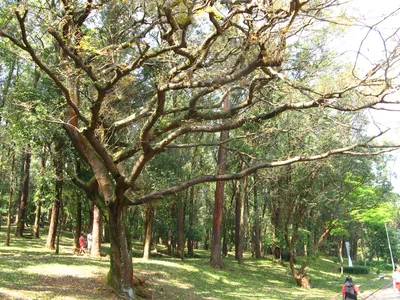
The tree they call diesel
Bore a hole into the trunk of a Copaifera and oil runs out. Not sap, not latex — a clear golden oleoresin, diesel-like enough that in 1980 the chemist Melvin Calvin reported it could be used directly in a diesel-powered car.[1]
On this page
Technically, it’s a legume
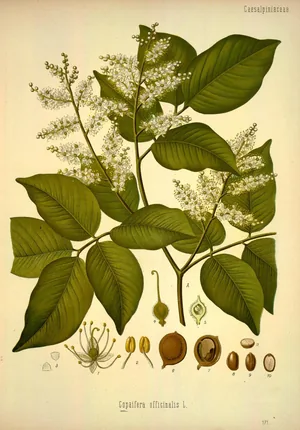
Copaifera is a genus of legumes — the same family as peas and beans — growing across the Amazon basin and tropical South America. What comes out of it is not pressed from a fruit or distilled from a flower.
It is tapped from a hole bored into the living trunk, the way rubber is tapped. The tree keeps growing, and a single trunk can be returned to for years.
Indigenous Amazonian peoples used the balsam for generations before any of it was written down.
Copaiba is still a working medicine across much of the Amazon basin, sold in markets, kept in houses, reached for first.
The first European accounts appear in the chronicles of the sixteenth and seventeenth centuries, describing topical use for wounds & irritated skin.
What the tree makes it for
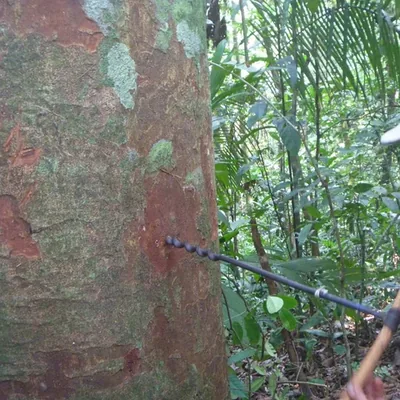
Copaiba oleoresin is not a product the tree offers up. It is a wound response.
Copaifera carries the resin in ducts running through the trunk, under pressure, and releases it where the wood is damaged — to seal the break and to see off whatever might use it as a way in. That is what the tapper is drawing on: a defence compound, made to be antimicrobial and made to close a wound, which happens also to be the raw material of the collection.
Its composition follows from the job. The volatile fraction runs forty to eighty-seven per cent beta-caryophyllene, depending on species and tapping.[2] Most plants that carry the terpene carry a trace — a fraction of a per cent in black pepper. Copaiba carries it as the bulk of the material, and there is no other commercial botanical where it is this concentrated.
Underneath the volatiles sits a second chemistry: diterpene acids, copalic acid among them, which stay behind in the resin and do not come over in a distilled oil. Different species build different proportions of both fractions, and the differences are measurable — a comparative study of three Copaifera species found the profiles varied and so did their activity in an inflammation model.[3] When a paper says "copaiba", it is worth knowing which species it used, and whether it used the resin or the oil.
What the studies found
In 2023 a group at the Federal University of Pará counted the papers instead of adding one. They screened 822 references and analysed 232.[4] The finding is the shape of the literature, not any single result. In vitro was the most published study type — the work clusters in Brazil, between 2010 and 2020, and concentrates on antimicrobial and anti-inflammatory activity.
Antimicrobial activity is the most-investigated property, roughly a third of everything studied, and copaiba performs: bactericidal and bacteriostatic across a range of organisms, including strains of Candida that resist the usual antifungals. That is a real result, obtained in glassware.
The closest the literature comes to the way the material is actually used is a 2020 study in which copaiba oleoresin, applied topically, showed antinociceptive activity in a UVB-induced skin-burn model — in mice.[5]
Copaiba is not under-studied. It is under-trialled. That is a more fixable problem.
Whether the tree can keep doing this
A plant you harvest without felling sounds like a solved problem. It is not quite one.
Copaiba oleoresin is a non-timber forest product — the term conservationists reach for when a forest is worth more standing than cut. Whether it works depends on numbers nobody had for a long time: how much a tree gives, how soon it can be tapped again, how many a stand can support.
An ethnobotanist measured yields across the eastern Brazilian Amazon in 2003: trees under 35 cm across the trunk gave nothing, mid-sized trees out-yielded the giants, and not one tree produced more than a litre.[6]
Those numbers have been gathered. Work in the forests around Manaus examined extraction and production of Copaifera multijuga and what sustainable management would require,[7] and a decade later the same researchers revised the guidance with better yield data.[8]
Tapping intervals matter more than tapping technique. Tree selection matters more than either. A stand can support extraction indefinitely or be exhausted inside a few seasons, and the difference is bookkeeping rather than botany.
The short version is that copaiba can be managed sustainably, and that doing so depends on tapping intervals and tree selection rather than on the tree's willingness to survive a hole.
The molecule it comes down to
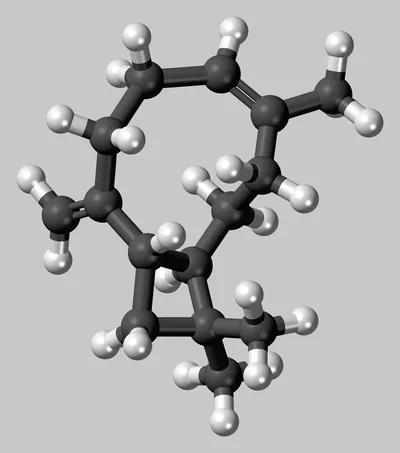
Copaiba is, chemically, close to one thing. Take the resin's volatile fraction and a single sesquiterpene dominates it — beta-caryophyllene, at forty to eighty-seven per cent depending on species and tapping.[2] Copaiba is among the richest natural sources of it on earth.
You have met the molecule already. Beta-caryophyllene is the compound behind black pepper's bite; it is in cloves, oregano and rosemary; it is a common food flavour, and you have eaten it your whole life. Which is what makes what it does next unlikely. Of all the terpenes a plant can make, this is the one that reaches into human cannabinoid signalling. In 2008 a group in Zurich showed it binds the CB2 receptor — selectively, and as a functional agonist — and gave the finding a title that reads almost like a shrug: Beta-caryophyllene is a dietary cannabinoid.[9] A spice that is also, by the strict definition, a cannabinoid.
CB2 sits out on the immune cells and the periphery, away from the head — in skin, on its mast cells and macrophages.[10] In cells and in mice, beta-caryophyllene works it,[9] and copaiba oleoresin itself, given by mouth to rats with wounded tongues, left smaller wounds and less inflammation.[11] That is the most plausible route by which copaiba earned the reputation it has.
Cells and animals, though, not people. A mechanism that can be named, not an outcome that can be promised. What copaiba brings to a formula is not a claim. It is a molecule — well studied, food grade, and unusually concentrated in this one Amazonian resin.
Why we use it
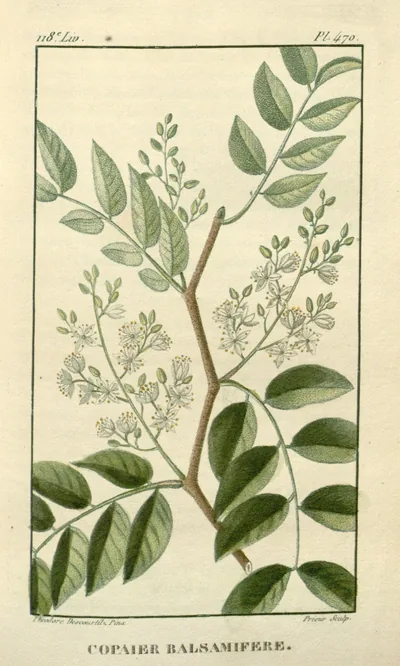
Long before any receptor had a name, copaiba was the Amazon's nearest thing to a cure-all.
The word is Tupi — cupaúba, the vessel, for the reservoir of resin the tree carries in its trunk. Amazonian peoples tapped it and reached for it for nearly everything: they put it on the navels of newborns and on the wounds of warriors after battle, on sores and ulcers and troubled skin, and took it for the lungs and the urinary tract.
The story handed down is that the use was learned by watching wounded animals rub themselves against the bark.[12]
It travelled. By 1677 copaiba was listed in the London Pharmacopoeia, and by 1820 in the pharmacopoeia of the United States — a rainforest resin that served as official Western medicine for the better part of two centuries.[13]
None of that is why it is in these blends. A plant asked to do everything is usually being asked to do too much, and most of that long list has never been tested. It is here for the narrow, specific reason the chemistry gives: a concentrated, food-grade, natural source of beta-caryophyllene — the one terpene that speaks to a human receptor anyone can point to.
Which is the honest shape of the whole thing. The Amazon reached for copaiba for a hundred reasons and could prove none of them. There is one reason here, and the receptor has a name. That is not the old knowledge being corrected. It is the old knowledge being caught up with — slowly, and one molecule at a time.
References
- [1] Calvin M. Hydrocarbons from plants: analytical methods and observations. Naturwissenschaften. 1980;67(11):525–533. doi:10.1007/BF00450661 ↩
- [2] Veiga Junior VF, Pinto AC. O gênero Copaifera L. Química Nova. 2002;25(2):273–286. doi:10.1590/S0100-40422002000200016 ↩
- [3] Veiga Junior VF, Rosas EC, Carvalho MV, Henriques MGMO, Pinto AC. Chemical composition and anti-inflammatory activity of copaiba oils from Copaifera cearensis, C. reticulata and C. multijuga — a comparative study. J Ethnopharmacol. 2007;112(2):248–254. PMID 17446019 · doi:10.1016/j.jep.2007.03.005 ↩
- [4] Frazão DR, Cruz JN, Santos de Oliveira M, et al. Evaluation of the biological activities of Copaiba (Copaifera spp): a comprehensive review based on scientometric analysis. Front Pharmacol. 2023;14:1215437. PMID 37719866 · doi:10.3389/fphar.2023.1215437 ↩
- [5] Becker G, Ferreira LM, Lopes Bezerra F, et al. Copaiba oleoresin has topical antinociceptive activity in a UVB radiation-induced skin-burn model in mice. J Ethnopharmacol. 2020;250:112476. PMID 31838179 · doi:10.1016/j.jep.2019.112476 ↩
- [6] Plowden C. Production Ecology of Copaíba (Copaifera spp.) Oleoresin in the Eastern Brazilian Amazon. Economic Botany. 2003;57(4):491–501. doi:10.1663/0013-0001(2003)057[0491:peoccs]2.0.co;2 ↩
- [7] Medeiros RS, Vieira G. Sustainability of extraction and production of copaiba (Copaifera multijuga Hayne) oleoresin in Manaus, AM, Brazil. Forest Ecology and Management. 2008;256(3):282–288. doi:10.1016/j.foreco.2008.04.041 ↩
- [8] Medeiros RS, Vieira G, de Almeida DRA, et al. New information for managing Copaifera multijuga Hayne for oleoresin yield. Forest Ecology and Management. 2018;414:85–98. doi:10.1016/j.foreco.2018.02.009 ↩
- [9] Gertsch J, Leonti M, Raduner S, et al. Beta-caryophyllene is a dietary cannabinoid. Proc Natl Acad Sci USA. 2008;105(26):9099–9104. PMID 18574142 · doi:10.1073/pnas.0803601105 ↩
- [10] Ständer S, Schmelz M, Metze D, Luger T, Rukwied R. Distribution of cannabinoid receptor 1 (CB1) and 2 (CB2) on sensory nerve fibers and adnexal structures in human skin. J Dermatol Sci. 2005;38(3):177–188. PMID 15927811 · doi:10.1016/j.jdermsci.2005.01.007 ↩
- [11] Alvarenga MOP, Bittencourt LO, Mendes PFS, et al. Safety and Effectiveness of Copaiba Oleoresin (C. reticulata Ducke) on Inflammation and Tissue Repair of Oral Wounds in Rats. Int J Mol Sci. 2020;21(10):3568. PMID 32443593 · PMC7278981 · doi:10.3390/ijms21103568 ↩
- [12] de Albuquerque KC, da Veiga AD, Silva JV, Brigido HP, et al. Brazilian Amazon Traditional Medicine and the Treatment of Difficult to Heal Leishmaniasis Wounds with Copaifera. Evid Based Complement Alternat Med. 2017;2017:8350320. PMID 28194218 · PMC5282428 · doi:10.1155/2017/8350320 ↩
- [13] Plowden C. The Ethnobotany of Copaíba (Copaifera) Oleoresin in the Amazon. Economic Botany. 2004;58(4):729–733. doi:10.1663/0013-0001(2004)058[0729:TEOCCO]2.0.CO;2 ↩
FAQs
What is copaiba, exactly?
An oleoresin — a balsam tapped from the trunk of Copaifera trees in the Amazon. Not an oil pressed from a seed or distilled from a flower. The tree is tapped and keeps growing.
Why is it in all six blends?
It is the botanical the blends are built around, and has been from the beginning. It also carries more β-caryophyllene than almost anything else on earth.
What is β-caryophyllene?
A terpene, also in black pepper and cloves. In 2008 it was shown to bind the CB2 receptor selectively — one of very few plant compounds that does. That work is laboratory and animal research, and we say so.
Is copaiba well studied?
Very — and mostly in a dish. A 2023 review analysed 232 studies and found in vitro work was the most published type. There's no human trial of topical copaiba for a defined skin endpoint.
Didn't you used to call copaiba an amplifier?
We did, and we've stopped. It's a word about what copaiba does to the other plants in the bottle, and that isn't something we can show you.
Is it related to cannabis?
No. Different plant, different family — copaiba is a legume. What they share is β-caryophyllene, which is why both meet the same receptor.
Can copaiba irritate skin?
It can at higher concentrations, like most concentrated botanicals. Ours sit at blend levels. If your skin reacts to things, patch test first.