
Heather Reilly Hiemstra is a Certified Menopause Coach, independent researcher, educator, speaker and founder of Rockstar Blends.
Many people who find me at Rockstar Blends have usually tried a CBD roll-on or topical cream before. Most of those ask some version of "does CBD roll-on actually work?" because they've had a range of experiences that are difficult to measure. They want to know what's different about Rockstar Roll On Entourage. The practitioners I work with ~ naturopaths, nurses, midwives and more ~ want to know the same thing, just in a whole lot more detail.
So for everyone, let's start at the beginning and get clear on what the science suggests so far.
On this page
- How topicals actually cross the skin barrier
- Natural penetration enhancers
- The carrier oils
- What is Rockstar Roll On Entourage?
- What's in the bottle, and what's not
- What the botanicals carry
- AKBA from frankincense serrata CO₂ extract
- Incensole acetate from frankincense carterii CO₂ extract
- β-caryophyllene from copaiba and black pepper
- Chamazulene from German chamomile CO₂ and blue tansy
- Italidione from helichrysum
How topicals actually cross the skin barrier
Yes, your skin is built to keep things out. The outermost layer — the stratum corneum, about 15 to 20 micrometers thick — is a dense brick-and-mortar architecture. Dead, flattened cells are the bricks. A highly ordered matrix of ceramides, cholesterol, and free fatty acids is the mortar. It exists to keep water inside your body and the rest of the world outside of it. It is extraordinarily good at its job.
For anything you apply to your skin to actually go anywhere past the surface, it has to navigate this barrier. The working rule in dermatological pharmacology is the 500 Dalton threshold: molecules above about 500 Da generally don't cross intact stratum corneum without help.[1] The molecule also has to be lipophilic enough to dissolve into the lipid matrix between cells, but not so lipophilic that it gets stuck there. The sweet spot is narrow.
Two things determine whether a topical does meaningful work past the surface: whether the active payload can actually cross the barrier, and whether the carrier system is structurally compatible with the skin that receives it. Most of what's written about topical efficacy focuses on the first question but both are important.
Natural penetration enhancers
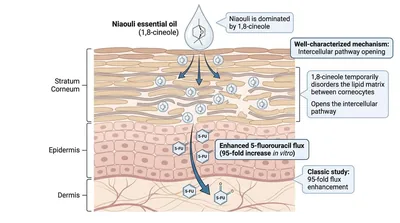
Two essential oils, niaouli and black pepper, are studied as penetration enhancers — compounds that temporarily disrupt the stratum corneum lipid matrix so other molecules can cross.
Niaouli essential oil Niaouli is dominated by 1,8-cineole, one of the most-studied natural penetration enhancers in the dermatological literature.[2][3] Its mechanism is well-characterized: it temporarily disorders the lipid matrix between corneocytes, opening the intercellular pathway. In a classic study using human skin in vitro, 1,8-cineole produced approximately 95-fold flux enhancement of 5-fluorouracil.[4]
Black pepper essential oil Black pepper contributes two things simultaneously: β-caryophyllene (which I'll come back to in a moment) and D-limonene, another well-characterized terpene penetration enhancer. Limonene works through a slightly different mechanism than cineole — it disrupts the lipid bilayer and helps open the polar pathway alongside the lipid one.[3]
Other botanicals carry monoterpenes of their own:
Lavender — carrying a heavy linalool load. Linalool is an established penetration enhancer in the dermatological literature[2][3] and a GABAergic modulator in its own right.Copaiba — contributing α-pinene alongside its β-caryophyllene.Frankincense serrata and carterii CO₂ extracts — combined, contributing additional α-pinene and high-value compounds like AKBA and incensole acetate.Thyme chemotype linalool — additional linalool load, with the chemotype confirmed by analysis.Juniper berry, cypress, and cedarwood atlas — together about 4% of the bottle, contributing a mixed monoterpene fraction.
The carrier oils
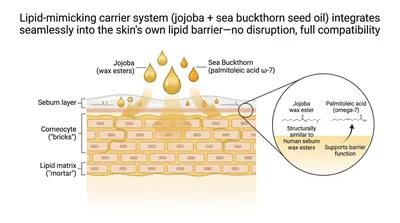
The carrier base of Rockstar Roll On Entourage is jojoba and sea buckthorn oil. Jojoba is not actually an oil in the chemical sense — it is a liquid wax ester, structurally close to the wax esters that make up human sebum.[5] Sea buckthorn oil contributes palmitoleic acid (omega-7), a major component of healthy sebum that supports skin barrier function. The combined effect is a carrier that the skin recognizes as compatible with its own outermost lipid layer.
What is Rockstar Roll On Entourage?
A botanical topical built on full-spectrum hemp, with CO₂ extracts and essential oils. The extraction methods are matched to the compounds — CO₂ where CO₂ is needed, essential oil where essential oil is appropriate.
What's in the bottle, and what's not
Here is where the design of Roll On Entourage diverges most sharply from what's typical in the topical CBD category.
Full-spectrum hemp from the whole plant, not CBD isolate. The hemp extract in Roll On Entourage is whole-plant — the full phytochemical profile, including the minor cannabinoids (CBG, CBN, CBC, and others present in trace amounts), the plant's own terpene fraction, and the flavonoid compounds that accompany them. This was a deliberate choice by me and it's a different ingredient than what's in most of the topical CBD market, which is built on lab-isolated CBD: the single molecule, separated from the rest of the plant.
A study in mice reported that whole-plant cannabinoid extracts and isolated CBD produce different dose-response profiles for inflammation, with the whole-plant extract showing a more linear and predictable response across a range of doses while isolated CBD showed a narrower effective window.[6]
That dose-response work was done systemically, with injected extract rather than topical application.
This is consistent with the broader entourage-effect framework — the working hypothesis that the cannabinoids and terpenes in the whole-plant matrix interact with one another and with the body's receptor systems in ways that an isolated single compound cannot.[7] That framework is supported by directional evidence, not by settled fact, and recent in vitro work has narrowed some of the proposed mechanisms without invalidating the overall picture.
A full-spectrum extract keeps the plant's compounds together: an integrated phytochemical matrix, not a single isolated molecule.
What I deliberately left out. Entourage contains no menthol, no camphor, and no capsaicin. Those compounds produce an immediate cooling or warming sensation on the skin, which is sometimes interpreted as evidence that a topical is working. The sensation is the compound irritating sensory nerves.
What the botanicals carry
Beyond full-spectrum hemp, the botanicals carry:
AKBA from frankincense serrata CO₂ extract
The CO₂ extraction method is the key: steam distillation cannot capture the boswellic acid fraction. CO₂ can. This is why the formula uses the CO₂ extract specifically, not the standard essential oil.
Incensole acetate from frankincense carterii CO₂ extract
Again, the CO₂ extraction is what captures this compound.
β-caryophyllene from copaiba and black pepper
BCP has been characterized in published research as a selective CB2 receptor agonist with documented action in animal and in vitro studies.[8][9] CB2 receptors are present in skin and in peripheral nervous tissue.
Chamazulene from German chamomile CO₂ and blue tansy
The deep blue color you can see in the bottle is chamazulene itself.
Italidione from helichrysum
A compound that appears nowhere else in the formula.
Citations
- [1] Bos JD, Meinardi MM. The 500 Dalton rule for the skin penetration of chemical compounds and drugs. Experimental Dermatology. 2000;9(3):165–169. ↩
- [2] Sapra B, Jain S, Tiwary AK. Percutaneous permeation enhancement by terpenes: mechanistic view. AAPS Journal. 2008;10(1):120–132. ↩
- [3] Aqil M, Ahad A, Sultana Y, Ali A. Status of terpenes as skin penetration enhancers. Drug Discovery Today. 2007;12(23–24):1061–1067. ↩
- [4] Williams AC, Barry BW. Terpenes and the lipid–protein–partitioning theory of skin penetration enhancement. Pharmaceutical Research. 1991;8(1):17–24. ↩
- [5] Pazyar N, Yaghoobi R, Ghassemi MR, Kazerouni A, Rafeie E, Jamshydian N. Jojoba in dermatology: a succinct review. Giornale Italiano di Dermatologia e Venereologia. 2013;148(6):687–691. ↩
- [6] Gallily R, Yekhtin Z, Hanuš LO. Overcoming the bell-shaped dose-response of cannabidiol by using cannabis extract enriched in cannabidiol. Pharmacology and Pharmacy. 2015;6(2):75–85. ↩
- [7] Russo EB. Taming THC: potential cannabis synergy and phytocannabinoid-terpenoid entourage effects. British Journal of Pharmacology. 2011;163(7):1344–1364. ↩
- [8] Gertsch J, Leonti M, Raduner S, et al. Beta-caryophyllene is a dietary cannabinoid. Proceedings of the National Academy of Sciences USA. 2008;105(26):9099–9104. ↩
- [9] Bahi A, Al Mansouri S, Al Memari E, et al. β-Caryophyllene, a CB2 receptor agonist produces multiple behavioral changes relevant to anxiety and depression in mice. Physiology and Behavior. 2014;135:119–124. ↩
FAQs
What is the 'Entourage Effect', and is it real?
The 'Entourage Effect' is the working hypothesis that the cannabinoids and terpenes in a whole-plant cannabis matrix interact with one another, and with the body's receptor systems, in ways that an isolated single compound cannot. It is supported by directional evidence in the published literature, not by settled fact. Recent in vitro work has narrowed some of the proposed mechanism without invalidating the broader framework.