A charm for the road.
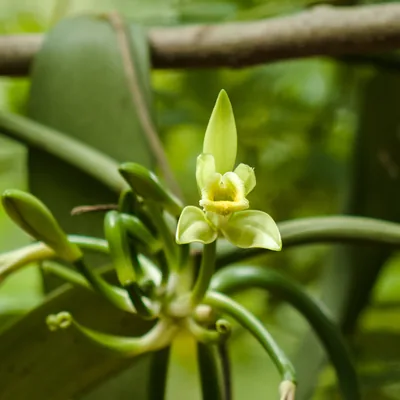
The oldest written use of vanilla found for this entry is Aztec, in the herbal a Nahua physician, Martín de la Cruz, wrote in Mexico in 1552. Under "The traveler's protection" the dried flowers of tlilxochitl, "black flower", are crushed with mecaxochitl and hueynacaztli, two other fragrant flowers, with the barks of fruit trees, white incense and a fragrant salve. The powder is packed inside a hollowed flower and hung from the neck, so the traveller could "receive the very redolent odor… and breathe it out."[1]
The "black" is the cured pod. The book's editor adds that tlilxochitl was one of the chief flavourings of the frothing chocolate drink, in Mexico and in Yucatán, where the Maya called it sisbic.[1] It was scent and flavour both, and it was carried by people on the move.
On this page
Gathered, then grown.
For most of its history, vanilla was gathered wild in the forests of tropical America rather than farmed. The first cultivation for export came in the 1760s, around Papantla in Veracruz, and all of it went to Europe.[2]
The plant travelled well enough. In 1819 five potted cuttings were readied at Antwerp for Java. A year later a single cutting survived the 181-day voyage and was grown, with difficulty, at Buitenzorg. Cuttings reached Réunion from Paris, and plants flowered in European glasshouses: at Padua in 1833, and again in 1840 and 1841.[2]
The aphrodisiac reputation.
Vanilla's reputation as an aphrodisiac is usually told as ancient. The written record is thinner. In Mexico, tlilxochitl flavoured chocolate, and by the seventeenth century vanilla was a popular spice in the chocolate Europe drank.[2] Francisco Hernández, the physician Philip II of Spain sent to study the medicines of New Spain, gave it a chapter. There, two pods steeped in water with cacao and mecaxochitl are drunk to bring on urine and the menses, to warm and strengthen the stomach, to strengthen the brain and help the womb, and against cold poisons and venomous bites.[9] Of desire, the chapter says nothing.
The line quoted most often comes later, and no one quoting it names a page. A German physician, 'Bezaar Zimmerman', is said to have written in 1762, in a treatise on experience, that 342 impotent men became astonishing lovers by drinking vanilla. No physician of that name has been traced. The treatise fits Johann Georg Zimmermann, town physician of Brugg, whose Von der Erfahrung in der Arzneykunst (On Experience in Medicine) appeared in 1763 and 1764. We searched its digitised editions, from 1764 to 1794. Vanilla appears in one chapter, on chocolate: among the spices that spoil it, and as a smell many of his nervous patients could not bear, bringing on sweats, headaches, trembling and dizziness. The same chapter notes that most young husbands drank chocolate to fortify their manhood, and judges that it excited them and left them weaker. There are no 342 men.[10]
The modern evidence is narrower, and more interesting, because it is about scent itself. In 2018 a Dresden group measured how keenly seventy young adults could smell and asked them about their sex lives. Those with keener noses reported finding sex more pleasurable, and the women among them reported orgasm more often; there was no link with desire.[11] In a hundred patients who had lost some or all of their sense of smell, about three in ten said their desire had fallen since, a change tied to low mood as well as to the loss itself, though on a standard desire questionnaire the group scored no differently from people who could smell.[12] Neither study used vanilla, and no one has shown that vanilla does anything a pleasant scent does not. What they show is that smell is part of how sex is experienced.
The orchid that would not fruit.
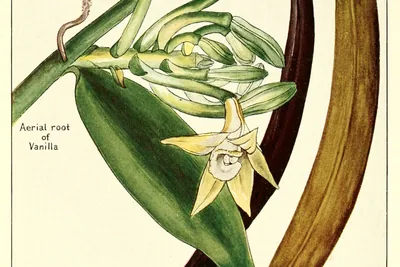
Flowering was not the problem. Fruiting was. Away from Mexico, the flowers came and went without setting pods.
A popular story says only one Mexican bee could pollinate them. The record behind it is an 1871 account of "bees" in many colours, some seven centimetres long, which no stingless bee is; translated and copied for decades, it hardened into fact. When researchers watched wild flowers in 2004, ants, bees and hummingbirds visited them, and none pollinated them.[2]
The breakthrough came in Liège. In 1836 the Belgian botanist Charles Morren, working at the botanical garden there, pollinated the flowers by hand, and in February 1837 the first pod ripened. He set 54 pods on one plant and 100 on another, and on 10 March 1837 he showed a fruiting branch at the horticultural society in Ghent. He described the obstacle exactly: above the stigma the column carries "a fleshy apron, which descends in front of the stigma and separates it" from the pollen. Get the pollen past it to the stigma, and "so soon as the following day the ovarium elongates." Later accounts describe the method as lifting the pollen masses out with a needle and setting them against the stigma. He built a greenhouse near his home to grow vanilla on a larger scale, and his wife, Marie Morren, showed the fruit at horticultural exhibitions. His method, though, used scissors to cut that apron away: fine in a greenhouse, slow anywhere else.[2]
On Réunion, Edmond Albius was born in 1829 to a mother enslaved on the Bellier-Beaumont estate, who died giving birth to him. He grew up a gardener there, unschooled and keen on plants, and he worked out a quick way to pollinate the flowers by hand. His is the method the crop spread with. The popular story makes him the sole discoverer. The historical review that traced every claim concludes otherwise, and gives both men their due: Albius "certainly played a crucial role in figuring out and implementing a practical way of pollinating Vanilla flowers, consequently turning it into an important crop in Réunion and later the whole region."[2]
Every plant a copy.
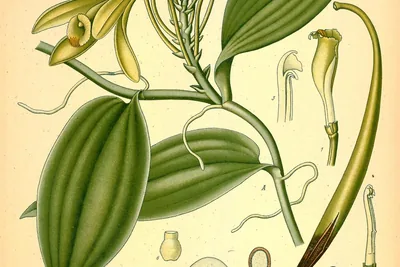
The vines that went out on those voyages were cuttings, and so is nearly everything grown since. The world's vanilla comes from plants "collected from Mesoamerica, clonally propagated and globally distributed as part of the early spice trade", which have had little genetic improvement since. The same genome study read its relatives too, including the Tahitian vanilla, and found genes that bear on the pods splitting open, the shape of the flower and resistance to disease.[3] One narrow base carries a global crop. When a single cyclone struck the growing region of Madagascar around the turn of the century, prices quadrupled overnight.[2]
Made, not picked.
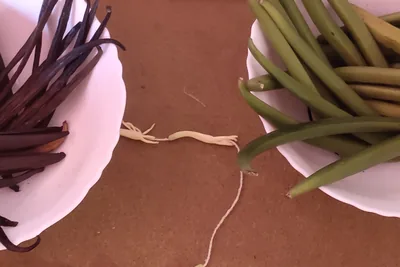
A green vanilla pod smells of almost nothing. The plant keeps its vanillin locked up, bound to a sugar as glucovanillin. In 2014 a Danish group found the enzyme that makes it, vanillin synthase, working in single cells a few layers in from the pod's inner wall. They then found a close relative of the same enzyme in ground ivy, a common European hedgerow plant that also makes vanillin.[4]
Curing sets it free. During curing, the glucovanillin moves outward through the bean and is split at the surface. Bacteria living on the bean help, carrying the enzyme that cuts the sugar away.[5] The scent people call vanilla is made after the harvest, and microbes are part of the making.
Vanillin is "the world's most popular flavor", and most of it is now made without the orchid, from ferulic acid, eugenol or glucose, by microbes and chemistry.[6] The cured pod carries vanillin along with the rest of what the plant and its curing make. That is the difference between vanilla and vanillin.
Vanillin, in skin cells.
In 2023 a group in Thailand exposed human skin cells to hydrogen peroxide and tested vanillin against the damage. Keratinocytes and fibroblasts survived it better with vanillin present, and in a scratch test they moved to close the gap faster.[7] That is vanillin, the single molecule, in a dish. It is a clean first result for the molecule vanilla is known by.
Vanillin can also sensitise. Reactions are uncommon, but they have been reported, including from vanillin in the air.[8] Anyone with reactive skin should patch test first, as with any botanical.
"The vanilla genome reported in this study may enable accelerated breeding of vanilla to improve high-value traits."
References
- [1] de la Cruz M, Badiano J. The de la Cruz–Badiano Aztec Herbal of 1552. Gates W (tr.). Baltimore: The Maya Society, 1939, pp. 103–104 ("The traveler's protection") and glossary p. 141 (Tlil-xochitl). ↩
- [2] Karremans AP. A historical review of the artificial pollination of Vanilla planifolia: the importance of collaborative research in a changing world. Plants (Basel). 2024;13(22):3203. PMID 39599412 · doi:10.3390/plants13223203 ↩
- [3] Hasing T, Tang H, Brym M, Khazi F, Huang T, Chambers AH. A phased Vanilla planifolia genome enables genetic improvement of flavour and production. Nat Food. 2020;1(12):811–819. PMID 37128067 · doi:10.1038/s43016-020-00197-2 ↩
- [4] Gallage NJ, Hansen EH, Kannangara R, et al. Vanillin formation from ferulic acid in Vanilla planifolia is catalysed by a single enzyme. Nat Commun. 2014;5:4037. PMID 24941968 · doi:10.1038/ncomms5037 ↩
- [5] Chen Y, Gu F, Li J, He S, Xu F, Fang Y. Involvement of colonizing Bacillus isolates in glucovanillin hydrolysis during the curing of Vanilla planifolia Andrews. Appl Environ Microbiol. 2015;81(15):4947–4954. PMID 25979899 · doi:10.1128/AEM.00458-15 ↩
- [6] Gallage NJ, Møller BL. Vanillin: bioconversion and bioengineering of the most popular plant flavor and its de novo biosynthesis in the vanilla orchid. Mol Plant. 2015;8(1):40–57. PMID 25578271 · doi:10.1016/j.molp.2014.11.008 ↩
- [7] Sinsuebpol C, Burapapadh K, Chowjaroen V, Changsan N. The radical scavenging activity of vanillin and its impact on the healing properties of wounds. J Adv Pharm Technol Res. 2023;14(2):99–104. PMID 37255868 · doi:10.4103/japtr.japtr_631_22 ↩
- [8] Kojder PL, Erickson CL. Airborne allergic contact dermatitis to vanillin. Dermatitis. 2021;32(2):e32–e34. PMID 33273232 · doi:10.1097/DER.0000000000000677 ↩
- [9] Hernández F. Rerum medicarum Novae Hispaniae thesaurus, seu plantarum, animalium, mineralium Mexicanorum historia. Recchi NA, ed. Rome: Vitale Mascardi, 1651. Book II, ch. 15, "De Tlilxochitl, seu flore nigro, Araco aromatico", p. 38. ↩
- [10] Zimmermann JG. Von der Erfahrung in der Arzneykunst. Zweyter Theil. Zürich: Heidegger, 1764. Book IV, ch. 7, pp. 352–355 (chocolate; vanilla). ↩
- [11] Bendas J, Hummel T, Croy I. Olfactory function relates to sexual experience in adults. Arch Sex Behav. 2018;47(5):1333–1339. PMID 29721723 · doi:10.1007/s10508-018-1203-x ↩
- [12] Schäfer L, Mehler L, Hähner A, Walliczek U, Hummel T, Croy I. Sexual desire after olfactory loss: quantitative and qualitative reports of patients with smell disorders. Physiol Behav. 2019;201:64–69. PMID 30576694 · doi:10.1016/j.physbeh.2018.12.020 ↩
FAQs
Why is vanilla pollinated by hand?
Outside its native Mexico, vanilla flowers rarely set fruit on their own. Hand pollination, first shown by Charles Morren in Liège in 1837 and made practical by Edmond Albius on Réunion, is what let the crop spread around the world.
Why doesn't a fresh vanilla pod smell of vanilla?
The plant stores its vanillin bound to a sugar. Curing, weeks of sweating and drying, frees it, with help from bacteria that live on the bean.
Is vanilla the same as vanillin?
No. Vanillin is one molecule, and most of it is now made without the plant. A cured vanilla pod carries vanillin along with hundreds of other compounds.
Where does the name tlilxochitl come from?
It is Nahuatl, the language of the Aztecs, for "black flower", after the dark cured pod.
Can vanilla irritate skin?
Vanillin can sensitise, though reactions are uncommon. Patch test first if your skin is reactive.