
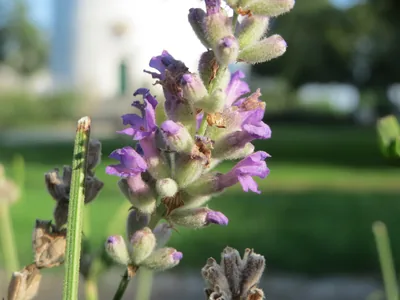
The Greeks' lavender grew on islands.
Dioscorides has a lavender, and he says where its name comes from. Stoichas grows on the Stoechades, a string of islands off Massalia — Marseille — "which is how it got its name." A herb with slender twigs like thyme, longer-leaved, sharp and somewhat bitter to taste; a decoction of it was good for the chest, and it went into antidotes. He records half a dozen other names for it besides.[1]
That plant is Lavandula stoechas, the French or Spanish lavender. It is not the one in these blends. Lavandula angustifolia — narrow-leaved, as its name says — does not appear in De materia medica at all.
On this page
A name nobody has pinned down.
The English word is younger than the plant's reputation. It arrives around 1300 from Anglo-French lavendre, out of Medieval Latin lavendula, and where that came from is not settled. It may be from lividus, bluish. It was certainly drawn toward lavare, to wash, because lavender scented washed linen and bathwater.[2]
The version that travels — that the Romans bathed in it, and named it for the bath — is the tidy one. The dictionaries hold it more loosely.
True lavender.
L. angustifolia is the one sold as true or English lavender, a small shrub of the western Mediterranean. Its oil is steam-distilled from the flowering tops, and two molecules dominate it: linalool and its ester, linalyl acetate.[3] Most of what is known, and most of what is argued, about lavender is about those two.
The plant has other chemistry that never reaches a still: flavonoids, phenolic acids, coumarins and triterpenes, which stay behind in the leaf and flower.[3] The oil is the volatile fraction, and it is the part that has been studied on and around people.
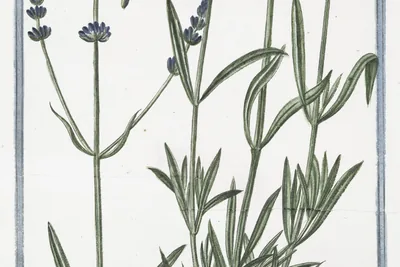
By the 1770s, when a Roman botanical garden had it engraved for its catalogue, the plant was already carrying its name and a pedigree of references: Caspar Bauhin's Pinax, Tournefort's Institutiones, and its Italian and French names, spighetta and lavande, lettered along the bottom of the plate.
The strongest evidence is not on skin.
Lavender's best human evidence is not topical at all.
The largest trial gave a standardised lavender oil, in a capsule of 80 or 160 milligrams a day, to 539 adults with generalized anxiety disorder for ten weeks, against a placebo and against paroxetine, a prescription antidepressant. Both doses of the lavender capsule scored better than placebo on the Hamilton Anxiety Scale, and side effects ran at the placebo rate.[4] That is a real result, and it is a result for a pill swallowed daily.
A body oil is not that pill. Lavender on skin is also lavender breathed in, but neither route is the one that trial tested, and nothing about it is claimed for anything applied to skin.
Lavender and menopause.
The menopause research gathered on lavender is aromatherapy, lavender alone or blended with other oils. In a trial published in 2016, a hundred women aged 45 to 55 in Ardabil, in northern Iran, breathed either lavender or a diluted-milk placebo from identical bottles, in twenty-minute sessions over twelve weeks, and after a four-week break the two groups swapped. Their recorded hot flushes fell by about half on lavender, from an average of 21.7 to 10.6, and barely moved on the placebo, from 20.7 to 19.7.[11] It is one small trial, and its paper gives the sessions as twice a day in one place and twice a week in another.
A 2020 review gathered sixteen studies of lavender aromatherapy in 1,092 women after menopause and pooled eight of them, 493 women.[12] Pooled, lavender came with lower menopausal-symptom scores and better sleep-quality scores, and the review also reports fewer hot flushes, less anxiety and better sexual function and self-esteem than placebo — alongside an unfavourable shift in two blood fats, triglycerides and HDL cholesterol — while asking for better studies, above all of harms.
These are small trials, and the ones pooled disagreed widely on how large the effect was: the direction has been consistent, the size has not. They tested lavender as aromatherapy. A blend on the skin is breathed too, but at no dose anyone has measured, and none of this is claimed for it.
The 2007 report.
In 2007 a group at the US National Institute of Environmental Health Sciences described three prepubertal boys who had developed breast tissue. All three were otherwise healthy, with normal levels of their own hormones. In each, it had begun while he was using products containing lavender and tea tree oils, and it went away after the products were stopped. In human cell lines, both oils showed oestrogenic and antiandrogenic activity. The authors concluded the oils had probably caused it.[5]
In 2019 the same laboratory added four more children, three girls and a boy, all exposed continuously to lavender-scented products, and found that some of the individual components of lavender and other essential oils had similar activity in cells. They were careful about the size of it: "whether the level of lavender oil estrogenic potency is sufficient to cause these effects is unknown."[6]
On the other side, a research institute funded by the fragrance industry applied lavender oil to the skin of immature female rats at two doses for three days and weighed their uteri, the standard test for a substance that acts like oestrogen. A synthetic oestrogen given to a comparison group did exactly what it should, which shows the test could see an effect. Neither dose of lavender produced one, and none of the rats' skin reacted.[7] And in 2014 a letter to Reproductive Toxicology put the opposing case in its title: "Lack of evidence that essential oils affect puberty."[8]
So the question has two sides of evidence and no human study built to settle it. No systemic oestrogenic effect from lavender applied to skin has been established. It is in the literature, and it is here for that reason.
Keep it closed.
The other thing worth knowing is chemistry. Linalool reacts slowly with air, and what it turns into — linalool hydroperoxides — is a far stronger skin allergen than linalool itself.
A Danish clinic reviewed ten years of patch tests, 6,719 patients between 2014 and 2025, and found 3.1 per cent reacting to linalool hydroperoxides — common enough that the authors recommend adding them to Europe's baseline test series.[9] A companion study from the same group had twelve people already allergic to them use a perfume containing the hydroperoxides twice a day for three weeks, at three strengths, without knowing which. Four of the twelve reacted at the highest strength, two at the middle one, one at the lowest, and none of the twenty people without the allergy reacted at all.[10] Fewer hydroperoxides, fewer reactions: the case for fresh oil in one line. Fresh oil is the gentler oil, and a bottle kept closed meets less air.
"It grows in the islands of Galatia near Massalia called the Stoechades, which is how it got its name."
References
- [1] Dioscorides, De materia medica, Book III, "Stoichas" (the Stoechades, the chest, the antidotes). ch. 31 in Goodyer's English (1655), modern version Osbaldeston TA, Wood RPA, Ibidis Press, Johannesburg 2000, pp. 398–399. ↩
- [2] Online Etymology Dictionary, "lavender (n.)": c. 1300, Anglo-French lavendre, Medieval Latin lavendula; perhaps from Latin lividus, associated with lavare. ↩
- [3] Jiang B, et al. Lavender: phytochemistry, pharmacology, cross-disciplinary applications, and clinical efficacy. Phytomedicine. 2025;148:157274. PMID 41014669 · doi:10.1016/j.phymed.2025.157274 ↩
- [4] Kasper S, Gastpar M, Müller WE, et al. Lavender oil preparation Silexan is effective in generalized anxiety disorder — a randomized, double-blind comparison to placebo and paroxetine. Int J Neuropsychopharmacol. 2014;17(6):859–869. PMID 24456909 · doi:10.1017/S1461145714000017 ↩
- [5] Henley DV, Lipson N, Korach KS, Bloch CA. Prepubertal gynecomastia linked to lavender and tea tree oils. N Engl J Med. 2007;356(5):479–485. PMID 17267908 · doi:10.1056/NEJMoa064725 ↩
- [6] Ramsey JT, Li Y, Arao Y, et al. Lavender Products Associated With Premature Thelarche and Prepubertal Gynecomastia: Case Reports and Endocrine-Disrupting Chemical Activities. J Clin Endocrinol Metab. 2019;104(11):5393–5405. PMID 31393563 · doi:10.1210/jc.2018-01880 ↩
- [7] Politano VT, McGinty D, Lewis EM, et al. Uterotrophic assay of percutaneous lavender oil in immature female rats. Int J Toxicol. 2013;32(2):123–129. PMID 23358464 · doi:10.1177/1091581812472209 ↩
- [8] Carson CF, Tisserand R, Larkman T. Lack of evidence that essential oils affect puberty. Reprod Toxicol. 2014;44:50–51. PMID 24556344 · doi:10.1016/j.reprotox.2013.09.010 ↩
- [9] Botvid S, Søgaard R, Schwensen JFB, Johansen JD. Ten Years of Patch Testing to Hydroperoxides of Limonene and Linalool: Prevalence, Patterns and Clinical Insights. Contact Dermatitis. 2026;94(5):504–514. PMID 41638887 · doi:10.1111/cod.70102 ↩
- [10] Botvid S, Bennike NH, Johansen JD, et al. Repeated Exposure to Hydroperoxides of Linalool Induces Immunologically Verified Allergic Contact Dermatitis. Contact Dermatitis. 2026;94(6):652–661. PMID 41713461 · doi:10.1111/cod.70119 ↩
- [11] Kazemzadeh R, Nikjou R, Rostamnegad M, Norouzi H. Effect of lavender aromatherapy on menopause hot flushing: a crossover randomized clinical trial. J Chin Med Assoc. 2016;79(9):489–492. PMID 27388435 · doi:10.1016/j.jcma.2016.01.020 ↩
- [12] Salehi-Pourmehr H, Ostadrahimi A, Ebrahimpour-Mirzarezaei M, Farshbaf-Khalili A. Does aromatherapy with lavender affect physical and psychological symptoms of menopausal women? A systematic review and meta-analysis. Complement Ther Clin Pract. 2020;39:101150. PMID 32379682 ↩
FAQs
Is this the lavender the ancient Greeks used?
No. The lavender Dioscorides described is Lavandula stoechas, French or Spanish lavender, named for the Stoechades islands off Marseille. The blends use Lavandula angustifolia, true lavender, which he does not describe.
Does lavender come from the Latin word for washing?
Possibly, but it is not certain. The word is medieval, and it may come from lividus, meaning bluish. It became linked with lavare, to wash, because lavender was used to scent linen and baths.
Is it true lavender affects hormones?
A 2007 report and a 2019 follow-up described children whose breast growth began while they were using lavender-scented products and went away when they stopped, and cell studies found hormone-like activity in some components. A test on rats found no such effect from lavender oil on skin. No systemic hormonal effect from topical lavender has been established.
Is lavender’s anxiety research about oil on skin?
The strong evidence for lavender and anxiety comes from a capsule taken by mouth, not from oil on skin. No such claim is made for these blends.
Can lavender oil cause skin reactions?
It can in some people, mainly once it has oxidised. Linalool in the oil reacts with air to form compounds that are stronger allergens, so fresh, well-stored oil is gentler. Patch test if your skin is sensitive to fragrance.