Phytocannabinoids and male sexual health | What the science shows

Table of Contents
- Phytocannabinoids and male sexual health
- The endocannabinoid system runs throughout male reproductive tissue
- The honest, mixed picture on cannabinoids, erections, and testosterone
- So, what is Rockstar Man?
- What's in the bottle, and why each ingredient is there
- Where sexual health meets healthspan
- The prostate research, carefully
- A note for men managing a serious diagnosis
- References
- FAQs
Phytocannabinoids and male sexual health
The endocannabinoid system is densely present in male reproductive tissue, and several of the botanicals in Rockstar Man are documented in peer-reviewed research for the mechanisms they engage. What no one has run is a clinical trial of this formula for sexual function in men. So the honest word is supported, not proven — and I'll mark every claim so you can see where the evidence is solid, where it's a reasonable class effect, and where it's still at the laboratory bench.
Men find Rockstar Man the same way women find Rockstar Woman — quietly, while looking for help with something they'd rather not raise at a dinner party. Lower drive than there used to be. Performance that's tangled up with stress. A general sense that the spark takes more coaxing than it once did. And the same question lands in my inbox from them as from the practitioners I work with: can a topical botanical actually do pharmacological work here, or is it a nice-smelling placebo?
There's one more honesty flag I'll put up front, because it's the most-searched and most-overhyped corner of this whole topic: the research on phytocannabinoids and male sexual health, and on cannabinoids and the prostate is genuinely interesting — and it is almost entirely happening in cell cultures and mice. I'll get there, and I'll be careful.
The endocannabinoid system runs throughout male reproductive tissue
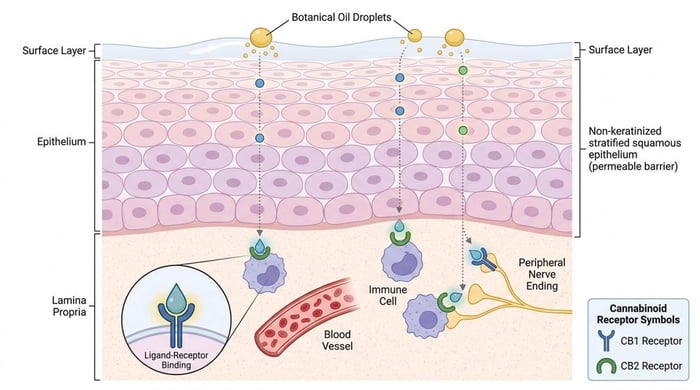
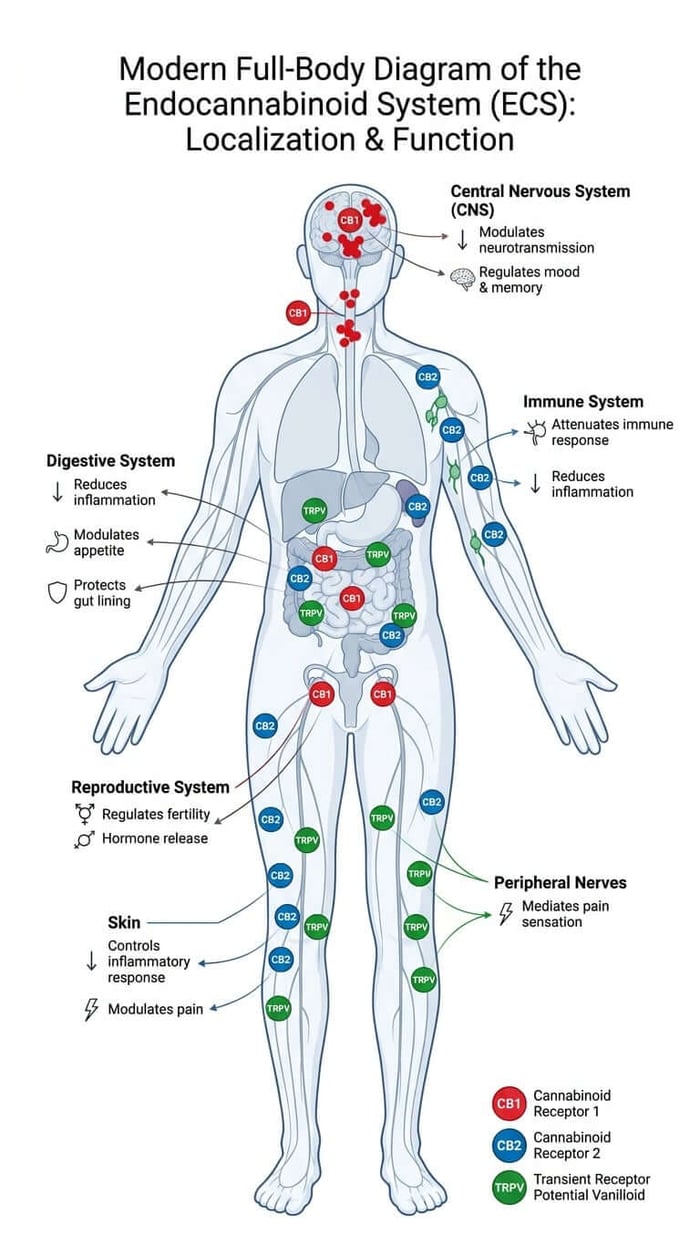
The endocannabinoid system is a body-wide signaling network — the one your body uses to manage pain, inflammation, immune tone, mood, sleep, and reproductive function. It runs on two main receptors: CB1, concentrated in the nervous system, and CB2, concentrated in immune tissue and at sites of inflammation. It makes its own messengers — anandamide and 2-arachidonoylglycerol, the one I call the Rockstar molecule — and breaks them down with its own enzymes.
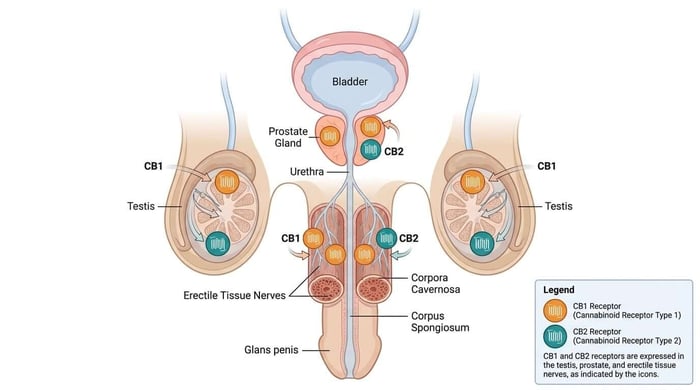
In men, this system is not a bystander to reproductive biology. A 2019 study in Scientific Reports mapped the full set of endocannabinoid components across the adult human testis — receptors, the messenger molecules, and the enzymes that build and degrade them — distributed across the different germ-cell stages, which the authors read as consistent with a direct role for the system in human testicular function. 1
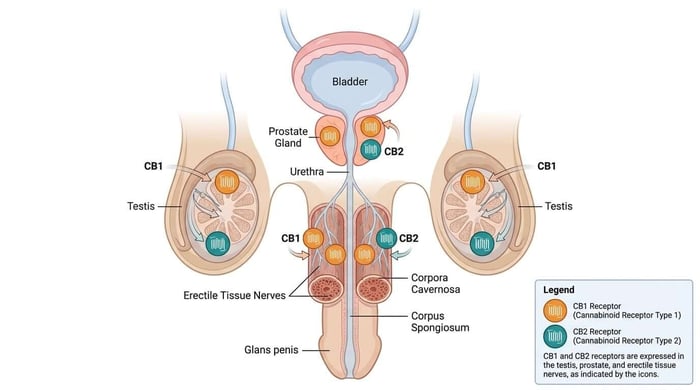
Human sperm themselves carry the CB1 receptor, where activation has been shown to influence motility and the acrosome reaction. 2 And in the lower genital tract, CB1 and CB2 receptors have been localized to the nitric-oxide-releasing nerves of the human and primate corpus cavernosum — the erectile tissue itself. 3
That last point is worth sitting with, because it's the bridge to the rest of this article. The receptors are wired into the same nitric-oxide machinery that governs erection — the exact pathway that pharmaceutical ED drugs act on. The system is present, and it is functionally connected to the plumbing. What it does when you add compounds from outside is where the story gets honest.
The honest, mixed picture on cannabinoids, erections, and testosterone
It's tempting to assume cannabinoids simply "boost" male sexual function — it's the kind of claim that sounds intuitively right. I want to slow that down, because the actual literature is mixed — and the mixedness is the interesting part.
On erections: in that same human and primate erectile-tissue study, adding anandamide didn't relax the tissue. It actually reduced the nerve-driven relaxation that an erection depends on — which the authors offered as a possible peripheral mechanism for the sexual dysfunction some people report with heavy cannabis use. 3 Animal studies in other species have pointed the other way. The honest synthesis is that the endocannabinoid system is plugged into erectile physiology, but flooding it with a full agonist is not straightforwardly "pro-erection," and effects appear to be dose-dependent and species-dependent. This is exactly why I keep Rockstar Man's story about local, topical, full-spectrum support of tissue tone and comfort — not about pharmacological erection enhancement, which the evidence does not support.
The population data are reassuring but limited and about whole cannabis, not topical CBD. A large U.S. survey analysis found that more frequent marijuana use was associated with somewhat higher self-reported sexual frequency in men, 4 and a study using a validated erectile-function questionnaire found no evidence that more frequent cannabis use impaired function. 5 Useful context — but correlational, about inhaled cannabis, and not transferable to a topical oil.
On testosterone, the cohorts openly disagree. One Danish study of young men found testosterone slightly higher in frequent users, while cautioning the signal couldn't be cleanly separated from tobacco; 6 a U.S. analysis found no meaningful difference between users and non-users. 7 The more consistent signal across this literature is that heavy, chronic THC use is associated with poorer sperm measures — which is a fertility story, not a topical-CBD story. I raise all of this not to muddy the water but because pretending the evidence is tidier than it is would be the opposite of what this brand is for.
The receptors are real. The plumbing connection is real. "This makes you harder" is not what the studies say — so it's not what I'll say.
The line we hold
So, what is Rockstar Man?
Rockstar Man is a plant-based body and intimate oil built around local engagement with the endocannabinoid system, in a carrier suited to daily skin use and intimate use alike. The cannabinoid payload is full-spectrum hemp extract. The CB2 mechanism is carried by copaiba's β-caryophyllene fraction. Rose damascena and frankincense round out a botanical stack chosen for documented, peer-reviewed mechanisms — anti-inflammatory, vascular, and mood-and-stress pathways that connect, plausibly and honestly, to how men actually experience sexual wellbeing. It is hormone-free, and like all of our oils it is topical only.
A practical note that matters more than fine print: the oil is oil-based, and oil degrades latex — so it is not compatible with latex condoms. Polyurethane and polyisoprene barriers are compatible. The mechanism here is local endocannabinoid and anti-inflammatory support, not a hormonal one.
What's in the bottle, and why each ingredient is there
Full-spectrum hemp extract. Whole-plant extract — CBD alongside the minor cannabinoids, the plant's own terpene fraction, and its flavonoids. Comparative research has documented that whole-plant cannabis extract and isolated CBD produce different dose-response profiles, the whole-plant preparation behaving more predictably across a range of doses, 8 consistent with the broader entourage framework, which is supported by directional evidence rather than settled fact. 9 CBD's most replicated human evidence is in anxiety: in placebo-controlled work it reduced anxiety during a public-speaking stress test, 10 with a notable catch — the effect follows an inverted-U dose curve, where a moderate dose worked and both lower and higher doses did not. 11 That matters here because performance anxiety is one of the better-recognized contributors to sexual difficulty in men. To be precise about the tier: this is human evidence that CBD may support anxiety, applied by reasoning to sexual context — not a trial of CBD for sexual performance, which hasn't been done.
Copaiba essential oil. Copaiba is dominated by β-caryophyllene, the cleanest endocannabinoid story in the bottle: a landmark 2008 paper in PNAS characterized it as a selective CB2 receptor agonist — a dietary compound that engages the same anti-inflammatory receptor as the body's own endocannabinoids, without any psychoactivity. 12 CB2 sits on the immune cells and peripheral nerve terminals you'd want a topical to reach. This is the same compound doing anti-inflammatory CB2 work in our Roll-On and in Rockstar Woman; it's a through-line in the whole line for a reason.
Frankincense (Boswellia). Frankincense contributes the boswellic acids, of which AKBA is the most studied. These have been characterized as selective inhibitors of 5-lipoxygenase — an anti-inflammatory route distinct from the familiar COX pathway. 13 The relevant tier is mechanistic: well-characterized enzyme inhibition and anti-inflammatory activity in laboratory and animal work.
Rose damascena. Rose is the most interesting botanical in this formula from a men's-health standpoint, and it deserves more room than a single product post can give it. The short version: rose damascena is the one ingredient here with direct randomized human trials in men.
Coming in the botanical series: there are two double-blind, placebo-controlled trials in men where rose damascena improved sexual function tied to mood and stress — the strongest direct human evidence among everything in this bottle — plus mechanism work on its vascular (nitric-oxide) and anxiolytic effects. It's a bigger story than a product post should carry, so we're devoting a dedicated piece to it. Read the rose damascena deep-dive →
Where sexual health meets healthspan
One framing on the Rockstar Man page is worth grounding in actual data: that sexual wellbeing is a real contributor to a man's healthspan. It is — and not in a vague way.
Erectile function is, in the cardiology literature, treated as a window onto vascular health: a meta-analysis pooling tens of thousands of men found erectile dysfunction associated with higher subsequent risk of cardiovascular disease and all-cause mortality, independent of conventional risk factors. 14 The blood-vessel health that supports erections is the same blood-vessel health that supports the heart. And in a long-running cohort, higher orgasmic frequency was associated with lower all-cause mortality in men over a decade of follow-up 15 — an observational finding with the usual caveats about cause and effect, but a striking one. The honest read: sexual function is entangled with vascular and overall health, which is a good reason to treat it as part of self-care rather than an embarrassment to ignore. That's the spirit Rockstar Man is sold in — proactive, daily, low-drama. Not a cure for anything.
The prostate research, carefully
This is the section people come looking for, and it's the one I'm most careful with — so let me set the frame before the findings. Everything below is laboratory research: cannabinoids studied in prostate cancer cell lines and in mice. None of it is evidence that any cannabinoid — or any product, including ours — treats, prevents, or cures prostate cancer in a human being. Rockstar Man is a topical cosmetic oil and makes no such claim. The compounds in these studies are synthetic laboratory cannabinoids and isolated, high-dose CBD, given at pharmacologic doses by injection or in cell culture — not the botanicals in a topical oil. I'm reporting what respected researchers have published because the audience asks, and because intellectual honesty cuts both ways: I'll surface the work and its limits.
What the bench work shows, tier-tagged as preclinical throughout: researchers found that cannabinoid receptors are expressed at higher levels in prostate cancer cells than in normal prostate cells, and that a synthetic cannabinoid slowed the growth of those cells in culture. 16 In a 2013 study, isolated CBD was the most potent of the non-THC cannabinoids tested at triggering programmed cell death in prostate cancer cell lines, and a CBD-rich extract reduced tumor size in a mouse model — though I'll note the study used extracts supplied by a pharmaceutical company with a stake in the outcome, exactly the kind of conflict worth putting on the table. 17 The paper most often cited for autophagy specifically — the cellular "self-eating" process — reported that a synthetic research cannabinoid suppressed prostate cancer cell growth through an autophagy-linked stress pathway and reduced tumor growth in mice. 18 Frankincense's boswellic acids — again, isolated and at pharmacologic concentration — show similar pro-apoptotic activity in prostate cancer cell lines. 20
Now the part most write-ups leave out. In humans, there is exactly one completed clinical trial of a cannabinoid in prostate cancer, and it was a small Phase I safety study — pharmaceutical-grade CBD in men with biochemically recurrent disease — designed to test tolerability, not to prove it works. It found the dose was tolerable; it did not, and was not built to, demonstrate that CBD treats prostate cancer. 19 That is the entire human story to date. So: real, legitimate, mechanistically interesting laboratory science — and a near-total absence of human efficacy evidence. Both of those things are true at once, and you deserve both halves, not just the flattering one. That's the standard I hold this whole article to.
What the literature supports strongly
Supported as a class effect — not yet measured for this product
The studies I would run
- A clinical outcomes study of this formula on validated male sexual-function measures
- A topical/transdermal pharmacokinetic study — how much actually reaches the tissue
- Any human efficacy trial (not just Phase I safety) of cannabinoids in prostate disease 19
A note for men managing a serious diagnosis
If you're living with a prostate cancer diagnosis, in treatment, or in survivorship, please hear this clearly: nothing above is a reason to change, delay, or substitute anything your oncologist has recommended. The laboratory research is not treatment evidence, and I am not going to imply that it is. If you want to add a topical botanical to your routine for comfort and daily wellbeing, the right move is to talk to your treating physician first. There's a concrete reason, not just a reflex: CBD can inhibit the CYP450 liver enzymes that metabolize many medications, which means it can alter the blood levels of some drugs — including certain chemotherapy agents and hormone-modulating treatments. Your treating physician knows your regimen and can tell you whether that matters in your case in a way I never could.
This post is for education, not diagnosis or treatment. These statements have not been evaluated by the Food and Drug Administration, and Rockstar Man is not intended to diagnose, treat, cure, or prevent any disease. It's a topical product for external use only.
— Heather
References
- Nielsen JE, Rolland AD, Rajpert-De Meyts E, et al. Characterisation and localisation of the endocannabinoid system components in the adult human testis. Sci Rep. 2019;9:12866. Moderate
- Rossato M, Ion Popa F, Ferigo M, Clari G, Foresta C. Human sperm express cannabinoid receptor Cb1, the activation of which inhibits motility, acrosome reaction, and mitochondrial function. J Clin Endocrinol Metab. 2005;90(2):984-991. Directional
- Gratzke C, et al. Localization and function of cannabinoid receptors in the corpus cavernosum: basis for modulation of nitric oxide synthase nerve activity. Eur Urol. 2010;57(1):38-44. Directional
- Sun AJ, Eisenberg ML. Association between marijuana use and sexual frequency in the United States: a population-based study. J Sex Med. 2017;14(11):1342-1347. Moderate
- Bhambhvani HP, et al. The association of cannabis use and erectile function. Sex Med. 2020. Moderate
- Gundersen TD, et al. Association between use of marijuana and male reproductive hormones and semen quality. Am J Epidemiol. 2015;182(6):473-481. Moderate
- Thistle JE, Graubard BI, Braunlin M, Vesper H, Trabert B, Cook MB, McGlynn KA. Marijuana use and serum testosterone concentrations among U.S. males. Andrology. 2017;5(4):732-738. Moderate
- Gallily R, Yekhtin Z, Hanuš LO. Overcoming the bell-shaped dose-response of cannabidiol by using cannabis extract enriched in cannabidiol. Pharmacol Pharm. 2015;6(2):75-85. Directional
- Russo EB. Taming THC: potential cannabis synergy and phytocannabinoid-terpenoid entourage effects. Br J Pharmacol. 2011;163(7):1344-1364. Directional
- Bergamaschi MM, et al. Cannabidiol reduces the anxiety induced by simulated public speaking in treatment-naïve social phobia patients. Neuropsychopharmacology. 2011;36(6):1219-1226. Strong
- Linares IM, et al. Cannabidiol presents an inverted U-shaped dose-response curve in a simulated public speaking test. Braz J Psychiatry. 2019;41(1):9-14. Strong
- Gertsch J, Leonti M, Raduner S, et al. Beta-caryophyllene is a dietary cannabinoid. Proc Natl Acad Sci USA. 2008;105(26):9099-9104. Moderate
- Safayhi H, et al. Boswellic acids: novel, specific, nonredox inhibitors of 5-lipoxygenase. J Pharmacol Exp Ther. 1992;261(3):1143-1146. Directional
- Dong JY, Zhang YH, Qin LQ. Erectile dysfunction and risk of cardiovascular disease: meta-analysis of prospective cohort studies. J Am Coll Cardiol. 2011;58(13):1378-1385. Strong
- Davey Smith G, Frankel S, Yarnell J. Sex and death: are they related? Findings from the Caerphilly cohort study. BMJ. 1997;315(7123):1641-1644. Moderate
- Sarfaraz S, et al. Cannabinoid receptor as a novel target for the treatment of prostate cancer. Cancer Res. 2005;65(5):1635-1641. Directional
- De Petrocellis L, et al. Non-THC cannabinoids inhibit prostate carcinoma growth in vitro and in vivo. Br J Pharmacol. 2013;168(1):79-102. Directional
- Olea-Herrero N, Vara D, Malagarie-Cazenave S, et al. Inhibition of human tumour prostate PC-3 cell growth by cannabinoids R(+)-methanandamide and JWH-015. Br J Cancer. 2009;101(6):940-950. Directional
- Myint ZW, et al. A Phase I dose escalation and expansion study of Epidiolex (cannabidiol) in patients with biochemically recurrent prostate cancer. Cancers. 2023;15(9):2505. Moderate
- Lu M, et al. Acetyl-keto-beta-boswellic acid induces apoptosis through a death receptor 5-mediated pathway in prostate cancer cells. Cancer Res. 2008;68(4):1180-1186. Directional
FAQs
Does the endocannabinoid system really affect men's sexual health?
The endocannabinoid system runs all through male reproductive tissue — including the nitric-oxide nerves of the erectile tissue — so it's plausibly involved, and researchers are actively studying it. But I'll be straight with you: the evidence is mixed and mostly preclinical. Cannabinoids don't simply "switch on" better erections in the lab, and the effects look dose- and species-dependent. The system's involvement is well supported; a tidy "this improves performance" claim is not.
Can CBD or cannabinoids treat prostate cancer?
No — and no study shows that. The anti-cancer findings you may have read about come from prostate cancer cells in a dish and from mice, using synthetic research compounds and isolated high-dose CBD. The only completed human study was a small Phase I trial that tested whether a dose was safe to tolerate — not whether it works. Rockstar Man is a topical wellness oil and makes no cancer claim. If you're facing a prostate cancer diagnosis, your oncologist's guidance comes first, always.
Does Rockstar Man contain THC or hormones — will it affect my testosterone?
It's hormone-free. The human research on cannabis and testosterone is genuinely mixed, and what exists is mostly about heavy inhaled cannabis use, not a topical full-spectrum oil. The way I formulated Rockstar Man, the mechanism is local — endocannabinoid and anti-inflammatory support at the skin — not a hormonal one.
Is there proof that Rockstar Man improves erections or sexual performance?
No, and I won't pretend otherwise. No one has run a clinical trial of this formula for sexual function in men - our understanding is based on anecdotal evidence only. What I can show you is real research on the individual botanicals and on the endocannabinoid system in male tissue. I describe Rockstar Man as supporting local tissue comfort and tone — not as a performance enhancer.
What does the research actually say about rose damascena for men?
Rose damascena is the one ingredient in this formula with direct randomized human trials in men — two double-blind, placebo-controlled studies where it improved sexual function tied to mood and stress. It's a big enough body of evidence that I gave it its own dedicated deep-dive in our botanical series rather than cram it into a product post.
What's the difference between full-spectrum hemp and CBD isolate here?
Full-spectrum means the whole-plant extract — CBD alongside the minor cannabinoids, the plant's own terpenes, and its flavonoids — rather than CBD stripped out on its own. Comparative research suggests whole-plant preparations can behave more predictably across a range of doses than isolated CBD. That's the thinking behind using full-spectrum hemp in Rockstar Man.
Is Rockstar Man safe to use with condoms?
This one's important, not fine print: Rockstar Man is oil-based, and may well degrade latex, even though it is 100% plant based. Rockstar Man may not be compatible with latex condoms, while polyurethane and polyisoprene barriers should be okay. We have not tested this and provide information based on our best understanding only: no guarantee implied.