Does CBD Roll-On Actually Work?

Table of Contents
- How topicals actually cross the skin barrier
- Natural penetration enhancers
- Our carrier system is designed to integrate with the skin's lipid architecture, not interrupt it.
- What is Rockstar Roll-On Entourage?
- What's in the bottle, and what's not
- The therapeutic payload that benefits from enhancement
- Once it's through skin, where can it go?
- Citations
- FAQs
Many people who find me at Rockstar Blends have usually tried a CBD roll-on or topical cream before. Most of those ask some version of "does CBD roll-on actually work?" because they've had a range of experiences that are difficult to measure. They want to know what's different about Rockstar Roll-On. The practitioners I work with ~ naturopaths, nurses, midwives and more ~ want to know the same thing, just in a whole lot more detail.
So for everyone, let's start at the beginning and get clear on what the science suggests so far.
How topicals actually cross the skin barrier
Yes, your skin is built to keep things out. The outermost layer — the stratum corneum, about 15 to 20 micrometers thick — is a dense brick-and-mortar architecture. Dead, flattened cells are the bricks. A highly ordered matrix of ceramides, cholesterol, and free fatty acids is the mortar. It exists to keep water inside your body and the rest of the world outside of it. It is extraordinarily good at its job.
For anything you apply to your skin to actually go anywhere past the surface, it has to navigate this barrier. The working rule in dermatological pharmacology is the 500 Dalton threshold: molecules above about 500 Da generally don't cross intact stratum corneum without help.1 The molecule also has to be lipophilic enough to dissolve into the lipid matrix between cells, but not so lipophilic that it gets stuck there. The sweet spot is narrow.
Two things determine whether a topical does meaningful work past the surface: whether the active payload can actually cross the barrier, and whether the carrier system is structurally compatible with the skin it's applied to. Most of what's written about topical efficacy focuses on the first question but both are important.
I created Rockstar Roll On to do both. Every ingredient in the blend has a defined role, a meaningful percentage of the formula exists specifically to get the rest of the formula through, and the carrier base was chosen to work with the skin's own structure rather than alongside it.
Natural penetration enhancers
Two ingredients in the Roll-On are there primarily as penetration enhancers — meaning their job is to temporarily disrupt the stratum corneum lipid matrix so the rest of the active payload can cross.
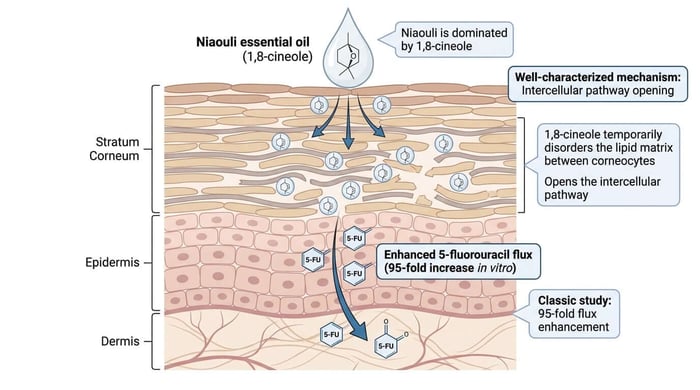
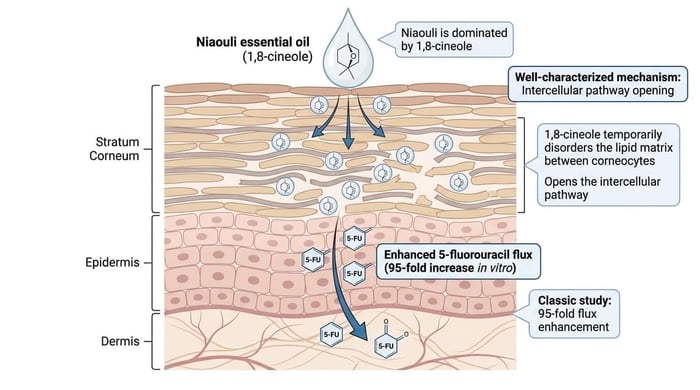
Niaouli essential oil Niaouli is dominated by 1,8-cineole, one of the most-studied natural penetration enhancers in the dermatological literature.23 Its mechanism is well-characterized: it temporarily disorders the lipid matrix between corneocytes, opening the intercellular pathway. In a classic study using human skin in vitro, 1,8-cineole produced approximately 95-fold flux enhancement of 5-fluorouracil.4 It doesn't mean every compound in the Roll-On crosses at 95 times the baseline rate, but it does mean the mechanism is real and the magnitude can be substantial.
Black pepper essential oil Black pepper contributes two things simultaneously: β-caryophyllene (which I'll come back to in a moment) and D-limonene, another well-characterized terpene penetration enhancer. Limonene works through a slightly different mechanism than cineole — it disrupts the lipid bilayer and helps open the polar pathway alongside the lipid one. Published studies have measured limonene-mediated flux enhancement at roughly 22-fold for specific lipophilic actives.3
The Roll-On contains an additional supporting layer of monoterpenes that are both doing their own therapeutic work and contributing to the lipid-matrix disruption that helps everything else get through:
Add it all together and roughly 15 percent of each bottle by volume is terpenes that are documented penetration enhancers in the peer-reviewed dermatological literature. The smaller, faster terpenes open the matrix, and larger, slower compounds get carried through.
Our carrier system is designed to integrate with the skin's lipid architecture, not interrupt it.
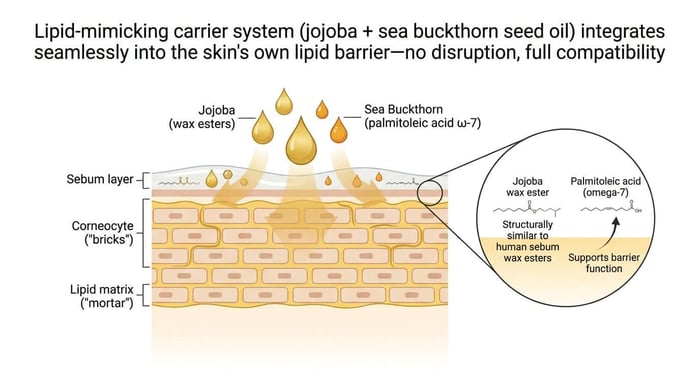
The carrier base of the Roll-On is jojoba and sea buckthorn seed oil. Jojoba is not actually an oil in the chemical sense — it is a liquid wax ester, structurally close to the wax esters that make up human sebum.12 Sea buckthorn seed oil contributes palmitoleic acid (omega-7), a major component of healthy sebum that supports skin barrier function. The combined effect is a carrier that the skin recognizes as compatible with its own outermost lipid layer. The Roll-On works with the skin's protective barrier rather than against it.
The compatibility between the carrier and the skin's own lipid structure is what allows the actives in the formula to integrate into the skin's lipid pathway efficiently — the same pathway the body uses to manage its own barrier. I chose this carrier system because it matches the skin's chemistry. The penetration network does the work of opening the matrix. The carrier does the work of moving the actives into a pathway the skin treats as native.
What is Rockstar Roll-On Entourage?
Rockstar Roll On Entourage
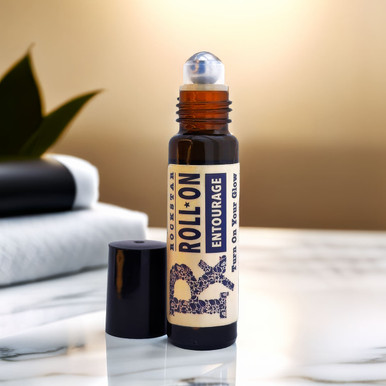
$75.00
Rockstar Entourage Roll-On — Targeted Comfort, On-Demand Recovery Concentrated, pocket-sized roll-on for fast, targeted skin support. Entourage pairs full-spectrum hemp with copaiba, frankincense & 20...… read more
A deliberately constructed botanical topical built around a real pharmacological architecture. The penetration network is specified, measured, and load-balanced. The active payload is delivered as full-spectrum hemp at meaningful concentration, carried in a base designed to integrate with the skin's own lipid structure. The compounds used are documented in peer-reviewed literature for their respective mechanisms. The extraction methods are matched to the compounds — CO₂ where CO₂ is needed, essential oil where essential oil is appropriate.
What's in the bottle, and what's not
Penetration is half the question and what you're moving through the barrier is the other half. And here is where the Roll-On's design philosophy diverges most sharply from what's typical in the topical CBD category.
Full-spectrum hemp from the whole plant, not CBD isolate. The hemp extract in the Roll-On is whole-plant — the full phytochemical profile, including the minor cannabinoids (CBG, CBN, CBC, and others present in trace amounts), the plant's own terpene fraction, and the flavonoid compounds that accompany them. This was a deliberate choice by me and it's a different ingredient than what's in most of the topical CBD market, which is built on lab-isolated CBD: the single molecule, separated from everything it grew with.
The two ingredients do not behave the same way in the body. There is a body of research demonstrating that whole-plant cannabinoid extracts and isolated CBD produce different dose-response profiles for inflammation, with the whole-plant extract showing a more linear and predictable response across a range of doses while isolated CBD showed a narrower effective window.11
That dose-response work was done systemically, with injected extract rather than topical application — but the underlying principle, that an integrated phytochemical matrix behaves differently in the body than an isolated single compound, applies regardless of route.
This is consistent with the broader entourage-effect framework — the working hypothesis that the cannabinoids and terpenes in the whole-plant matrix interact with one another and with the body's receptor systems in ways that an isolated single compound cannot.10 That framework is supported by directional evidence, not by settled fact, and recent in vitro work has narrowed some of the proposed mechanisms without invalidating the overall picture.
Important to understand is that full-spectrum extract delivers an integrated phytochemical matrix, not a single isolated molecule. The accompanying compounds appear to buffer, complement, and broaden the activity of the CBD itself. The Roll-On is built around that integrated matrix on purpose. I believe — based on the published research and the real-world response I see in the market — that this is a meaningful pharmacological difference.
The hemp extract goes in first, before any of the botanicals, as the foundation of the formula. At this concentration the penetration enhancement matrix matters: there's enough active that getting it past the barrier efficiently is the difference between a product that does something and a product that doesn't.
In one of the better-controlled studies on transdermal CBD pharmacokinetics, researchers measured both plasma CBD concentrations and inflammatory outcomes in an animal model of arthritis and demonstrated a dose-dependent reduction in joint inflammation and pain-related behavior from topical application.5 It's an animal study. It's not a human clinical trial of this product. But it is one of the few published studies that actually measures what happens when topical CBD is applied at meaningful concentrations, and the answer is: it gets through, and at sufficient doses, it acts both locally and systemically, activating CB receptors throughout the body.
What I deliberately left out. Entourage contains no menthol, no camphor, and no capsaicin. Those compounds produce an immediate cooling or warming sensation on the skin, which is sometimes interpreted as evidence that a topical is working. The sensation is the compound irritating sensory nerves — it is not the same thing as therapeutic action. The Entourage effect comes from the actives themselves, not from a topical sensation, and the absence of those agents is part of why the formula doesn't read as immediately as some products do.
The therapeutic payload that benefits from enhancement
So what's the penetration network actually delivering?
Beyond full-spectrum hemp, the payload includes:
AKBA from frankincense serrata CO₂ extract
Acetyl-11-keto-β-boswellic acid is a selective 5-lipoxygenase inhibitor — a different anti-inflammatory mechanism than the more familiar COX pathway. At about 512 Daltons, AKBA is right at the threshold of what stratum corneum will pass without help. The CO₂ extraction method is the key: steam distillation cannot capture the boswellic acid fraction. CO₂ can. This is why the formula uses the CO₂ extract specifically, not the standard essential oil.
Incensole acetate from frankincense carterii CO₂ extract
A TRPV3 agonist with documented anxiolytic and anti-inflammatory effects in published research. Again, the CO₂ extraction is what makes this compound available to a topical formula.
β-caryophyllene from the copaiba, black pepper, and frankincense stack
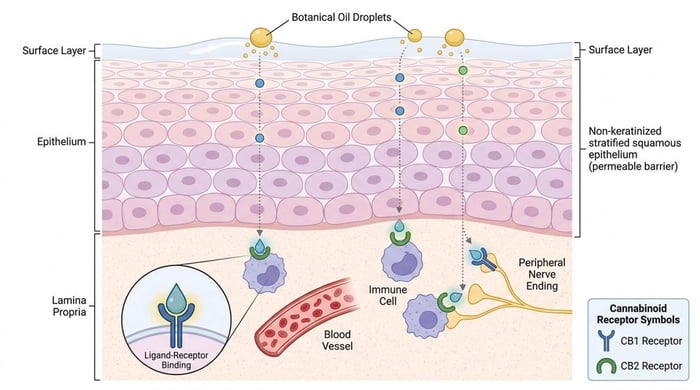
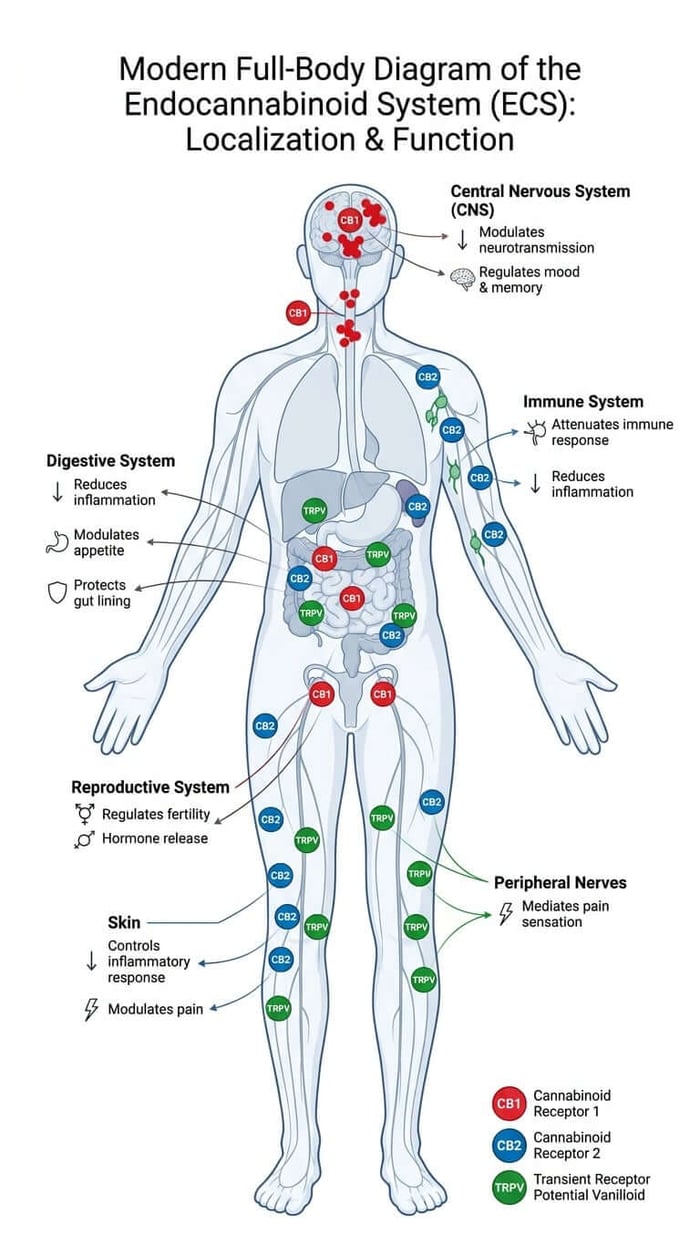
BCP has been characterized in published research as a selective CB2 receptor agonist with documented action in animal and in vitro studies.67 CB2 receptors are present in skin and in peripheral nervous tissue, suited for topically applied BCP — though direct human pharmacokinetic measurement of this pathway for this specific product has not been published. The mechanism is plausible and well-supported at the compound level.
Chamazulene from German chamomile CO₂ and blue tansy
The deep blue color you can see in the bottle is this magic molecule itself — a natural and ever so powerful anti-inflammatory compound.
Curcuminoids from turmeric CO₂
NLRP3 inflammasome inhibition. Curcumin is famously poorly absorbed when you take it orally — which is part of why a topical preparation through an enhancement matrix is a meaningful delivery route.
Italidione from helichrysum
A fibrin-chelating mechanism that doesn't appear elsewhere in the formula.
This is what the penetration network exists to deliver. A specific therapeutic payload, at meaningful concentrations, carried through a barrier that's been temporarily and reversibly opened by the terpene matrix, into a skin that recognizes the carrier as compatible with its own structure.
Once it's through skin, where can it go?
Several of the terpenes in the Roll-On — β-caryophyllene, linalool, 1,8-cineole, and α-pinene — are documented to be permeable to the blood-brain barrier when they reach systemic circulation.6789 They are small and lipophilic and thus structurally compatible with the kind of passive diffusion that the BBB lipid membrane allows. This established pharmacology is in part why these compounds are studied for neurological and psychiatric applications in the first place.
Some of the strongest evidence comes from inhalation studies in humans. In one study, plasma concentrations of 1,8-cineole were measured in healthy adults after exposure to rosemary essential oil aroma, and those plasma concentrations correlated with measurable cognitive performance changes.9 In another body of work, β-caryophyllene has been characterized as a selective CB2 agonist with documented central nervous system effects via systemic administration in animal models — and crucially, those effects were blocked by a CB2 antagonist, confirming the mechanism is receptor-specific.67
I cannot tell you that the Rockstar Roll-On Entourage delivers cannabinoids and terpenes across your blood-brain barrier at therapeutic doses. There is no published human pharmacokinetic study quantifying how much of any of these compounds, applied topically in a roll-on at the Roll-On's specific loading percentages, actually reaches central circulation at a concentration sufficient to act centrally. So, "does CBD roll-on actually work?"
The science supports this:
Rockstar Roll-On's primary mechanism is local. The compounds act on the skin, the underlying tissue, the peripheral nerves, the lymphatic system, and the local vasculature where the product is applied. This is where the bulk of the therapeutic work happens with a topical preparation. The CB2 receptors, the TRPV channels and the peripheral inflammation pathways are there. This is the point of a topical.
A secondary mechanism is plausible: some of the volatile terpenes will reach systemic circulation, and once there, this class of compounds is documented to be capable of reaching the central nervous system. Whether the topical route at this dose produces a centrally meaningful effect in any given person is a question the literature on this specific formula has not yet answered. The mechanism is supported and the compounds are correct.
One note worth making here: the mechanism profile I'm describing is for application to intact skin — the wrist, the neck, a sore joint, the abdomen, the back. Entourage is formulated to dermal safety standards. The pharmacokinetics change meaningfully when a topical of this kind is applied to thinner skin or mucous membrane, where the barrier behaves differently and the systemic absorption profile shifts. I mention this because customers use Rockstar Roll On with wonderful reported results, to treat hemorrhoids.
What the published literature supports strongly
- Terpene-mediated penetration enhancement of topical actives through the stratum corneum — well-characterized mechanism, multiple cited reviews234
- β-caryophyllene as a selective CB2 receptor agonist — Gertsch 2008 and subsequent literature6
- AKBA as a 5-LOX inhibitor — characterized in the boswellia literature
- Linalool GABAergic activity — multiple studies, multiple routes of administration8
- CO₂ extraction yielding the boswellic acid fraction that steam distillation cannot capture — analytical fact
- Jojoba's structural similarity to human sebum — established in dermatological research12
- Full-spectrum vs. isolated CBD producing different dose-response profiles — supported by published comparative research11
Supported as a class effect — not yet measured for this specific product
- BBB permeability of named terpenes once in systemic circulation — established for the compound class, not measured for the Roll-On's specific topical formulation6789
- The synergy ("entourage effect") between cannabinoids and accompanying terpenes — a working hypothesis with directional supporting evidence from the published literature10; recent in vitro work has narrowed the proposed mechanism without invalidating the framework
- Specific flux enhancement multipliers for any given compound in this formula in human skin — established for the class, not measured for this product
The studies I would run
- A specific systemic concentration of any active produced by topical application of Rockstar Roll-On Entourage on humans
- A specific clinical outcome — for example, sleep quality, joint pain, anxiety — in a defined population using our products
- A direct head-to-head pharmacokinetic comparison against another topical solution
Citations
- Bos JD, Meinardi MM. The 500 Dalton rule for the skin penetration of chemical compounds and drugs. Experimental Dermatology.2000;9(3):165–169.
- Sapra B, Jain S, Tiwary AK. Percutaneous permeation enhancement by terpenes: mechanistic view. AAPS Journal.2008;10(1):120–132.
- Aqil M, Ahad A, Sultana Y, Ali A. Status of terpenes as skin penetration enhancers. Drug Discovery Today.2007;12(23–24):1061–1067.
- Williams AC, Barry BW. Terpenes and the lipid–protein–partitioning theory of skin penetration enhancement. Pharmaceutical Research.1991;8(1):17–24.
- Hammell DC, Zhang LP, Ma F, et al. Transdermal cannabidiol reduces inflammation and pain-related behaviours in a rat model of arthritis. European Journal of Pain.2016;20(6):936–948.
- Gertsch J, Leonti M, Raduner S, et al. Beta-caryophyllene is a dietary cannabinoid. Proceedings of the National Academy of Sciences USA.2008;105(26):9099–9104.
- Bahi A, Al Mansouri S, Al Memari E, et al. β-Caryophyllene, a CB2 receptor agonist produces multiple behavioral changes relevant to anxiety and depression in mice. Physiology and Behavior.2014;135:119–124.
- Linck VM, da Silva AL, Figueiró M, et al. Effects of inhaled linalool in anxiety, social interaction and aggressive behavior in mice. Phytomedicine.2010;17(8–9):679–683.
- Moss M, Oliver L. Plasma 1,8-cineole correlates with cognitive performance following exposure to rosemary essential oil aroma. Therapeutic Advances in Psychopharmacology.2012;2(3):103–113.
- Russo EB. Taming THC: potential cannabis synergy and phytocannabinoid-terpenoid entourage effects. British Journal of Pharmacology.2011;163(7):1344–1364.
- Gallily R, Yekhtin Z, Hanuš LO. Overcoming the bell-shaped dose-response of cannabidiol by using cannabis extract enriched in cannabidiol. Pharmacology and Pharmacy.2015;6(2):75–85.
- Pazyar N, Yaghoobi R, Ghassemi MR, Kazerouni A, Rafeie E, Jamshydian N. Jojoba in dermatology: a succinct review. Giornale Italiano di Dermatologia e Venereologia.2013;148(6):687–691.
FAQs
Does CBD actually absorb through the skin?
Yes - at the right concentration and with the right delivery architecture. CBD molecules are small and lipophilic enough to cross the stratum corneum, but they cross more efficiently when carried alongside terpene penetration enhancers that temporarily disrupt the skin's lipid matrix. Rockstar Roll-On Entourage is about 15 percent by volume documented terpene penetration enhancers for exactly this reason.
How much CBD is in the Rockstar Roll-On?
333 milligrams of full-spectrum hemp per bottle; 33.3 milligrams per milliliter. The hemp extract goes in first, before any of the botanicals, in a carrier of MCT oil. At this concentration the penetration enhancement matrix matters: it is enough active that getting it past the skin barrier efficiently changes the outcome.
What is the 'Entourage Effect', and is it real?
The 'Entourage Effect' is the working hypothesis that the cannabinoids and terpenes in a whole-plant cannabis matrix interact with one another, and with the body's receptor systems, in ways that an isolated single compound cannot. It is supported by directional evidence in the published literature, not by settled fact. Recent in vitro work has narrowed some of the proposed mechanism without invalidating the broader framework. The Roll-On is built around the integrated phytochemical matrix on purpose.