
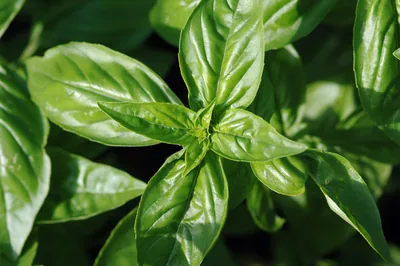
The herb that made the Greeks sneeze.
"Ocimum is commonly known," Dioscorides begins, and then he spends the chapter being wary of it. Eaten in quantity it dulls the eyes, is hard to digest and moves wind. It is diuretic and brings on milk, and its seed, in a drink, is given for melancholy. Crushed with polenta flour, oil of roses and vinegar, it went on stings from scorpions and venomous fish, and on its own, with wine from Chios, it went on sore eyes; the juice was said to clear dim sight. Smelled, "it causes considerable sneezing… The eyes must be shut whilst the sneezing lasts."[1]
Some people, he says, refused to eat it at all, "because when it is chewed and set in the sun it breeds little worms." Others valued it for a stranger reason: in Africa it was eaten because "those who eat it and are touched by a scorpion remain without pain."[1]
It is a portrait of a plant everyone knew and no one quite trusted. The modern reason for caution turns out to be real, and it is chemical: which basil you have matters more than the fact that it is basil. The linalool chemotype is the one in our blend; this entry explains why.
On this page
One species, five oils.
In 1996 a team of botanists and chemists analysed sixteen accessions of sweet basil, fresh and freeze-dried. They identified some thirty aromatic compounds, monoterpenes, sesquiterpenes and phenylpropanoids, and five of them could each make up more than a fifth of an oil: linalool, methyl chavicol (also called estragole), eugenol, methyl eugenol and geraniol. From those five, the plants fell into five distinct oil profiles. A lemon basil they included alongside went its own way, led by geranial and neral, together the citral of lemon peel.[2]
The profiles did not follow the named varieties. Two basils sold under one name could make different oils, and two names could share one oil. The authors concluded that basil should be classified by its chemistry as well as its looks. Drying shifted the balance too: the dried leaves lost methyl chavicol and eugenol relative to linalool.[2]
Thirty years on, a 2026 field study of ninety basil genotypes in southern Türkiye, grown over the 2023 and 2024 seasons, found the same thing: five chemotypes, named for the molecule that leads each oil. They are linalool, methyl chavicol, citral, methyl cinnamate and methyl eugenol.[3] The same study screened each plant's phenolic content and antioxidant capacity, with the stated aim of standardising basil as a raw material for the pharmaceutical and fragrance industries.[3]
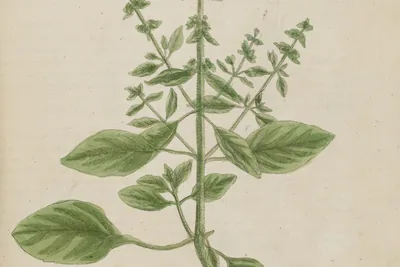
What the chosen basil leaves out.
Estragole is the reason the chemotype matters. Toxicologists describe it as "a naturally occurring food-borne genotoxic compound", one able to damage DNA, found in a variety of herbs and spices.[5] In 2012 a group at Wageningen gave male rats, ten to each dose group, single oral doses of estragole, up to 300 milligrams per kilogram of body weight, and measured the result two days later. Estragole had bound to DNA in the liver, rising with the dose, with lower levels in the lungs and kidneys. The point of the study was to test a computer model of how the body processes estragole and how much of it reaches DNA, and the model's predictions came within a factor of ten of what was measured, opening the way to modelling the same process in people.[5]
That is an animal result, by mouth, and it is the reason for the choice. The same Wageningen group had already found that an extract of the leaf blunts a later step in activating estragole, in rat and human liver preparations and in a human liver cell line. In the authors' words, the harm "might be lower in a matrix of other basil ingredients than what would be expected on the basis of experiments using 1'-hydroxyestragole as a single compound." Whole basil leaf does not behave like the isolated molecule. That work was done on an extract of the herb, not on its distilled oil.[6]
The linalool chemotype is chosen because its oil is led by linalool, not estragole.
Written in the enzymes.
Why one basil makes estragole and another does not comes down to an enzyme. In 2000 a group in Israel found the one that finishes estragole, by adding a methyl group to its precursor, chavicol. The enzyme was busy in young leaves and nearly silent in old ones.[4]
Different chemotypes carried different versions of it. A high-estragole basil, catalogued as R3, had an enzyme that worked on chavicol and almost nothing else. A basil that made estragole and methyl eugenol in equal measure had one that accepted both precursors. And a basil rich in eugenol, with neither estragole nor methyl eugenol, had no such activity at all.[4] The oil a basil makes is written in which enzymes it carries.
Linalool, again.
The molecule that names this chemotype is the same one that leads lavender, and it needs the same care. In air, linalool slowly forms hydroperoxides that can sensitise skin. Among 6,719 patients patch-tested at a Danish dermatology clinic, 3.1 per cent reacted to linalool hydroperoxide, and reactions were more likely in people over forty.[7] In a blinded use test, people already sensitised developed dermatitis from repeated exposure while controls did not.[8] The lavender entry tells this story at length. The answer is the same for basil: fresh oil, a closed bottle, and a patch test first for anyone with reactive skin.
Basil in people.
The human research on basil is recent and small, and most of it did not use an oil like the one in the blend. In 2020 a group in Khorramabad randomly assigned 144 people with migraine to basil essential oil at 2, 4 or 6 per cent, or to a placebo, applied to the skin every eight hours for three months, with a small dose of acetaminophen for everyone. Over those months the headaches in the basil groups became less intense and less frequent than in the placebo group, more so at the higher strengths.[10] The published summary does not say which chemotype the oil was.
The knee trial used a different material. In 2024 an Iranian group gave a hundred people with knee osteoarthritis either a traditional Persian basil oil — basil leaf juice cooked into sesame oil until the water was gone, not a distilled oil — or a diclofenac gel, rubbed on three times a day for four weeks. Both groups improved, neither did measurably better than the other, and there was no placebo group to show how much of the improvement either one made.[11]
The mood trial was swallowed. In 2025 a group in Fasa gave sixty people with major depression, all taking the antidepressant sertraline, either a syrup of basil-leaf extract or a sugar syrup each night for four weeks, in a single-blind design. Anxiety and depression scores fell further on basil; the authors note that the basil's smell may have told some participants which syrup they had.[12] That was an extract taken by mouth, alongside a prescription drug. None of the three is a claim for these blends.
The sacred one is a cousin.
The basil held sacred in India is tulsi, Ocimum sanctum, now often called O. tenuiflorum. It is a different species. In Ayurveda it is "preeminent" among the herbs, and it is grown for "both spiritual and practical significance."[9] Sweet basil is its cousin.
"The classification of five major chemotypes offers a strategic foundation for targeted breeding programs aimed at developing high-quality cultivars."
References
- [1] Dioscorides, De materia medica, Book II, "Okimon" (commonly known; sneezing, eyes shut; worms in the sun; the scorpion lore). ch. 171, modern version Osbaldeston TA, Wood RPA, Ibidis Press, Johannesburg 2000, pp. 296–298. ↩
- [2] Grayer RJ, Kite GC, Goldstone FJ, Bryan SE, Paton A, Putievsky E. Infraspecific taxonomy and essential oil chemotypes in sweet basil, Ocimum basilicum. Phytochemistry. 1996;43(5):1033–1039. PMID 8987875 · doi:10.1016/s0031-9422(96)00429-3 ↩
- [3] Barut M, Tansi LS. Chemical profiling and chemotypic diversity of basil (Ocimum basilicum L.) genotypes: a large-scale evaluation of bioactive compounds and antioxidant capacity. BMC Plant Biol. 2026;26(1):1319. PMID 42231174 · doi:10.1186/s12870-026-09147-9 ↩
- [4] Lewinsohn E, Ziv-Raz I, Dudai N, et al. Biosynthesis of estragole and methyl-eugenol in sweet basil (Ocimum basilicum L). Developmental and chemotypic association of allylphenol O-methyltransferase activities. Plant Sci. 2000;160(1):27–35. PMID 11164574 · doi:10.1016/s0168-9452(00)00357-5 ↩
- [5] Paini A, Punt A, Scholz G, et al. In vivo validation of DNA adduct formation by estragole in rats predicted by physiologically based biodynamic modelling. Mutagenesis. 2012;27(6):653–663. PMID 22844077 · doi:10.1093/mutage/ges031 ↩
- [6] Jeurissen SM, Punt A, Delatour T, et al. Basil extract inhibits the sulfotransferase mediated formation of DNA adducts of the procarcinogen 1'-hydroxyestragole by rat and human liver S9 homogenates and in HepG2 human hepatoma cells. Food Chem Toxicol. 2008;46(6):2296–2302. PMID 18433972 ↩
- [7] Botvid S, Søgaard R, Schwensen JFB, Johansen JD. Ten years of patch testing to hydroperoxides of limonene and linalool: prevalence, patterns and clinical insights. Contact Dermatitis. 2026;94(5):504–514. PMID 41638887 · doi:10.1111/cod.70102 ↩
- [8] Botvid S, Bennike NH, Johansen JD, et al. Repeated exposure to hydroperoxides of linalool induces immunologically verified allergic contact dermatitis. Contact Dermatitis. 2026;94(6):652–661. PMID 41713461 · doi:10.1111/cod.70119 ↩
- [9] Cohen MM. Tulsi – Ocimum sanctum: a herb for all reasons. J Ayurveda Integr Med. 2014;5(4):251–259. PMID 25624701 · doi:10.4103/0975-9476.146554 ↩
- [10] Ahmadifard M, Yarahmadi S, Ardalan A, Ebrahimzadeh F, Bahrami P, Sheikhi E. The efficacy of topical basil essential oil on relieving migraine headaches: a randomized triple-blind study. Complement Med Res. 2020;27(5):310–318. PMID 32155616 · doi:10.1159/000506349 ↩
- [11] Askari A, Hasheminasab FS, Sadeghpour O, Naghizadehd MM, Ravansalar SA, Iraji A, Hashempur MH. A randomized double-blind active-controlled clinical trial on the efficacy of topical basil (Ocimum basilicum) oil in knee osteoarthritis. Front Pharmacol. 2024;15:1377527. PMID 38769995 ↩
- [12] Talaei M, Zare K, Hashemi Y, Pahlevani AH, Fakhraei B, Namjooyan F, Hashempur MH, Kouhpaye A, Mosavat SH. Basil (Ocimum basilicum) to alleviate anxiety in patients with major depressive disorder: a randomized placebo-controlled clinical trial. Brain Behav. 2025;15(11):e70994. PMID 41236933 ↩
FAQs
What does "ct. linalool" mean?
"ct." stands for chemotype. Basil comes in several chemical types that look alike but make different oils. The linalool chemotype is the one whose oil is led by linalool.
Why does the basil chemotype matter?
Basil comes in chemical types that look alike, and some are led by estragole. In a 2012 study of rats given single doses of estragole by mouth, the compound was found bound to DNA in their livers. The linalool chemotype is chosen because its oil is led by linalool, not estragole.
Is sweet basil the same as holy basil?
No. Holy basil, or tulsi, is a different species, Ocimum sanctum (O. tenuiflorum), and it is the basil held sacred in India.
Does basil have anything in common with lavender?
Yes: linalool. It leads the oil of this basil and of lavender, and in both it should be kept fresh, because linalool that has reacted with air can cause a skin allergy in some people.
How old is the use of basil?
Dioscorides described it in the first century as a common herb, used in food and on stings, and noted that its smell made people sneeze.