
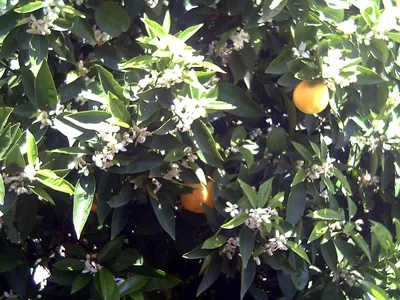
The Greeks had a golden fruit.
Dioscorides knew a citrus. He calls it the Median or Persian apple, citria in Latin, a tree "that bears fruit throughout the whole year one under another." The fruit is long and wrinkled, "resembling gold in colour, smelling sweet with heaviness." Taken in wine it was thought to resist poisons; its juice sweetened the breath; and its leaves, laid in chests, kept moths from the clothes.[1]
That is the citron, and it is the only citrus in his book. The orange is not there. It came to the Mediterranean later and from further east, and it came with a family history no one in Rome could have guessed.
On this page
The bitter cousin is its parent.
In 2025 a group in Wuhan sequenced 226 citrus accessions and assembled complete, phased genomes of the sweet orange and the sour orange. The sweet orange, they found, "originated from a sour orange × mandarin cross." Then they checked their answer the direct way: they made the cross by hand, and the seedlings behaved as the model said they would.[2]
So the bitter orange of marmalade and perfumery is not a distant relation of the sweet one. It is a parent. That is also why some botanical databases now file the sweet orange under the bitter orange's own name, Citrus aurantium. The name C. × sinensis is still the one the trade and most of the literature use.
The family is old. Reading the genomes of sixty citrus accessions in 2018, an international team proposed that citrus radiated out of Southeast Asia in the late Miocene, as the monsoons weakened, and later crossed the Wallace line to give Australia its native limes. Its familiar fruits are a network of crosses among ten natural species. Pummelo genes run widely through the mandarins, and they track fruit size and acidity: the likeliest explanation is that pummelo ancestry helped people select mandarins worth eating.[3] The sweet orange's sweetness has that history in it.
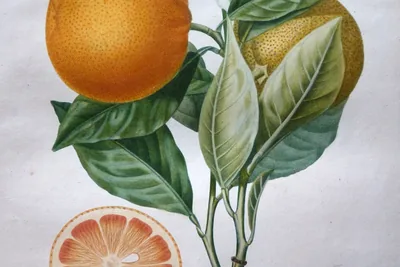
One tree, copied.
Nearly every sweet orange orchard shares one genetic background. The Wuhan group names the cost plainly: the crop "suffers from various devastating diseases because of its monogenetic background." Their answer was to start again from the cross, raising new seedlings with wide variety in flavour and disease resistance, and selecting sweet oranges that resist citrus canker. Along the way they found defence compounds that strongly held back several bacteria that damage citrus crops.[2]
Pressed from the peel.
The oil is not distilled. It is pressed from the peel, cold, and so it keeps everything the peel holds, including the heavy molecules a still would leave behind.
What comes out is mostly one molecule. In a cold-pressed oil from Gannan navel oranges, limonene made up 85.32 per cent of the oil, the largest of twenty-seven identified constituents. The same oil held back spoilage microbes in the lab, which is why food scientists study it as a natural preservative.[4] Other oranges and other presses give other figures, so no single percentage describes every sweet orange oil. But the character is the same: bright, sweet, and almost all limonene.
The orange's old romance belongs to its blossom, not its peel. Queen Victoria married in 1840 in a wreath of orange blossom, the only flower she wore, and in the language of flowers it stood for chastity — the reason, a garden historian suggests, that Victorian brides chose it first and foremost.[9]
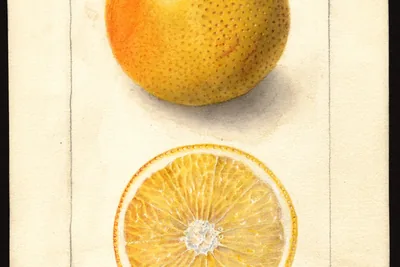
What light does to citrus.
Citrus peel oils carry furocoumarins, molecules that make skin burn in sunlight. How much depends on the fruit, and the spread is enormous.
In 2022 a lab screened 374 commercial cold-pressed citrus oils from twelve species for these compounds. Italian bergamot carried the most by far. Calamansi carried the least. A distilled yuzu oil, used as the lab's blank, carried almost none, because these molecules are too heavy to come over in a still. The oranges and mandarins fell together in the low group. Each group carried its own pattern of these molecules, a fingerprint that traces back to the fruit's wild ancestors and that shows up when a costly oil such as bergamot has been stretched with a cheaper one such as bitter orange. Bitter orange's own oil has reported bergapten, the best-known of these molecules, at 0.035 to 0.073 per cent. Shape matters as well as amount: the linear furocoumarins have caused phototoxic reactions at lower doses than the angular ones.[5]
Low is not the same as none. The same lab found xanthotoxin, another furocoumarin, at 4.85 parts per million in sweet orange oil, "contrary to the literature", which had called it absent.[5] In 2004 a flavour-house chemist wrote that the EU was likely to restrict furocoumarins in cosmetic products to one part per million.[6] That is why the kind of orange matters, and why a sweet orange oil is chosen for skin.
A calming scent, twice.
In 2012 a group in Brazil had forty men inhale sweet orange oil, at 2.5, 5 or 10 drops, before a classic stress task, the Stroop colour-word test. Two control groups breathed tea tree oil or water. Their anxiety, tension and calm were rated before the inhalation and before, during and after the test, which was filmed. Through the test, the men who had breathed sweet orange showed no rise in state anxiety, tension or loss of calm; the controls did. Heart rate and muscle tension rose in every group.[7] One session, forty people, one scent: a small, specific result about what orange does as a smell.
The same result turned up in a dental waiting room. In 2000 a neurology group in Vienna diffused orange oil into the waiting room and questioned seventy-two patients as they waited: the women who waited with the scent reported less anxiety, a better mood and more calm than the women who waited without it, and the paper reports the effect in the women.[10] Five years later, with two hundred patients split between orange, lavender, music and a room with neither, orange and lavender each lowered anxiety and lifted mood against the plain room.[11] A Dutch team then repeated the test in three large, busy clinics with 219 patients and found no difference at all, from orange or from apple.[12] A scent in the air of a small waiting room, one visit at a time: that is the size of it.
Air changes it.
Limonene reacts slowly with air, and the products, limonene hydroperoxides, can sensitise skin. In a Danish clinic's registry of 6,719 patients patch-tested between 2014 and 2025, 1.6 per cent reacted to limonene hydroperoxide. Most reactions were weak and peaked on the third or fourth day. Men were less likely to react than women. The authors conclude that the test belongs in the standard European patch-test series.[8] The lavender entry tells the same story for linalool. The practical answer is the same too: fresh oil, and a bottle kept closed.
"Our findings elucidate the origin of sweet orange and de novo domesticated disease-resistant sweet oranges, illuminating a strategy for the rapid domestication of perennial crops."
References
- [1] Dioscorides, De materia medica, Book I, "Medika" (the Median or Persian apple, the citron: gold, sweet and heavy; fruit all year; leaves against moths). ch. 166, modern version Osbaldeston TA, Wood RPA, Ibidis Press, Johannesburg 2000, p. 169. ↩
- [2] Liu S, Xu Y, Yang K, et al. Origin and de novo domestication of sweet orange. Nat Genet. 2025;57(3):754–762. PMID 40045092 · doi:10.1038/s41588-025-02122-4 ↩
- [3] Wu GA, Terol J, Ibanez V, et al. Genomics of the origin and evolution of Citrus. Nature. 2018;554(7692):311–316. PMID 29414943 · doi:10.1038/nature25447 ↩
- [4] Guo Q, Liu K, Deng W, Zhong B, Yang W, Chun J. Chemical composition and antimicrobial activity of Gannan navel orange (Citrus sinensis Osbeck cv. Newhall) peel essential oils. Food Sci Nutr. 2018;6(6):1431–1437. PMID 30258585 · doi:10.1002/fsn3.688 ↩
- [5] Dosoky NS, Satyal P, Setzer WN. Authentication of Citrus spp. cold-pressed essential oils by their oxygenated heterocyclic components. Molecules. 2022;27(19):6277. PMID 36234812 · doi:10.3390/molecules27196277 ↩
- [6] Frérot E, Decorzant E. Quantification of total furocoumarins in citrus oils by HPLC coupled with UV, fluorescence, and mass detection. J Agric Food Chem. 2004;52(23):6879–6886. PMID 15537290 · doi:10.1021/jf040164p ↩
- [7] Goes TC, Antunes FD, Alves PB, Teixeira-Silva F. Effect of sweet orange aroma on experimental anxiety in humans. J Altern Complement Med. 2012;18(8):798–804. PMID 22849536 · doi:10.1089/acm.2011.0551 ↩
- [8] Botvid S, Søgaard R, Schwensen JFB, Johansen JD. Ten years of patch testing to hydroperoxides of limonene and linalool: prevalence, patterns and clinical insights. Contact Dermatitis. 2026;94(5):504–514. PMID 41638887 · doi:10.1111/cod.70102 ↩
- [9] Nelson EC. Victorian royal wedding flowers: orange, myrtle, and the apotheosis of white heather. Garden History. 2009;37(2):231–236. (Extracts The Times Court Circulars, incl. 11 February 1840, p. 4: 'nothing but a simple wreath of orange blossom'.) ↩
- [10] Lehrner J, Eckersberger C, Walla P, Pötsch G, Deecke L. Ambient odor of orange in a dental office reduces anxiety and improves mood in female patients. Physiol Behav. 2000;71(1–2):83–86. PMID 11134689 · doi:10.1016/s0031-9384(00)00308-5 ↩
- [11] Lehrner J, Marwinski G, Lehr S, Johren P, Deecke L. Ambient odors of orange and lavender reduce anxiety and improve mood in a dental office. Physiol Behav. 2005;86(1–2):92–95. PMID 16095639 · doi:10.1016/j.physbeh.2005.06.031 ↩
- [12] Toet A, Smeets MA, van Dijk E, Dijkstra D, van den Reijen L. Effects of pleasant ambient fragrances on dental fear: comparing apples and oranges. Chemosens Percept. 2010;3(3–4):182–189. PMID 21125006 · doi:10.1007/s12078-010-9078-9 ↩
FAQs
Is sweet orange related to bitter orange?
Closely. Genome work published in 2025 shows the sweet orange came from a cross between a sour (bitter) orange and a mandarin, so bitter orange is one of its parents.
Is sweet orange oil phototoxic?
Sweet orange oil carries low levels of the furocoumarins that make some citrus oils burn in sunlight, far lower than bergamot and lower than bitter orange. Low is not zero, which is why the kind of orange oil matters.
How is sweet orange oil made?
It is pressed, not distilled, from the peel. It is mostly limonene.
Does the scent of orange do anything?
One small 2012 study found that men who breathed sweet orange oil before a stressful test did not show the rise in anxiety the control groups did. It was a single session with forty people.
Should sweet orange oil be kept fresh?
Yes. Limonene reacts with air over time, and the products can irritate sensitive skin. A closed bottle and fresh oil are best.