
Too much flower for one room.
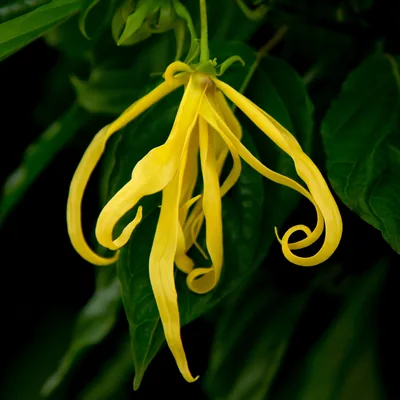
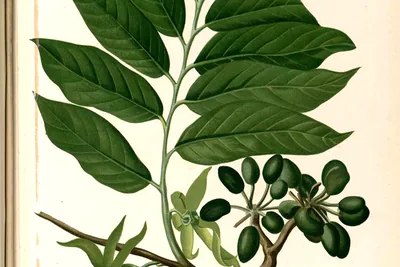
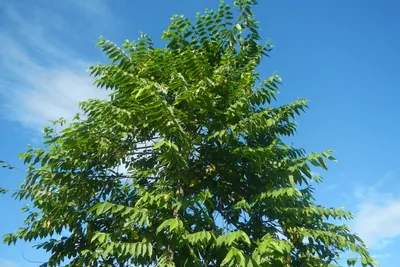
In 1837 an Augustinian friar in Manila, Manuel Blanco, published his book, Flora de Filipinas. Among the relatives of the custard apple he describes a tall tree with smooth, obliquely oval leaves half a foot long and flowers of six very long, pointed petals, the colour of the calyx, around a tight cluster of stamens. Each fertilised pistil becomes a small oval berry on its own long stalk, holding three or four lentil-shaped seeds. The tree grows very tall. He calls it Unona odoratissima, "the very fragrant", and gives its Tagalog name: alangilan.[1]
Then he gives a warning from experience. The flowers are "en extremo olorosas", extremely fragrant, "and for that very reason harmful to the head." A small handful of them cannot be left in a room overnight without the sleeper risking a bad headache, "as has happened to me." The fruit, he adds, has no scent at all, and the local people make no notable use of the tree.[1]
It is an honest first record: a scent so strong that a botanist lost a night's sleep to it. Nearly two centuries later, the same flower is used by the drop.
On this page
The wedding flower.
Blanco lost a night's sleep to a handful of these flowers. In Indonesia, where the tree is kenanga, the same scent is wanted close. The standard reference on the region's essential-oil plants records women hiding a flower in their hair, flowers put away with clothes or scattered about the bed, and kenanga mixed with jasmine and rose in ceremonies across Java and Bali.[2]
Weddings are among those ceremonies. A 2020 survey of the plants used at traditional weddings in Tulungagung, East Java, found kenanga in the water the bride uses to wash the groom's feet, and on the offerings, where the flowers were said to wish the couple a beautiful household.[3] That the petals are strewn on the bed of a newly married couple is a custom widely reported from Indonesia; the best source we have found for it is a tree reference database, not a field record.[4] Either way, the strength of the scent is the point, not the problem.
An old branch of the family tree.
In 2024 a group in Yunnan assembled the most complete genome yet for a plant of its lineage, 735.83 million letters of DNA read end to end, telomere to telomere. It settled where ylang ylang sits. Cananga is a magnoliid, part of an old branch of the flowering plants, and the analysis places the magnoliids as sister to the eudicots, the great group that includes roses, oranges and basil, after both split from the monocots.[5]
So the flower that perfumes a bottle of body oil belongs to a lineage that branched off early among the flowering plants.
The copaiba molecule, in a flower.
The same study read the scent itself. In both the essential oil and the living flower, the sesquiterpenes dominated, and above all one of them: β-caryophyllene. The team traced it to a pair of terpene-synthase genes, copies of each other made by a duplication in the genome, that are highly active while the flower develops, and two regulatory genes that appear to switch them on.[5]
β-Caryophyllene is the molecule this series keeps meeting. In 2008 a group in Zurich showed that it binds CB2, one of the two receptors of the endocannabinoid system, at 155 nanomolar, and acts there as a functional agonist, in human immune cells and in mice. Given to mice, it damped an induced inflammatory response, and the effect disappeared in mice bred without CB2, which is how the group knew the receptor was doing the work.[6] It is common in spice plants and in cannabis; the paper's title calls it "a dietary cannabinoid". It is the reason copaiba sits in every blend.
It is a quiet pleasure that the molecule behind copaiba's place in every bottle is the one that leads this flower's scent. The blend was built for its smell; the chemistry turned out to rhyme.
Composition shifts with origin and with how long the still runs. Oils distilled from flowers grown in northern Grande Comore, tested at three different distillation times, led instead with linalool, geranyl acetate and benzyl benzoate, and showed antioxidant and antibacterial activity in the lab. The same authors stress that, for skin, the oil needs careful formulation to keep irritation down.[7] No single analysis describes every ylang ylang oil.
Picked at seven.
The flower keeps time. In a 2026 study led by a researcher based in the Comoros, using the genuina form of the tree grown for perfume, flowers picked at seven in the morning or three in the afternoon gave better oil than flowers picked at eleven. Flowers were held for four, eight, twenty-four and thirty hours before distilling. Up to eight hours the yield held, but after a day in storage the yield fell, and the share of aromatic compounds dropped from 73.66 per cent in fresh petals to 57.02 per cent.[8]
The practical rule follows: pick in the cool of the day, and get the flowers to the still the same morning.
On skin, with the nose left out.
In 2006 a group in Thailand gave forty healthy volunteers ylang ylang oil to absorb through the skin, and measured skin temperature, pulse, breathing and blood pressure, alongside the volunteers' own ratings of how they felt. Against a control group, blood pressure fell and skin temperature rose, and the volunteers rated themselves calmer and more relaxed.[9] That is one session, forty people, and a result about the body's state rather than about skin.
It is a small, clear study of what the oil does to how a body feels, which is the part of ylang ylang a blend is built around.
Why it is used at a whisper.
Big scents carry big exposure. The IVDK, a network of dermatology clinics centred on Germany, patch-tested 10,930 patients against twelve essential oils between 2010 and 2019. In all, 908 of them, 8.3 per cent, reacted to at least one oil, often to several at once. Only six of the oils sensitised more than one per cent of those tested, and ylang ylang, in its first and second grades, came first, at 3.9 per cent; neroli, sixth, sat at 1.1. Women, people over forty, and masseurs and cosmeticians, who handle oils all day, were over-represented among the patients who reacted.[10] The main allergens in the oil have been reviewed in detail in the dermatology literature.[11]
That is the reason ylang ylang goes into a blend at a low level, and the reason anyone with reactive skin should patch test first. A friar in Manila reached the same conclusion about the dose, the hard way.
"Our results shed light on the molecular mechanisms underlying the biosynthesis of the unique floral fragrance in C. odorata."
References
- [1] Blanco M. Flora de Filipinas, según el sistema sexual de Linneo. Manila: Imprenta de Sto. Tomás, 1837, "Unona odoratissima" (Tagalog alangilan), p. 400; quotations translated from the Spanish by the editors. ↩
- [2] Umi Kalsom Yusuf, Sinohin VO. Cananga odorata (Lamk) Hook.f. & Thomson. In: Oyen LPA, Nguyen Xuan Dung, eds. Plant Resources of South-East Asia No. 19: Essential-oil plants. Leiden: Backhuys; 1999. Via Pl@ntUse. ↩
- [3] Nursita DC, Amalia D, Minarno EB. Ethnobotanical Study of Plants Used For The Wedding Ceremony in The Boyolangu Subdistrict, Tulungagung District, East Java Province. El-Hayah: Jurnal Biologi. 2020;7(4):167–177. doi:10.18860/elha.v7i4.10830 ↩
- [4] Orwa C, Mutua A, Kindt R, Jamnadass R, Anthony S. Agroforestree Database: a tree reference and selection guide, version 4.0. Nairobi: World Agroforestry Centre (ICRAF); 2009. Cananga odorata. ↩
- [5] Zheng Y, Yang D, Yin X, et al. The chromosome-level genome assembly of Cananga odorata provides insights into its evolution and terpenoid biosynthesis. New Phytol. 2024;243(6):2279–2294. PMID 39031984 · doi:10.1111/nph.19977 ↩
- [6] Gertsch J, Leonti M, Raduner S, et al. Beta-caryophyllene is a dietary cannabinoid. Proc Natl Acad Sci U S A. 2008;105(26):9099–9104. PMID 18574142 · doi:10.1073/pnas.0803601105 ↩
- [7] Mrani SA, Zejli H, Azzouni D, et al. Chemical composition, antioxidant, antibacterial, and hemolytic properties of ylang-ylang (Cananga odorata) essential oil: potential therapeutic applications in dermatology. Pharmaceuticals (Basel). 2024;17(10):1376. PMID 39459015 · doi:10.3390/ph17101376 ↩
- [8] Chakira A, Soria C, Minier J, Chillet M, Garcia C. Effect of flower storage and harvest times on the dynamics of volatile compounds in ylang-ylang essential oil. Plants (Basel). 2026;15(6):891. PMID 41901410 · doi:10.3390/plants15060891 ↩
- [9] Hongratanaworakit T, Buchbauer G. Relaxing effect of ylang ylang oil on humans after transdermal absorption. Phytother Res. 2006;20(9):758–763. PMID 16807875 · doi:10.1002/ptr.1950 ↩
- [10] Geier J, Schubert S, Reich K, et al. Contact sensitization to essential oils: IVDK data of the years 2010–2019. Contact Dermatitis. 2022;87(1):71–80. PMID 35417610 · doi:10.1111/cod.14126 ↩
- [11] de Groot AC, Schmidt E. Essential oils, part VI: sandalwood oil, ylang-ylang oil, and jasmine absolute. Dermatitis. 2017;28(1):14–21. PMID 28002230 · doi:10.1097/DER.0000000000000241 ↩
FAQs
Where does ylang ylang come from?
It is a tropical tree of Southeast Asia, including the Philippines, where a Manila botanist recorded it in 1837. Much of the research on its oil now comes from the Comoros, where it is grown and distilled.
Why is ylang ylang used in such small amounts?
The scent is strong, and the oil is one of the more common essential-oil sensitisers: in German clinic data, 3.9 per cent of patients tested reacted to it. A little goes a long way, and we keep it low.
What gives ylang ylang its scent?
A genome study found that β-caryophyllene leads the scent of both the flower and its oil, along with other sesquiterpenes. Oils from different places and grades also carry linalool, geranyl acetate and benzyl benzoate.
Does ylang ylang have anything in common with copaiba?
Yes: β-caryophyllene, the molecule that binds the CB2 receptor in laboratory studies, is a major part of both.
When are ylang ylang flowers picked?
Early morning or mid-afternoon, and distilled within hours. Oil from flowers stored for a day loses much of its aromatic character.
Which Rockstar products contain ylang ylang?
Rockstar Woman, Rockstar Woman Hemp Free and Rockstar Man, and the Entourage blends.