
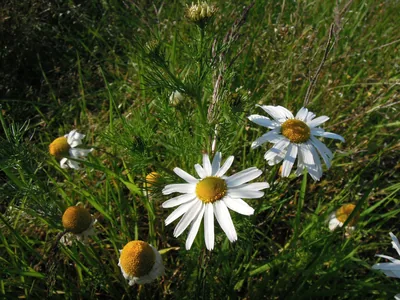
Apples on the ground.
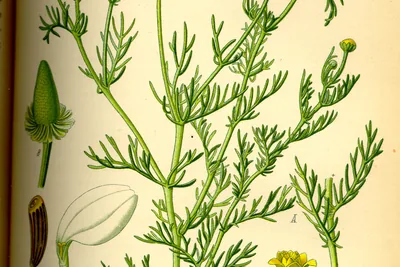
Dioscorides describes three kinds of anthemis that differ only in their flowers: little round heads with gold at the centre and a ring of petals around them — white in one, yellowish in another, purple in the third. They grow in rough places and by the road, and are gathered in spring. Some, he adds, call it chamaemelon, "because of the similarity of its smell to apples"; the Romans called it malium.[1]
His uses run long and mostly internal — drunk or bathed in for stones, for jaundice and the liver, for wind; smeared on for ulcers at the corner of the eye; chewed for thrush. The flowers and leaves were pounded and rolled into little balls to keep. It was a working plant, gathered by the roadside and stored by the handful.[1]
The English word keeps that. Chamomile comes down from the Greek khamaimelon: khamai, on the ground, and melon, apple.[2]
Which of his three is the plant in these blends cannot be settled from flower colour alone. The editors of the modern English version match the white-flowered kind to Matricaria chamomilla, and it is a fair match, but a gold disc ringed with white describes half the daisies in Europe.
On this page
Two names for one daisy.
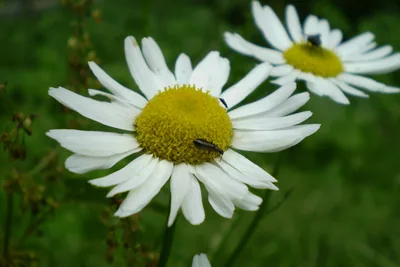
The plant goes by two botanical names. Matricaria recutita is the one on most product labels and in much of the research; Matricaria chamomilla is the one the botanical authorities now accept, with recutita listed as its synonym.[3] Both mean the same annual daisy of field margins and waste ground — German chamomile, as distinct from Roman chamomile, which is another plant entirely.
The difference shows when a flower head is cut in half. German chamomile's disc sits on a cone that is hollow inside, which is how botanists tell it from the look-alikes that grow beside it.
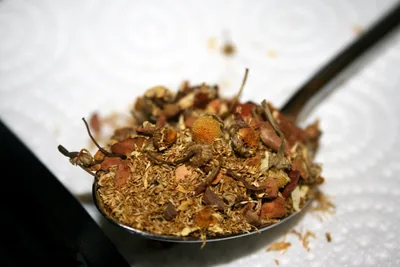
The blends use a CO2 extract of the flowers, a gentler method than steam.
A colour made in the still.
A group mapping the plant's chemistry in 2012 called chamomile one of the oldest and most important medicinal plants in Europe, and traced several of its aromatic molecules to the enzymes that build them. One of those enzymes, working in the flowers and leaves, makes β-caryophyllene — the molecule at the centre of the hemp and copaiba entries in this collection. How much of it survives into an extract is a separate question, and not one that paper asked. Another makes germacrene A, which barely accumulates, because the plant appears to turn it into something else, likely matricine.[4]
The flower is white and yellow. Its distilled oil is a deep, inky blue.
The blue is not in the flower. It comes from chamazulene, and chamazulene forms during steam distillation, spontaneously, from a colourless compound the flower does make: matricine.[4] The colour is manufactured on the way out of the plant.
It does not keep. A 2024 study exposed chamazulene to ultraviolet light and watched it turn from blue to green within three hours, then fade toward yellow as the molecule broke into dimers and fragments. Oxygen made it worse. Heat on its own did not: held at 50 °C in the dark for fifty days, it did not degrade at all. Of the antioxidants tested, tocopherol — vitamin E — protected it best.[5] Light and air are the enemies of the blue, which is the whole case for a dark bottle kept shut.
A drug found backwards.
When matricine breaks down it can also form chamazulene carboxylic acid. In 2006 a German group noticed that the molecule is shaped like the profens — the family ibuprofen belongs to — and tested it as one. It inhibited cyclooxygenase-2, the inducible enzyme of inflammation, and left cyclooxygenase-1 alone. It worked against inflammation in several animal models, applied locally or given systemically, and volunteers who swallowed matricine had it in their blood at micromolar levels. The conversion happened in artificial stomach fluid, not in intestinal fluid: the plant's compound is a prodrug, and acid is what turns it on.[6]
The authors pointed out the oddity of how they found it. Plants usually hand chemists a lead that becomes a drug. This time the drug came first, and the plant turned out to have been making something like it all along.
That is chemistry and animal pharmacology — reasonable grounds, and a good reason to keep looking.
One trial on skin.
The best-known human test of chamomile on skin is a cream, Kamillosan, made from a variety called Manzana, which its makers state carries no chamomile-related allergen potential. In a partially double-blind trial, patients with moderate atopic eczema compared it side against side — with a 0.5 per cent hydrocortisone cream, and with the plain base cream — for two weeks.[7]
The result, in the authors' words: "a mild superiority towards 0.5% hydrocortisone and a marginal difference as compared to placebo." The base cream did almost as well as the chamomile. The paper's contact address is at Asta Medica, the company that sold Kamillosan. It is a small, honest result, and it is the one there is.
The daisy family.
Chamomile is an Asteraceae, with ragweed, yarrow and arnica, and it can sensitise. Usually that is blamed on the family's sesquiterpene lactones, but a Danish clinic has shown that a coumarin in German chamomile, herniarin, is a sensitiser in its own right: of thirty-six patients with known or suspected Compositae allergy tested against it, one reacted clearly and three doubtfully, and all four were allergic to chamomile.[8] Chamomile is still counted a weak sensitiser. Anyone who reacts to the daisy family should patch test first.
"Intriguingly, the biological activity of the natural compound was found because of its similarity to fully synthetic drug substances."
References
- [1] Dioscorides, De materia medica, Book III, "Anthemis" (three kinds by flower colour; chamaemelon for the smell of apples; the Roman malium). ch. 154 in Goodyer's English (1655), modern version Osbaldeston TA, Wood RPA, Ibidis Press, Johannesburg 2000, pp. 526–527. ↩
- [2] Online Etymology Dictionary, "chamomile (n.)": from Greek khamaimelon, "earth-apple" — khamai, on the ground, and melon, apple. ↩
- [3] GBIF Backbone Taxonomy, Matricaria chamomilla L. (accepted); Matricaria recutita L., synonym. ↩
- [4] Irmisch S, Krause ST, Kunert G, Gershenzon J, Degenhardt J, Köllner TG. The organ-specific expression of terpene synthase genes contributes to the terpene hydrocarbon composition of chamomile essential oils. BMC Plant Biol. 2012;12:84. PMID 22682202 · doi:10.1186/1471-2229-12-84 ↩
- [5] Gabbanini S, Neba JN, Matera R, Valgimigli L. Photochemical and Oxidative Degradation of Chamazulene Contained in Artemisia, Matricaria and Achillea Essential Oils and Setup of Protection Strategies. Molecules. 2024;29(11):2604. PMID 38893479 · doi:10.3390/molecules29112604 ↩
- [6] Ramadan M, Goeters S, Watzer B, et al. Chamazulene carboxylic acid and matricin: a natural profen and its natural prodrug, identified through similarity to synthetic drug substances. J Nat Prod. 2006;69(7):1041–1045. PMID 16872141 · doi:10.1021/np0601556 ↩
- [7] Patzelt-Wenczler R, Ponce-Pöschl E. Proof of efficacy of Kamillosan(R) cream in atopic eczema. Eur J Med Res. 2000;5(4):171–175. PMID 10799352 ↩
- [8] Paulsen E, Otkjaer A, Andersen KE. The coumarin herniarin as a sensitizer in German chamomile [Chamomilla recutita (L.) Rauschert, Compositae]. Contact Dermatitis. 2010;62(6):338–342. PMID 20557339 · doi:10.1111/j.1600-0536.2010.01730.x ↩
FAQs
What is the difference between German and Roman chamomile?
They are different plants. German chamomile is Matricaria chamomilla, an annual daisy; Roman chamomile is Chamaemelum nobile. These blends use German chamomile.
Why is chamomile oil blue when the flower is white?
The blue is chamazulene, which is not in the living flower. It forms during steam distillation from a colourless compound the flower makes, matricine.
Is Matricaria recutita the same as Matricaria chamomilla?
Yes. They are two names for the same plant. Matricaria chamomilla is the name botanical authorities now accept, and recutita is listed as its synonym, though it is still common on labels.
Is there research on chamomile on skin?
The best-known skin trial tested a branded chamomile cream, run by its maker, for two weeks. It did only marginally better than the same cream without chamomile. It is one small study of a different product.
Can chamomile cause allergies?
It can. Chamomile belongs to the daisy family, with ragweed, and some people react to it. Patch test first if you know you react to that family.