
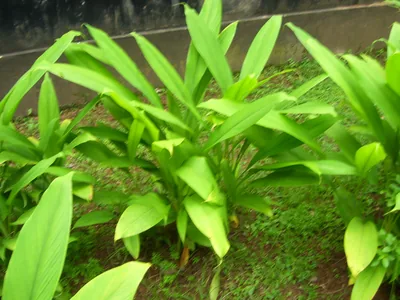
A cooking pot at Farmana.
Farmana is a Harappan town in what is now Haryana, lived in between about 2600 and 2200 BCE. In 2010 two archaeologists scraped fifty surfaces there — pots, grinding stones, the tartar on people's teeth — and looked for the starch grains that cooking leaves behind. Out of a handi, a deep, narrow-mouthed cooking pot, came starches comparable to turmeric's, beside starches comparable to ginger's.[1] The method matters. Archaeologists usually identify ancient food from charred seeds, and a rhizome, eaten ground or grated, leaves no seed to char. Starch caught in the scratches of a pot is how a root crop shows up at all.
"Comparable to" is the archaeologists' careful phrasing. If the reading holds, turmeric was going into dinner in the Indus valley four and a half thousand years ago.
On this page
The Indian cyperus.
When Greek medicine did write about it, it did not know what it was looking at. Dioscorides, describing the sedge called cyperus, adds that "some speak also of another kind of cyperus, like ginger, which grows in India, which when chewed is found to taste bitter like saffron." Rubbed on as an ointment, he says, it takes hair off.[2]
A Victorian pharmacologist, Jonathan Pereira, put the likely identification in one line: "Turmeric is probably the κύπειρος ινδικός of Dioscorides." He also traced the Latin name. Curcuma comes from kurkum, the Persian for saffron.[3] Two languages, and both reached for saffron.
In Pereira's day turmeric reached London from Bengal, where it was "much cultivated about Calcutta", and from China and Java. It was sold as a condiment, as a colouring, and as something almost forgotten now: a chemical test. Paper soaked in it turns from yellow to reddish-brown at the touch of an alkali, and "turmeric paper", he wrote, "is employed as a test for alkalies." Its medical reputation he put in the past tense: "formerly, it had some reputation in hepatic and other visceral diseases, and especially in jaundice."[3]
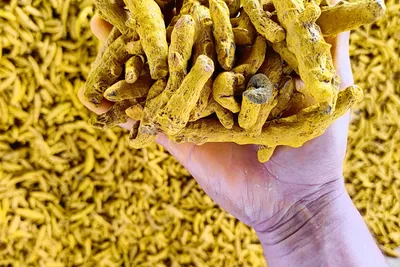
A root that is not a root.
Curcuma longa belongs to the ginger family, and what is harvested is the same kind of organ ginger gives: a rhizome, a swollen underground stem that branches into the fingers the trade calls it by. It is lifted, dried and ground, and sold in India by named variety — Lakadong, Vasmat, Waigaon — the way wine is sold by village.
The fingers are orange-yellow all the way through, and the colour is the first thing anyone learns about turmeric, usually from a shirt.
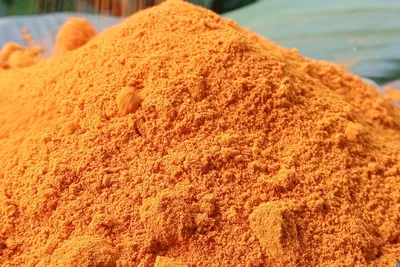
Two fractions.
That colour and the smell come from two different families of molecule.
The colour is the curcuminoids, curcumin chief among them. They are not the bulk of the plant: curcumin makes up at most about five per cent of turmeric.[4]
The smell is the turmerones. Distil the rhizome and they dominate the oil — a group in Alabama growing five varieties found ar-turmerone at up to a third of it, α-turmerone about the same, β-turmerone less, with α-phellandrene and 1,8-cineole behind them. Their point was agricultural: a tropical crop, grown in the warm, humid American south, gave oils comparable to those from the tropics.[5]
The blends use a CO2 extract of the rhizome rather than a distilled oil or a powder.
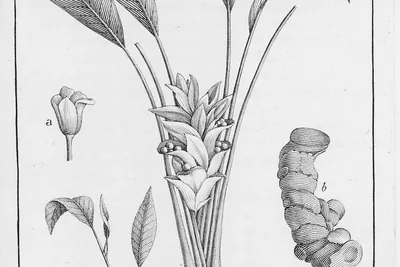
More than one molecule.
Curcumin is the part of turmeric most people have heard of, and the most studied — partly because it is so easy to pull out of the powder and purify. On its own it has proved a difficult candidate. Medicinal chemists who reviewed the work in 2017 found the isolated molecule unstable and poorly absorbed when swallowed, and hard to test cleanly: the same reactivity that turns turmeric paper reddish-brown makes it lively in a laboratory assay.[4]
What that shows is that turmeric was never just curcumin. Curcumin is at most about a twentieth of the rhizome.[4] The rest carries the turmerones and the other aromatic molecules, the second chemical family, alongside everything else the plant makes. And turmeric has been used whole for four and a half thousand years, in the pot and as a colour, long before anyone isolated anything from it.
A whole extract on skin is a different question from a purified molecule in a capsule, and it keeps both families together.
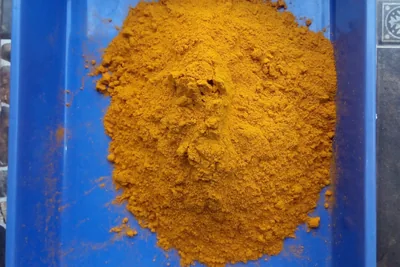
It stains, and it can sensitise.
Turmeric stains skin and cloth yellow, briefly on skin and for good on a white shirt. It is also not inert: turmeric in a massage oil has been reported as a cause of contact dermatitis.[6] Reports are few, and anyone with sensitive skin should patch test first, as with any botanical.
On skin, a promising start.
The skin research is young and moving in a good direction. A 2016 systematic review found 234 papers and kept eighteen clinical studies: nine of turmeric or curcumin taken by mouth, eight applied to the skin, one both, across a range of skin conditions. Ten of the eighteen reported a significant difference from the control group. The authors called it early evidence and asked for larger, better studies to follow.[7] For anything applied to skin, the eight topical studies are the ones that matter most, and they are where the next work belongs.
Four and a half thousand years after someone stirred it into a pot at Farmana, turmeric is still giving researchers reasons to look closer.
"Overall, there is early evidence that turmeric/curcumin products and supplements, both oral and topical, may provide therapeutic benefits for skin health."
References
- [1] Kashyap A, Weber S. Harappan plant use revealed by starch grains from Farmana, India. Antiquity Project Gallery. 2010;84(326). doi:10.15184/s2978855200902191 ↩
- [2] Dioscorides, De materia medica, Book I, "Kupeiros" (the Indian kind like ginger, bitter like saffron; depilatory). ch. 4 in Goodyer's English (1655), modern version Osbaldeston TA, Wood RPA, Ibidis Press, Johannesburg 2000, p. 5. ↩
- [3] Pereira J. The Elements of Materia Medica and Therapeutics, vol. II, 3rd American ed. Philadelphia 1854: "77. Curcuma longa, Linn. — The Long-rooted Turmeric." ↩
- [4] Nelson KM, Dahlin JL, Bisson J, Graham J, Pauli GF, Walters MA. The Essential Medicinal Chemistry of Curcumin. J Med Chem. 2017;60(5):1620–1637. PMID 28074653 · doi:10.1021/acs.jmedchem.6b00975 ↩
- [5] Setzer WN, Duong L, Poudel A, Mentreddy SR. Variation in the Chemical Composition of Five Varieties of Curcuma longa Rhizome Essential Oils Cultivated in North Alabama. Foods. 2021;10(2):212. PMID 33494170 · doi:10.3390/foods10020212 ↩
- [6] Lopez-Villafuerte L, Clores KH. Contact dermatitis caused by turmeric in a massage oil. Contact Dermatitis. 2016;75(1):52–53. PMID 27264290 · doi:10.1111/cod.12549 ↩
- [7] Vaughn AR, Branum A, Sivamani RK. Effects of Turmeric (Curcuma longa) on Skin Health: A Systematic Review of the Clinical Evidence. Phytother Res. 2016;30(8):1243–1264. PMID 27213821 · doi:10.1002/ptr.5640 ↩
FAQs
Is turmeric the same as curcumin?
No. Curcumin is one molecule in turmeric, at most about five per cent of it. Turmeric also carries the turmerones, which give it its smell, and much else. Research on isolated curcumin is not research on turmeric.
How long has turmeric been used?
Starch grains comparable to turmeric's were found in a cooking pot at the Harappan site of Farmana, dated to about 2600 to 2200 BCE. The Greek physician Dioscorides described what is probably turmeric in the first century.
Why is it called curcuma?
From kurkum, the Persian word for saffron, because of its colour.
Why use turmeric rather than curcumin?
Curcumin is one molecule, at most about five per cent of turmeric, and on its own it is unstable and poorly absorbed when swallowed. The blends use an extract of the whole rhizome, which keeps the curcuminoids and the turmerones together.
Is there research on turmeric and skin?
A 2016 systematic review found eighteen clinical studies, oral and topical, across several skin conditions. The authors called the evidence early and the studies limited.