
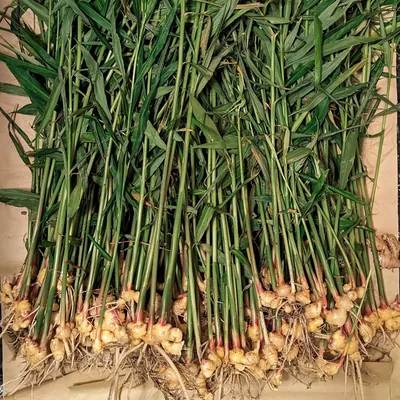
Pickled, and shipped to Rome.
Dioscorides knew ginger from its roots: small ones, he says, like those of the sedge, whitish, "resembling pepper in taste, and with a sweet smell." Choose those that are least rotten, he advises, because they rot quickly. So some "are preserved and carried into Italy in ceramic jars," and they are eaten with meat, "used together with their pickle."[1]
He calls them "warming and digestive," gentle on the bowels and good for the stomach, and he notes that the root was used for things that darken the eyes, went into antidotes, and resembled pepper in strength. The green herb, too, was boiled and mixed into oil for drinking and cooking, the way Rome used rue.[1]
He places the plant in Arabia. It did not grow there; Arabia was where the traders were. Like frankincense in Pliny, ginger reached the Roman writers by the route it travelled rather than the ground it came from. What arrived in Italy was a rhizome in a jar, and it was prized enough to pickle for the voyage.
On this page
What makes it hot.
The root is a mixture of phenolic compounds, terpenes, polysaccharides, lipids, organic acids and fibre. Its bite belongs to one family of the phenolics, the gingerols, with 6-gingerol the most abundant in the fresh root. With their close relatives the shogaols, they are the compounds the modern literature credits with most of what ginger does.[2]
In 2021 a group in Chongqing assembled a high-quality genome for 'Zhugen', a ginger grown in southwest China and eaten fresh as a vegetable. They read both copies of each chromosome separately, and found that 11.9 per cent of the 17,226 paired genes, about one in eight, were used unequally between the two copies. From the genome, the plant's active genes and its chemistry together, they proposed the backbone of how ginger makes gingerols: a route through twelve families of enzymes, with the switches that regulate it. They describe the pathway as specific to ginger.[3]
The heat, in other words, is not borrowed from pepper. It is ginger's own chemistry, built by its own route.
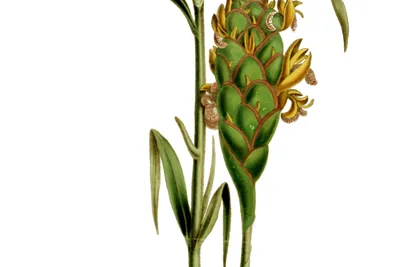
The heat that heat undoes.
Gingerols have a weak point. In 2001 a pharmacy group measured 6-gingerol in water from 37 °C, body temperature, up to 100 °C, at pH 1, 4 and 7. The molecule is "thermally labile". Its weak point is a hydroxyl group sitting next to a ketone, and heat pulls water out between them: 6-gingerol becomes 6-shogaol. The reaction runs both ways, settling at a balance between the two. It was slowest in mildly acidic conditions, and at 100 °C in strong acid it reached that balance within two hours.[4]
A steam still runs at about 100 °C, the top of the range that study tested. Heat is the one thing the gingerols do not keep through.
Carbon dioxide works cooler. In a 2025 study, a group in Lima and Cádiz tested supercritical CO₂ extraction of Peruvian ginger at 40 to 50 °C and 80 to 250 bar, and settled on 50 °C and 250 bar for six hours. The yield is small, about 26 milligrams of extract from each gram of dried ginger. The extract carried the whole pungent family: 254.71 milligrams of 6-gingerol in every gram, with the 8- and 10-gingerols and 6-, 8- and 10-shogaol alongside; 8-shogaol, at 51.01 milligrams per gram, was the second largest of them all. Stored for 180 days in the cold, at room temperature and at 40 °C, its polyphenol content and antioxidant capacity held steady.[5]
We chose a CO₂ extract of ginger for exactly this reason: it carries the root's pungent fraction whole, at a temperature the gingerols survive.
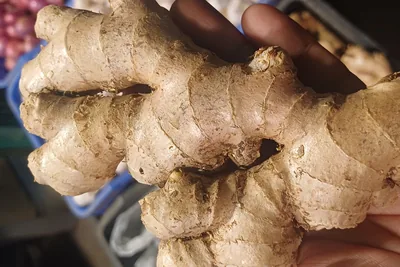
Through human skin.
In 2007 a pharmacy group in Milan tested ginger extracts on skin. Applied to the ears of mice irritated with croton oil, a commercial dry extract reduced the swelling, dose by dose. An extract enriched in gingerols did slightly less well, so more 6-gingerol was not better. The group then built the extract into a medicated plaster, at one milligram per square centimetre, which also worked on the mice. They measured what passed through: 6-gingerol crossed human epidermis at 6.9 micrograms per square centimetre and mouse skin at 22.1, and in the first eight hours the two rates were comparable.[6]
The same year a group in Seoul applied 6-gingerol to the skin of hairless mice before exposing them to ultraviolet B. It held back COX-2 and the NF-κB signal, two parts of the skin's response to sunburn, and in skin cells in a dish it lowered the reactive oxygen the light produced, along with the signals that tell sun-damaged cells to die.[7]
That is two animal studies and a permeation measurement. Ginger's main molecule can reach through human skin, and in mice it acts on the chemistry of irritation and of light. A trial in people is the next step.
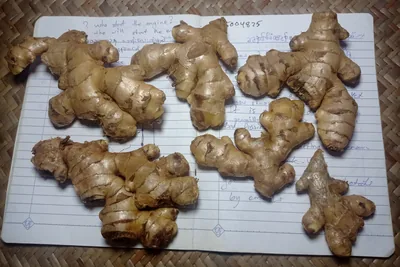
A spice worth respecting.
Ginger is a kitchen spice, and like several kitchen spices it can sensitise the people who handle it most. An occupational dermatology clinic that examined about a thousand patients between 1991 and 1995 found five with allergic contact dermatitis from spices, all chefs or kitchen and restaurant workers with dermatitis of the hands. Ginger was among the spices responsible, with garlic, cinnamon, allspice and clove, and the same patients also reacted to foods such as tomato, lettuce and carrot.[8] Patch testing with the spices themselves can find it, though diluted tests may be needed to confirm a true allergy. It is a rare reaction, and a warming extract can also tingle on sensitive skin at strength. Anyone with reactive skin should patch test first.
"Overall, this study… lays a foundation for a better understanding of ginger evolution, and presents an intact biosynthetic pathway for species-specific gingerol biosynthesis."
References
- [1] Dioscorides, De materia medica, Book II, "Zingiberi" (small whitish roots, peppery and sweet-smelling; preserved and carried into Italy in ceramic jars, eaten with their pickle; warming and digestive). ch. 190, modern version Osbaldeston TA, Wood RPA, Ibidis Press, Johannesburg 2000, pp. 318–319. ↩
- [2] Mao QQ, Xu XY, Cao SY, et al. Bioactive compounds and bioactivities of ginger (Zingiber officinale Roscoe). Foods. 2019;8(6):185. PMID 31151279 · doi:10.3390/foods8060185 ↩
- [3] Li HL, Wu L, Dong Z, et al. Haplotype-resolved genome of diploid ginger (Zingiber officinale) and its unique gingerol biosynthetic pathway. Hortic Res. 2021;8(1):189. PMID 34354044 · doi:10.1038/s41438-021-00627-7 ↩
- [4] Bhattarai S, Tran VH, Duke CC. The stability of gingerol and shogaol in aqueous solutions. J Pharm Sci. 2001;90(10):1658–1664. PMID 11745724 · doi:10.1002/jps.1116 ↩
- [5] Cárdenas-Toro FP, Meza-Coaquira JH, Gonzalez-Gonzalez M, et al. Supercritical CO2 extraction of oleoresin from Peruvian ginger (Zingiber officinale Roscoe): extraction yield, polyphenol content, antioxidant capacity, chemical analysis and storage stability. Molecules. 2025;30(5):1013. PMID 40076238 ↩
- [6] Minghetti P, Sosa S, Cilurzo F, et al. Evaluation of the topical anti-inflammatory activity of ginger dry extracts from solutions and plasters. Planta Med. 2007;73(15):1525–1530. PMID 18058610 · doi:10.1055/s-2007-993741 ↩
- [7] Kim JK, Kim Y, Na KM, Surh YJ, Kim TY. [6]-Gingerol prevents UVB-induced ROS production and COX-2 expression in vitro and in vivo. Free Radic Res. 2007;41(5):603–614. PMID 17454143 · doi:10.1080/10715760701209896 ↩
- [8] Kanerva L, Estlander T, Jolanki R. Occupational allergic contact dermatitis from spices. Contact Dermatitis. 1996;35(3):157–162. PMID 8930476 · doi:10.1111/j.1600-0536.1996.tb02334.x ↩
FAQs
Why use a CO₂ extract of ginger rather than the essential oil?
Ginger's pungent molecules, the gingerols, change in heat, and a steam still runs at 100 °C. A CO₂ extraction runs much cooler and carries the whole pungent fraction, not just the scent. That is why we use it.
What makes ginger hot?
A family of molecules called gingerols, with 6-gingerol the main one, and their relatives the shogaols. Ginger makes them by a biochemical route that genome work describes as specific to ginger.
How long has ginger been traded?
At least two thousand years. Dioscorides, writing in the first century, describes ginger preserved in jars and shipped to Italy.
Does ginger do anything on skin?
In mice, ginger extract applied to skin reduced induced swelling, and 6-gingerol applied before ultraviolet light damped the skin's response to it. Its main molecule also passes through human skin in laboratory tests. There is not yet a trial in people.
Can ginger irritate skin?
It can warm or tingle at strength, and allergy to ginger has been reported, rarely, in people who handle spices at work. Patch test first if your skin is reactive.