
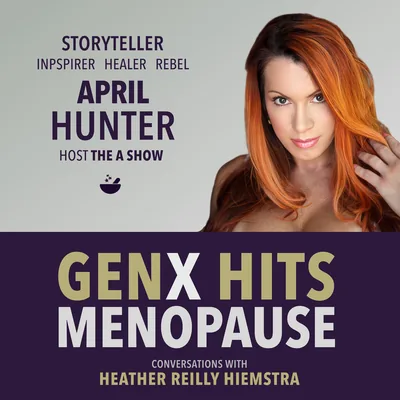
In “The Apothecary in Your Yard | Food, Trust & Going Rogue with April Hunter”, host Heather Reilly Hiemstra sits down with April Hunter — a model, professional wrestler, author and podcast host based in the Tampa Bay area — for a conversation about The Food Has Changed, The Apothecary in Your Yard, Connection and Longevity, America Through Visitors’ Eyes and Going Rogue with April Hunter.
On this page
Heather Reilly Hiemstra sits down with April Hunter — pro wrestler, model, writer and host of The A Show — for an unscripted conversation that goes wherever it needs to. From World Cup visitors rewriting what they’d heard about America to the weeds we pull from our own lawns, April keeps returning to one idea: much of what keeps us well has been within reach all along.
If you’ve ever wondered why food you’ve eaten for decades doesn’t sit the same way, or why the people who live longest seem to laugh the most, this one’s for you. Two Gen X women, no script, and a running argument about what belongs in a 2026 time capsule.
Conversations include:
- The Food Has Changed Why “I haven’t changed a thing” may not mean the food hasn’t — April on reformulated household brands, and Heather on the ketchup label that made her look twice.
- The Apothecary in Your Yard Dandelion, milk thistle and stinging nettle: the plants we mow down, and the old folk tradition of using what grows outside the back door.
- Connection and Longevity What Blue Zones communities have in common beyond the menu — laughter, daily movement and an in-person circle of people.
- America Through Visitors’ Eyes Scottish fans in kilts singing “Pretty Woman” in Boston, chips that arrive before you pay, a first plate of Texas barbecue — World Cup travelers on the country they found.
- Going Rogue with April Hunter The first woman to wrestle for TNA, twelve-plus Playboy rejections before a friend’s referral, and the lesson she kept from it: take nothing personally.
Tune in for two Gen X women trading stories, laughing a lot, and reminding each other that knowing how your own body works is still the best place to start.
About April Hunter
April Hunter is a model, professional wrestler, author and podcast host based in the Tampa Bay area. A 1999 Playboy special edition, landed after more than a dozen rejections, opened the door to wrestling: she worked WCW as a valet with the nWo, trained under Killer Kowalski, became the first woman to wrestle for TNA and the first to hold a men’s tag-team title.
She holds a degree in Creative Writing for Entertainment from Full Sail University and writes short stories, thrillers, television scripts and comic books, among them her own series Code Red and the children’s book Monty, A Tale of No Tail. She keeps a homestead garden, fosters rescue dogs and works the comic-con circuit.
April hosts The A Show, live on Tuesday nights on Twitch and YouTube, where Heather was her guest earlier this year. Here the two trade chairs.
Episode Highlights
Why the FDA’s Name Tells You Everything
“Our food is embedded with our medical system. So that’s why we are the only country who has normalized having a food and drug administration. That is just weird. Food and drugs together. It’s in our best interest as a for-profit healthcare system to make our people sick and to send them into the medical system because it’s very, very profitable. If you look at the version of the foods that we send overseas, it’s different than the version we feed our own people. Because a lot of the stuff we feed our own people is completely banned in over 200 other countries. But we’re feeding it to our kids like it’s nothing.”
Your Yard Is an Apothecary You Were Trained to Kill
“I have a theory that we have been given the tools — the fuel — to heal ourselves quite often. They have trained us to put chemicals all over our lawn. They’ve indoctrinated us that a green lawn is a showpiece. So now we’re growing grass instead of food. But when you have a yard full of weeds, those weeds are an apothecary — dandelions and milk thistle and all these things actually have real properties. So we’ve taken stinging nettle, we’ve taken all these things out of our yards that now we have to go see doctors for.”
When Crisis Cracks Everything Open
“I’ve always felt really lucky that I had cancer at the age that I did because it forced a lot of questions for me. And I think that COVID did that for the world. And what we’re experiencing right now is cracking so many systems and structures just wide the fuck open. And there’s no going back now.”
Connection Is Medicine: The 50% Survival Finding
“We can fall victim to the anger and the manipulation, or we can choose to live our lives to the best of our ability while we’re here on this earth. Everything’s a choice. And it’s all so much about connection — because research suggests that strong social connection may increase your odds of survival by as much as 50%. That’s a real finding, and it matters.”
FAQs
Who is April Hunter and why is she on a menopause podcast?
April Hunter is a pro wrestler, model, writer, and podcast host best known as the first woman to wrestle for TNA Impact and a 1999 Playboy special edition — but she’s on Gen X Hits Menopause because host Heather Reilly Hiemstra wanted an unscripted conversation with someone who has a real finger on the pulse of what midlife women are actually talking about. Hunter hosts The A Show live on Twitch and YouTube, where Heather had previously been a guest. In this episode the two trade chairs and go wherever the conversation leads — food, longevity, self-healing, and a spirited debate about what belongs in a 2026 time capsule.
Why does food I’ve eaten for years suddenly feel like it’s making me gain weight or feel worse in midlife?
April Hunter’s answer is direct: the food changed, not you. She explains that major household brands have quietly reformulated products — swapping higher-quality proteins for cheaper fillers, extending shelf life, and cutting costs — so the thing on the shelf today is not what you bought a decade ago. Heather backs this up with a personal example, noting that Heinz ketchup now contains high-fructose corn syrup where the old recipe did not, a shift that started in the 1980s. The practical takeaway: start reading current ingredient labels on products you consider staples, even ones you’ve trusted for years.
What common backyard weeds actually have health or medicinal benefits?
Dandelion, milk thistle, and stinging nettle are plants April Hunter calls “an apothecary in your yard” — ones most people mow down without realizing their traditional uses. She specifically mentions stinging nettle as a folk remedy for pain and arthritis, describing a technique of tapping the plant directly against the affected skin. Heather notes that dandelion greens are edible and that she collects them during visits to North Carolina where they grow freely. The takeaway: before pulling a “weed,” look it up — several of the most common ones have documented folk and herbal uses that predate the products now sold to replace them.
What do Blue Zone communities actually have in common when it comes to living past 100?
Blue Zone centenarians share strong in-person social networks, regular movement woven into daily life, and frequent laughter — and their diets are often less pristine than people assume. Both Heather and April note that some Blue Zone populations drink wine regularly and eat dessert, yet connection and socializing appear to matter more than any single food choice. Heather cites a study she read that day showing social connection increases longevity odds by 50 percent, and April argues the real number may be even higher once you account for everything the Blue Zone data shows. The practical takeaway: prioritize an in-person social circle and daily movement at least as much as you prioritize what’s on your plate.
What is the endocannabinoid system and why does Heather bring it up in a conversation about laughing and healing?
The endocannabinoid system (ECS) is the body’s internal signaling network that Heather references as one of the systems activated when we laugh, dance, sing, or experience pleasure — producing what she calls “our own dopamine that’s not artificial.” She mentions it in the context of a broader conversation about how the body manufactures its own healing chemistry, noting that molecular biologists and researchers in her network are actively trying to design studies that can rigorously prove what many people already feel: that joy-based activities have measurable physiological effects. The takeaway is a question worth sitting with — activities that activate the ECS and reward pathways may be doing more therapeutic work than they get credit for, and the science to confirm it is still catching up.