
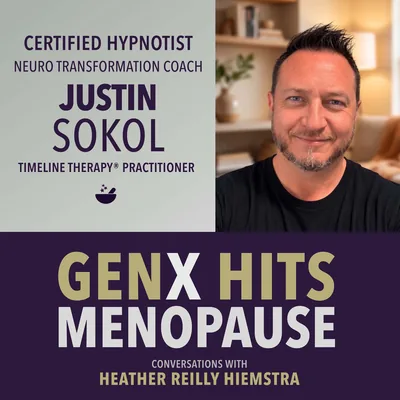
In “The Alarm Is Lying | Clearing Trauma’s Charge at the Subconscious Level”, host Heather Reilly Hiemstra sits down with Justin Sokol — a Neuro Transformation Coach, Timeline Therapy® Practitioner, and Certified Hypnotist who works with people who have already done the work — therapy, coaching, all the books — and still get hijacked by the same one or two things — for a conversation about Managed vs. Resolved, Memory Reconsolidation: The Science of Rewriting Reactions, The Alarm Is Lying, Step Zero: The Three-Breath Reset and Which Version of You Is Making This Decision?.
On this page
- About Justin Sokol
- Episode Highlights
- Managed vs. Resolved: Clearing the Charge Instead
- Why Insight Alone Can’t Stop a Triggered Brain
- Memory Reconsolidation: The Science of Rewriting Reactions
- The Alarm Is Lying: Old Wiring in a New House
- You Can’t Think Your Way Out of a Subconscious Pattern
- Share this episode
Heather sits down with neuro-transformation coach and Timeline Therapy® practitioner Justin Sokol to ask the question midlife keeps forcing: what if the problem isn’t that you haven’t done enough work on yourself — it’s that you’re running new software on a system that was never updated? Justin’s work doesn’t operate at the level of behavior or insight. It goes to the layer where the reaction was encoded, long before the conscious mind even gets a vote. For women navigating the emotional volatility, relational friction, and identity shifts that come with perimenopause and midlife, that distinction is everything.
If your mood, your relationships, or your sense of self keep getting hijacked by the same one or two things — no matter how much therapy, coaching, or self-help you’ve absorbed — this conversation is your next move.
Conversations include:
- Managed vs. Resolved Most approaches work at the level of behavior and insight — and they help. But Justin’s work targets where the reaction was originally encoded: the subconscious prediction engine that matches first and gives you a vote later. The result isn’t a better coping strategy. It’s the trigger losing its charge entirely.
- Memory Reconsolidation: The Science of Rewriting Reactions When an encoded memory is reactivated, a brief window opens where what the brain built from that event — the meaning, the emotional charge — can be updated. Drawing on Karim Nader’s lab research, Justin explains how guided recall under light hypnosis can access that window so that Timeline Therapy® can clear the six root negative emotions in sequence, from anger down to shame, and cascade the change forward across your entire timeline.
- The Alarm Is Lying Your nervous system is still wired to the house you grew up in. When a partner goes quiet, a tone shifts, or sirens sound in the distance, the alarm fires — and it fires hard. Justin’s fire-alarm metaphor lands the core insight: the work isn’t to silence the alarm. It’s to stop treating the alarm as proof that there is a fire.
- Step Zero: The Three-Breath Reset Before any protocol, any parenting step, any hard conversation — there is a physiological fact you can use right now. You cannot be in a panic response and perform diaphragmatic breathing simultaneously. Justin’s three-breath reset (in through the nose, hold, exhale longer than the inhale) changes your state before your story has a chance to write itself.
- Which Version of You Is Making This Decision? The identity edit isn’t about becoming someone new. It’s about asking, in the moment: is it the version of me that everything happened to — or the one who survived it and has a future? That single question, paired with rating the moment against your reaction, is the entry point to everything Justin teaches.
Tune in to find out why you can’t think your way out of patterns that were never created by thinking — and what it actually looks like to stop managing your triggers and start clearing them.
About Justin Sokol
Justin Sokol is a Neuro Transformation Coach, Timeline Therapy® Practitioner, and Certified Hypnotist who works with people who have already done the work — therapy, coaching, all the books — and still get hijacked by the same one or two things. Most approaches work at the level of behavior and insight. His work goes to the layer where the reaction was encoded, beneath conscious reasoning, installed long before the moments it now hijacks. The result isn’t a better strategy deployed faster. It’s the trigger losing its charge.
The Identity Edit Intensive is his primary private engagement for leaders, physicians, executives, attorneys, and high-performing professionals. He is also the author of The Grounded Heart Method™, which brings the same subconscious-level work to parents who want to stop passing down what was passed to them.
Justin holds a Bachelor of Music in Jazz Performance and a Master of Arts in Teaching, teaches and consults on curriculum, and is a professional drummer. He serves as a Global Ambassador for the Parenting 2.0 Global Initiative, and lives in Northern California with his wife — a surgeon — and their three daughters. Find him and the Identity Edit assessment at justinsokol.com/start.
Episode Highlights
Managed vs. Resolved: Clearing the Charge Instead
“I came into this work because I could explain my reactions, but they were still happening. And they were still affecting the people I loved in a negative way and myself. So rather than more strategies to manage my past trauma — failed relationships, intense betrayal — I came into a way to make everything lose its charge. What if you could just learn to clear the trauma’s charge so that you didn’t have to manage it anymore?”
Why Insight Alone Can’t Stop a Triggered Brain
“Your brain isn’t reacting to what’s happening in that moment — or it’s not only reacting to what’s happening. It’s reacting to what it predicts is about to happen based on what it already learned. And it matches first and then you kind of get a vote later. That’s why insight isn’t enough. The insight is great, but it really just gives you a better seat to the show, right? It doesn’t really change the show that’s happening.”
Memory Reconsolidation: The Science of Rewriting Reactions
“Kareem Nader’s lab found that when an encoded memory is reactivated, it opens a brief window where what the brain built from it — the meaning and the charge — can be updated if it meets a direct contradiction inside that window. Researchers believe this same window may be accessible through guided recall techniques, though the clinical evidence is still developing. So when you recall a traumatic event and you sit with it, and then you ask your subconscious mind, what do I need to learn from this in order to let this go? That may update the memory’s emotional charge — what researchers call reconsolidation. The event never changes, but what the brain built from that event can.”
The Alarm Is Lying: Old Wiring in a New House
“The alarm is lying. It detected something that matched the conditions it was designed to detect. The mistake happens when we assume the alarm itself is proof of danger. That’s what can happen with old emotional programming. Maybe somebody’s tone changes and your alarm says, I’m about to be rejected. Maybe your partner gets quiet and it says, I’m being abandoned. Or somebody criticizes you and suddenly your system says, I’m not good enough. Those alarms may have been calibrated during experiences where those predictions were absolutely reasonable and correct. But now you’re in a different house, so the work isn’t to shut off the alarm. It’s to stop treating the alarm as evidence that there is a fire.”
You Can’t Think Your Way Out of a Subconscious Pattern
“You can’t think your way out of patterns that were never created by thinking. All of those well-intended conscious self-help things that you’ve been doing are great, but you’re trying to run them on a system that’s not updated.”
Share this episode
Know someone who needs this conversation right now? Send them this episode — and tag us @genxhitsmenopause so we can amplify right back.
FAQs
What is memory reconsolidation and can it actually change how you react to old trauma?
Memory reconsolidation is a neuroscience process where recalling an encoded memory opens a brief window in which the brain’s meaning and emotional charge from that event can be updated — without the original event changing. Justin Sokol cites Karim Nader’s lab research, explaining that “when an encoded memory is reactivated, it opens a brief window where what the brain built from it — the meaning and the charge — can be updated if it meets a direct contradiction inside that window.” In practice, Justin uses guided recall under light hypnosis to access that window, then works through six root negative emotions in sequence — anger, sadness, fear, hurt, guilt, and shame — so the change cascades forward across your entire timeline. The takeaway: insight alone gives you a better seat to the show; reconsolidation actually changes the show.
Why do I keep getting triggered the same way even after years of therapy and self-help?
The reason the same triggers keep firing is that most therapy and self-help works at the level of conscious behavior and insight, but your reactions were encoded at the subconscious level — where the brain matches a prediction and fires a response before your conscious mind even gets a vote. Justin Sokol puts it plainly: “You can’t think your way out of patterns that were never created by thinking.” He uses the metaphor of trying to install the latest software on an iPhone 10 — the new programs won’t run because the underlying system was never updated. The practical entry point is rating the triggering moment on a scale of 1–10, then rating your reaction: if the moment is a 4 and your reaction is a 9, that extra 5 “came with you” and points to subconscious material that can be cleared, not just managed.
What is Justin Sokol’s Identity Edit Intensive and who is it for?
The Identity Edit Intensive is Justin Sokol’s primary private one-on-one engagement designed for people who have already done significant therapy, coaching, or self-help work and still find themselves hijacked by the same reactions. It uses Timeline Therapy® and light hypnosis to go to the subconscious layer where emotional charge was originally encoded, with the goal of clearing triggers entirely rather than developing better strategies to manage them. It’s built for high-performing professionals — leaders, physicians, executives, attorneys — as well as anyone in midlife who is tired of managing old patterns instead of resolving them. You can take an assessment to see if it’s a fit at justinsokol.com/start.
What is the three-breath reset and does diaphragmatic breathing actually stop a panic response?
Yes — it is physiologically impossible to be in a panic response and perform diaphragmatic breathing at the same time, which means breathing is the fastest tool available to change your state when triggered. Justin Sokol’s three-breath reset is: inhale through the nose for four counts, hold for two counts or longer, then exhale through the mouth with the exhale lasting longer than the inhale — repeated three times. He calls this “Step Zero,” the regulation step that has to happen before any parenting protocol, hard conversation, or relational repair can actually land. Use it the moment you feel yourself activating, before your story has a chance to write itself.
How do you tell in the moment whether your emotional reaction is about what’s actually happening or about old trauma?
Justin Sokol offers two quick checks: first, ask yourself whether this feels like an alarm (something is genuinely unsafe right now) or an ache (this feels older than today — the past is in the room). Second, ask “which version of me is making this decision — the one these things happened to, or the one who survived and has a future?” His fire-alarm metaphor captures the core issue: your nervous system may be calibrated to a house you no longer live in, so when a partner goes quiet or a tone shifts, the alarm fires as if there’s a fire — but the alarm detecting smoke is not proof that there is one. The work, as Justin says, “isn’t to shut off the alarm — it’s to stop treating the alarm as evidence that there is a fire.”