
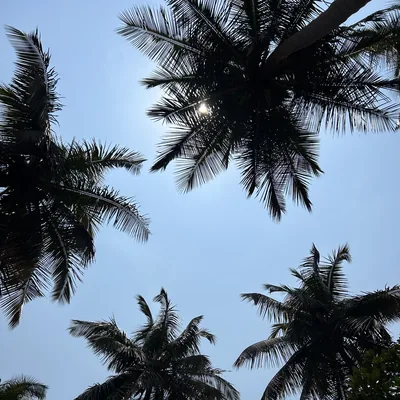
The Indian nut.
In the sixth century an Alexandrian merchant who had become a monk, Cosmas, known later as Indicopleustes, "the India-sailor", wrote down what he had seen of the trade to India. Among the pepper vine and the other wonders is a tree that bears argellia, "that is, the large Indian nuts."[1]
It "differs nothing from the date-palm," he says, "except that it is of greater height and thickness and has larger fronds." It carries two or three flower-spathes, each bearing three nuts. The nut "is at first full of a very sweet water which the Indians drink, using it instead of wine." The taste, he says, is "sweet and very pleasant, like that of green nuts." He gives the drink a name, rhongcosura, and his nineteenth-century editor, quoting the geographer Henry Yule, suspects he has mixed up the nut's water with the toddy tapped from the palm, which the Malabar coast called sura; the first half of the word may be lanha, the local name for a nut ripe but still soft.[1]
This entry is about the part of the coconut made to keep.
On this page
Water that turns to flesh.
He also describes what happens to a nut that is kept. "If the fruit is gathered ripe and kept, then the water gradually turns solid on the shell, while the water left in the middle remains fluid." And if it is kept too long, "the concretion on the shell becomes rancid and unfit to be eaten."[1]
He is describing the white flesh forming from the water, and the flesh is where the oil is. He is also describing the oil's old problem: it spoils.
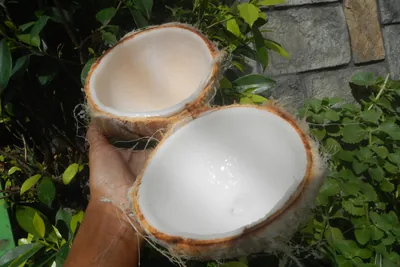
Two coconuts, two oceans.
The coconut was, in one team's words, "a portable source of food, water, fuel, and construction materials," and it travelled with people. In 2011 a group led from the Australian National University genotyped 1,322 coconuts from around the tropics at ten genetic markers. They fell into two genetically distinct groups, one belonging to the Pacific and one to the Indian and Atlantic Oceans. The authors proposed two separate origins of coconut cultivation: island Southeast Asia, and the southern margins of the Indian subcontinent.[2] Cosmas's Indian nuts belonged to the second.
The fruit itself tells the same story. Botanists have long recognised two forms, named after Polynesian varieties. The niu kafa form is oblong and triangular, with a thick fibrous husk, and it is read as the older shape, built to float. The niu vai form is round, often brightly coloured, and full of water, and it is read as the shape people selected. Growers also sort palms into tall and dwarf. Dwarf palms, self-pollination and the niu vai fruit, the clearest marks of human selection, all arose only in the Pacific.[2]
The two groups meet in the southwestern Indian Ocean. Pacific coconuts reached Madagascar along the ancient Austronesian trade route from Southeast Asia, and later Arab trade along the East African coast mixed them again. In the study's samples, the coconuts of the Comoros and Madagascar carry both ancestries, and those on the Pacific coast of Panama are almost wholly Pacific.[2] The coconut in a bottle of body oil has, in its ancestry, two oceans and two sets of sailors.

What fractionation keeps.
Whole coconut oil is a mix of fats of different chain lengths. Fractionated coconut oil is the medium-chain part: triglycerides, glycerol carrying fatty acids eight and ten carbons long, caprylic and capric acid. Medium-chain triglycerides occur naturally in coconut oil, palm kernel oil and milk fat, and they are also made by joining those fatty acids to glycerol directly.[3] In industry that second route is common: caprylic and capric acids are esterified with glycerol, chemically or with enzymes, to give a high-purity oil.[4] On an ingredient list either one is named caprylic/capric triglyceride.
What matters on skin is the shape of the molecule. The chains are short and fully saturated. With no double bonds in them, they give air little to react with, so the oil keeps far better than the flesh Cosmas watched turn. It stays liquid, clear and nearly odourless. It carries the botanicals dissolved in it and stays out of their way, which is the whole job of a base.
A different oil from the famous one.
The coconut study most often quoted for skin was a double-blind trial in 117 children that used virgin coconut oil, the whole oil, applied for eight weeks and compared with mineral oil. Water loss through the skin fell from 26.68 to 7.09 on the virgin oil, and the skin's measured hydration rose from 32.0 to 42.3.[5] That is a real result for a different material. Virgin coconut oil keeps its long-chain fats, lauric acid above all, and fractionated oil largely does not. The two share a tree, not a composition, and what one does is not evidence for the other.
The same caution applies to a claim often made for fractionated oil, that it does not clog pores. The scores behind that claim come from a model in which substances are applied to the ears of rabbits for two weeks and the follicles examined. Its 1979 version was checked against the older method on sixteen materials and agreed well, but it remains a rabbit's ear.[6] It is an animal assay, and the scores it gives are guides, not measurements of human skin. This entry makes no such claim until the human evidence is read.
Gentle by design.
Medium-chain triglycerides are generally recognised as safe as food ingredients in the United States, and in Europe and Japan they are used in medical nutrition.[4] On skin, fractionated coconut is bland: no fragrance of its own, and little for air to change. Anyone with a known coconut allergy should still patch test first.
"…the coconut… played a fundamental role in human migrations and the development of civilization across the humid tropics."
References
- [1] Cosmas Indicopleustes. The Christian Topography of Cosmas, an Egyptian Monk. McCrindle JW (tr.). London: Hakluyt Society, 1897, Book XI, pp. 362–363 ("Argellia"). ↩
- [2] Gunn BF, Baudouin L, Olsen KM. Independent origins of cultivated coconut (Cocos nucifera L.) in the Old World tropics. PLoS One. 2011;6(6):e21143. PMID 21731660 · doi:10.1371/journal.pone.0021143 ↩
- [3] Jadhav HB, Annapure US. Triglycerides of medium-chain fatty acids: a concise review. J Food Sci Technol. 2023;60(8):2143–2152. PMID 35761969 · doi:10.1007/s13197-022-05499-w ↩
- [4] Heidt C, Oertling H, Abramowicz M, et al. Medium-chain triglycerides: scientific and regulatory perspectives from Germany and Japan with a US context — a concise review. Nutrients. 2026;18(7):1027. PMID 41978079 · doi:10.3390/nu18071027 ↩
- [5] Evangelista MT, et al. The effect of topical virgin coconut oil on SCORAD index, transepidermal water loss, and skin capacitance in mild to moderate pediatric atopic dermatitis: a randomized, double-blind, clinical trial. Int J Dermatol. 2014;53(1):100–108. PMID 24320105 · doi:10.1111/ijd.12339 ↩
- [6] Kligman AM, Kwong T. An improved rabbit ear model for assessing comedogenic substances. Br J Dermatol. 1979;100(6):699–702. PMID 157151 · doi:10.1111/j.1365-2133.1979.tb08075.x ↩
FAQs
What is fractionated coconut oil?
It is the medium-chain part of coconut oil: triglycerides of caprylic and capric acids, listed as caprylic/capric triglyceride. It stays liquid, clear and nearly odourless.
Why use fractionated coconut oil as a base?
Its short, saturated fatty-acid chains give air little to react with, so it keeps well, and it carries other botanicals without adding a scent of its own.
Is fractionated coconut oil the same as virgin coconut oil?
No. Virgin coconut oil keeps its long-chain fats, especially lauric acid. Most of those are removed from, or never part of, the medium-chain oil, so research on virgin coconut oil does not apply to it.
Does fractionated coconut oil clog pores?
It is widely described as non-comedogenic, but the scores behind that description come from an animal test, not from human skin, and we do not make that claim here.
Where do coconuts come from?
Genetic work points to two origins of cultivation: island Southeast Asia and southern India. Sailors carried coconuts across the Indian Ocean long before modern trade.
Which Rockstar products contain fractionated coconut?
It is the base of Rockstar Woman, Rockstar Woman Hemp Free and Rockstar Man.