
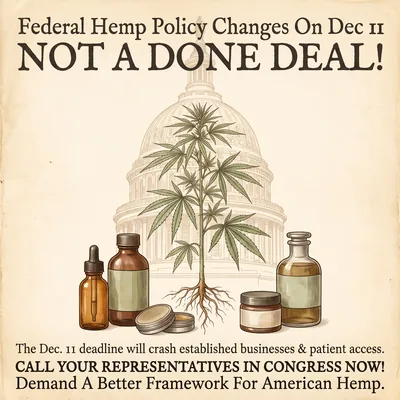
Without intervention, federal hemp law changes scheduled to take place on December 11, 2026 will shutter much of the hemp-derived cannabinoid market built since the 2018 farm bill. The new rules were written to block unregulated intoxicating gummies and drinks [1] , but also applies to topicals and low-dose tinctures that are mostly not intoxicating at all [2][3][4].
Executives value that market at $28 billion [5], and an industry-commissioned study puts as many as 226,000 jobs at risk [6]. December 11 is also the day government funding runs out [7], so the spending bill Congress must pass before then is a real leverage point to change the rule before it takes effect.
On November 17, two senators, one from each party, filed a bill to replace the cap with testing, labels and an age limit [8]. Congress has until December 11 to pass that bill; this page dives into what's going on, what's at stake and what you can do to support a more sensible regulatory framework for hemp products instead.
On this page
What's the problem?
The people who wrote the rule were answering a real problem. A bipartisan coalition of 39 state and territorial attorneys general asked Congress in October 2025 to stop the sale of intoxicating hemp products [9]. Alcohol producers' trade groups asked it to "act immediately to remove hemp-derived THC products from the marketplace until a robust federal regulatory framework is established" [10]. The U.S. Cannabis Council, a marijuana trade group, spent $100,000 lobbying on the issue in 2024 and urged Congress to "close the loophole" [11]. Their concern, as the Congressional Research Service summarizes it, is intoxicating cannabinoids sold as gummies, drinks and candies, some in packages that resemble snack foods [1].
Keeping intoxicants away from children is a goal few people dispute, but most of the products the rule blocks are not part of that problem.
The fix, Section 781 of a 2025 spending law, measures the wrong thing. It judges a finished product by how much THC its whole container holds, whatever the product's strength.
Hemp itself is still judged by strength: the plant may hold no more than 0.3% total THC, now including THCA, on a dry weight basis, and an extract no more than 0.3% of THC and THC-like cannabinoids combined [12]. But now, a finished product must also hold no more than 0.4 milligrams of THC and similar cannabinoids in its container [12].
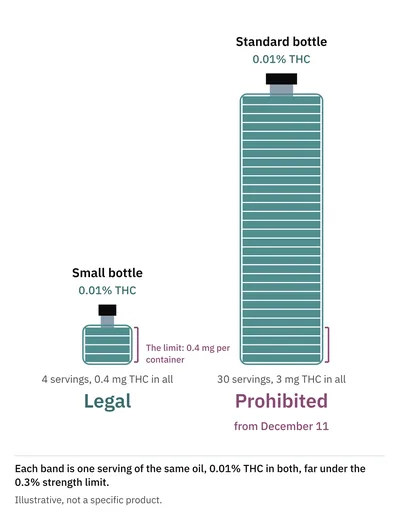
This change never reconciles the two. Picture a full-spectrum oil with 0.1 milligram of THC in each serving, far weaker than the 0.3% limit the law sets for the plant and for an extract. A small bottle of four servings is hemp. A standard bottle of 30 servings, the same product at the same strength, holds 3 milligrams and is not.
So the exact same product can be legal in production, illegal in a large consumer container, and legal in a smaller container - all at the same time.
Same oil, same strength: about 0.01% THC, far below the 0.3% limit for the plant and for an extract; 0.1 milligram of THC a serving. Four servings in a small bottle, 0.4 milligrams in all, meet the new limit per container and stay legal. Thirty servings in a standard bottle, 3 milligrams in all, are prohibited from December 11. Illustrative, not a specific product. Source: Public Law 119-37, Division B, Section 781; Public Law 119-103, Section 2019.
Further, the products caught this way are mostly not intoxicating.
A tincture at 0.1 milligram of THC a serving carries a thirtieth of the 3 milligrams a serving that a Medicare program lets care organizations give patients in hemp products [13], and a fiftieth of the 5 milligrams a serving that H.R. 7212 would set as a fallback limit for products taken by mouth [14]. Pure cannabidiol, the main cannabinoid in most of them, was not found to have any psychoactive properties by the World Health Organization's drug-dependence experts [4]. The container cap catches full-spectrum products for their trace THC.
Many wellness products are being restricted by a solution to a problem they do not cause.
The container, not the serving, is now the unit. The statute defines it as "the innermost wrapping, packaging, or vessel in direct contact with a final hemp-derived cannabinoid product in which the final hemp-derived cannabinoid product is enclosed for retail sale to consumers" [12]. One 30-milliliter bottle holding 3 milligrams of THC is not legal; on the statute's words, the same oil divided among eight small vials, each under 0.4 milligrams, would be. A rule that a smaller bottle satisfies does not measure what a person takes. The Food and Drug Administration (FDA) has not yet said more about what a container is [1].
The rule also ignores the route.
It covers products used "through any means of application or administration, such as inhalation, ingestion, or topical application" [12], so a topical oil is counted like a gummy.
In one controlled study at Johns Hopkins, 46 healthy adults applied one of five commercial hemp topicals, or a placebo, twice a day for nine days; THC and its metabolites stayed below the limit of detection in blood for every product, though nine participants showed THC in oral fluid at or above the federal workplace threshold [2].
In an earlier study, three volunteers applied two THC salves every two to four hours for three days, and every blood and urine sample tested negative [3].
A transdermal system built to carry cannabinoids through the skin is the exception: after a single application of 100 milligrams of THC, it reached the blood in 18 healthy adults, though with no psychoactive effects reported [15].
And no one has explained the new limiting number. No hearing, report or published draft we could find gives a reason for 0.4 milligrams or names who chose it. Lobbying filings only show money spent on an issue, not authors of changes [11].
How we got here.
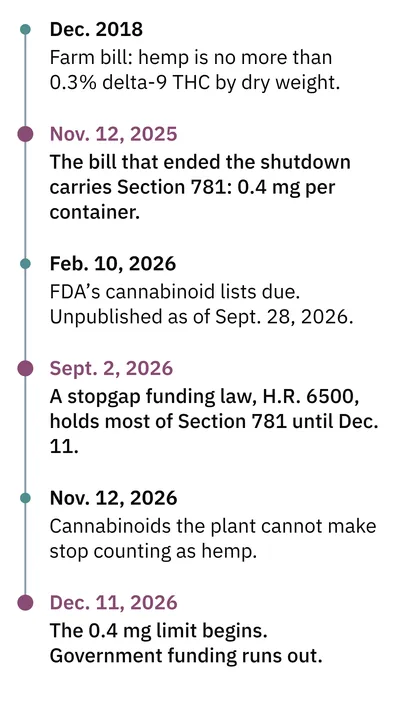
The 2018 farm bill defined hemp as cannabis with no more than 0.3% delta-9 THC by dry weight [1]. It was a number written for a field crop, and the same percentage applied to every derivative and extract made from it, which left room. Gummies, drinks and candies followed [1], and the market grew outside the state systems that license marijuana [16].
That definition measured one molecule, and only as a share of dry weight [1]. Three ways around it opened, and each was argued to be legal on the face of the text.
The first was weight. The limit is a percentage, not an amount, so "beverages or snacks could meet that threshold and still contain more than enough THC to get people high" [16]. A five-gram gummy at 0.3% delta-9 THC holds 15 milligrams, three times the 5 milligrams per serving that a pending House bill, H.R. 7212, sets as a fallback limit for products taken by mouth [14]. A heavier gummy holds more.
The second was the acid. THCA, the acid form of THC, is not named in the 2018 definition, and it "only turns into impairing delta-9 when heated or burned" [16]. Flower rich in THCA could pass as hemp and be smoked as marijuana.
The third was conversion. Hemp holds very little delta-8 THC, so concentrated delta-8 is typically made from cannabidiol extracted from hemp, with added chemicals, and the FDA warned that manufacturers were "packaging and labeling these products in ways that may appeal to children" [17]. In 2022, a federal appeals court, ruling in a trademark case, held that the plain text of the farm bill made the delta-8 vaping products before it lawful, whatever the manufacturing method, and handed the problem back: "If Boyd Street is correct, and Congress inadvertently created a loophole legalizing vaping products containing delta-8 THC, then it is for Congress to fix its mistake" [18].
One early attempt to close that gap came as a farm bill amendment from Representative Mary Miller of Illinois, adopted in the House Agriculture Committee's markup on May 23, 2024 [11]. Smart Approaches to Marijuana Action spent $120,000 supporting it in the first half of that year [11].
The change became law another way: as a rider, a policy provision carried inside a spending bill. In the fall of 2025 the federal government went through the longest shutdown in its history. The bill that reopened it, H.R. 5371 (Public Law 119-37), signed on November 12, 2025, also carried the year's agriculture budget, and inside that budget sat Section 781, the new definition of hemp [19][12]. Representative Andy Harris, who chairs the House subcommittee that writes the agriculture budget, helped write it with Senator Mitch McConnell [20]. In the Senate, an amendment from Senator Rand Paul to strike the hemp provision failed, 76 to 24 [21].
Section 781 is written to close all three ways around the 2018 law. It counts total THC, THCA included; it excludes cannabinoids the plant cannot make and those synthesized outside it; and for finished products it adds a fixed cap per container [12].
Section 781 gave the industry a year: it was set to take effect 365 days after enactment [19]. It also told the FDA to publish, within 90 days, lists of the cannabinoids the plant makes naturally and of those with THC-like effects, and to say more about what counts as a container. As of September 28, 2026, the Congressional Research Service reported that no such list had been published [1], and on November 12 Marijuana Moment reported that it still had not been issued [22].
Then a second spending law moved the date. On September 2, 2026, H.R. 6500, a stopgap that funds the government only through December 11, became Public Law 119-103. Its Section 2019 holds most of Section 781 back until that same day [23][22]. On August 8, the Senate voted 61 to 32 to set aside Senator Ted Budd's amendment to strip that delay [24]. One part was not held: since November 12, 2026, a product with cannabinoids the plant cannot make is no longer hemp [22]. Senators Tim Sheehy of Montana and Amy Klobuchar of Minnesota led the delay, and Roll Call reported that Harris would fight to undo it [20].
So the hemp deadline and the funding deadline are the same day. Congress must pass another spending law by the end of December 11, or the government shuts down on December 12 [7], and whatever it passes is the next chance to change, delay or keep the hemp rule. According to Foley Hoag, the White House's director of legislative affairs committed that there would be no further extension [25].
Who wants what.
The divide runs through both parties, and through the alcohol and cannabis industries themselves.
| Who | What they want now | On the record |
|---|---|---|
| Hemp Guardrails Act sponsors | Replace the cap with FDA rules by December 11 | Sens. Sheehy and Klobuchar, Nov. 17, 2026 [8] |
| U.S. Hemp Roundtable | The bill, or similar language, in the next spending bill | Marijuana Moment, Nov. 17, 2026 [26] |
| Wine & Spirits Wholesalers of America | National standards for hemp drinks, with states deciding how they are sold | Statement, Sept. 3, 2026 [27] |
| 35 attorneys general | Keep the 2025 definition as enacted | Letter to Congress, Aug. 2026 [28] |
| Alcohol producers | Remove the products until a framework exists | Trade groups' letter, Nov. 2025 [10]; their lobbyists urged attorneys general to sign a letter, per Politico [29] |
| American Trade Association for Cannabis and Hemp | No further delay | Agri-Pulse, Oct. 7, 2026 [30] |
| Sens. Ted Budd and Pete Ricketts | Block any funding bill that delays or regulates | Nov. 18, 2026 [31] |
| Rep. Andy Harris | Keep the rule he helped write | Roll Call, Aug. 2026 [20] |
| Reps. Morgan Griffith and Marc Veasey | FDA rules by route, H.R. 7212 | H.R. 7212, January 2026 [14]; Oct. 2026 [32] |
The alcohol industry is split: the producers want the products off shelves until federal rules exist, and the wholesalers who distribute their drinks want them regulated now [10][27]. Two cannabis trade groups have pressed to close the loophole: the U.S. Cannabis Council in 2024, and now the American Trade Association for Cannabis and Hemp, which says closing it puts intoxicating hemp products "in the same category as marijuana" [11][30].
The November 3 midterms held no statewide vote on hemp, and the only statewide cannabis measures on the ballot, which sought to roll back or restrict cannabis policy, failed [33]. In Massachusetts, about three in four voters rejected a measure to repeal legal adult-use marijuana sales, by unofficial results [34]. In Texas, Lieutenant Governor Dan Patrick, who led the state's push to crack down on THC products, lost to Vikki Goodwin, who made his THC position a central issue of her campaign [35]. In Kentucky, Representative Andy Barr, author of a House bill to keep regulated hemp products legal, won Senator McConnell's open seat; he takes office in January, after December 11 [36][30].
The polls point the same way, with a caution about who paid for them. Independent polls show broad support for legal cannabis, and Pew found 88% of adults favor legal medical use [37]. On hemp products specifically, the independent numbers are fewer. In Texas, the University of Texas's Texas Politics Project found 53% of voters opposed the state's 2025 THC ban and 31% supported it [38]. A national survey by Verasight, which funded it, found that 62% of adults do not use hemp THC products; asked where they would turn once the products were sold only in dispensaries, 16% said a dispensary and 9% informal or unregulated sources [39]. Polls paid for by interested parties report larger majorities, on questions they wrote. A poll for Hemp Industry & Farmers of America, a hemp industry group, found 72% of likely voters favor keeping hemp products legal under new safety and licensing rules, with 86% backing a minimum age of 21 [40]; a poll for Total Wine & More, an alcohol retailer whose customers have sent nearly 300,000 messages to Congress, reported 85% opposed to banning low-dose hemp drinks, without publishing its question [41].
Congress returned to the same divide. On November 17, Senators Sheehy and Klobuchar filed the Hemp Guardrails Act [8]. On November 18, Marijuana Moment reported that Senator Budd will not support any year-end package that "extends, delays, or builds a regulatory framework" for these products, and that Senator Pete Ricketts of Nebraska will oppose any bill that lets them stay on sale [31]. Representative James Comer of Kentucky said the best chance is "to get this on a bill that is going to pass" [26].
What the new bill would change.
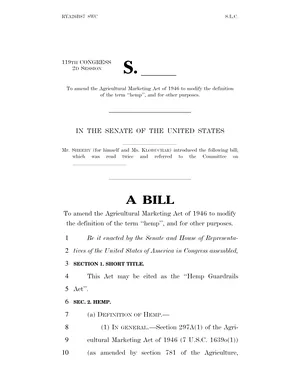
The Hemp Guardrails Act, as released on November 17, keeps the rule against cannabinoids the plant cannot make, drops the rule against those synthesized outside it, and replaces the container cap with a regulatory framework under the FDA [42]. It has no bill number in the released text yet, and it would take effect on December 11, 2026, the same day as the rule it replaces [42].
Read the bill as released: Hemp Guardrails Act, full text (PDF, 17 pages).
| What changes on December 11 | Section 781, as enacted | Hemp Guardrails Act, as proposed |
|---|---|---|
| THC test for hemp | 0.3% total THC, THCA included, by dry weight [12] | 1.0% total THC, THCA included, by dry weight [42] |
| Finished products | No more than 0.4 mg of THC and THC-like cannabinoids per container [12] | No per-container cap; no more than trace amounts of restricted cannabinoids [42] |
| Delta-8, delta-10, HHC, THC-O | Excluded if the plant cannot make them or they were synthesized outside it; otherwise counted toward the 0.4 mg cap [12] | Named as restricted cannabinoids [42] |
| Cannabidiol, cannabinol, cannabigerol and other non-intoxicating cannabinoids | Count toward the cap only if federal health officials find they have, or are marketed to have, THC-like effects [12] | Expressly not restricted [42] |
| Topicals | Counted like a gummy [12] | Covered like other hemp products: FDA packaging, labeling and testing rules, 21 and over, no per-container cap [42] |
| Age | No federal minimum | 21 to buy, possess or use [42] |
| Labels and testing | None set | Child-resistant packaging, a QR code to the certificate of analysis, third-party testing, manufacturing standards, within 180 days [42] |
| Supplements | No provision; the FDA has said no supplement pathway fits cannabidiol [43] | Products taken by mouth may be dietary supplements; cannabis-derived ingredients alone do not bar them [42] |
| Origin | No rule | Grown, processed and packaged in the United States [42] |
| Smokable flower | Measured by total THC, THCA included [12] | Barred from interstate commerce when sold for inhalation [42] |
| States | No new provision | May regulate more strictly, but may not block lawful products passing through [42] |
What the bill does not do is set a milligram limit of its own for delta-9 THC per serving. Read the way the 2018 limit was read, 1.0% by dry weight would let a five-gram gummy hold 50 milligrams; the bill answers intoxication with the age limit, child-resistant packaging, labels and testing, and sets no amount of its own [42]. That is the bill's open question, and it deserves an answer in the final text. A per-serving limit for products taken by mouth, of the kind H.R. 7212 sets as a fallback [14], would answer it without counting a skin oil like a gummy.
What's the fallout if Congress does nothing?
For businesses, the fallout is closures. Whitney Economics, in a study commissioned by the American Healthy Alternatives Association, surveyed 496 hemp businesses in 35 states: 68.1% expect to shut down entirely if the rules take effect as written. It estimates that between 188,961 and 225,861 workers would lose their jobs, with $7.5 billion to $8.9 billion in wages, and that annual industry revenue would fall by $35.1 billion to $41.3 billion [6]. For taxpayers, Whitney's own release projects $2.1 billion in lost state sales tax potential [44]. These are industry projections from a survey of operators; we found no independent or government estimate. Our October episode with Nick Steiner of CBDistillery walks through what the change means from inside the industry [45].
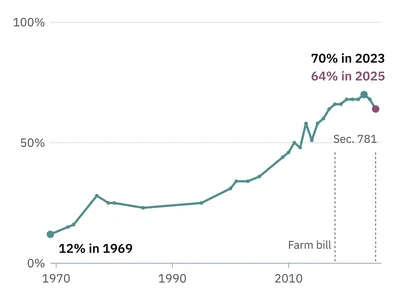
For consumers, the fallout is fewer choices, at a time when most Americans favor legal marijuana [46][47], and the choices that go first are the ones that were never intoxicating: the skin oil and the low-dose tincture.
Most Americans still favor legal marijuana.
These changes land more heavily on people who already have fewest options. In an online survey of 258 women in perimenopause and after menopause, most of them current cannabis users, 78.7% used medical cannabis for menopause symptoms, most often for sleep and for mood or anxiety, and most smoked it or ate it [48].
They reach for it inside a thin system. Of 177 U.S. residents in family medicine, internal medicine, and obstetrics and gynecology, 6.8% felt adequately prepared to manage menopause [49]. The clinical evidence on cannabis and menopause is thin [48], and across cannabis research the National Academies named one main reason: "the classification of cannabis as a Schedule I substance" was among the barriers that "impede the advancement of cannabis and cannabinoid research" [50].
And cost already stands between people and their medicine: 43% of adults say they did not take a medicine as prescribed in the past year because of cost [51].
Meanwhile, federal hemp policy is moving in two directions at once.
In April 2026, the Drug Enforcement Administration moved marijuana in FDA-approved drugs and marijuana sold under state medical licenses from Schedule I to Schedule III; other marijuana stays in Schedule I, and a broader rescheduling is still under review [52].
In December 2025, an executive order on medical marijuana and cannabidiol research warned that under the new definition some full-spectrum products "will once again be controlled as marijuana," and directed the White House's legislative office to "work with the Congress to update the statutory definition of final hemp-derived cannabinoid products" [53].
Since April 2026, a Medicare innovation incentive has let participating care organizations give eligible patients up to $500 a year of hemp products with no more than 0.3% delta-9 THC and no more than 3 milligrams of THC per serving for products taken by mouth; Medicare does not pay for the products [13]. Three milligrams, that program's limit for one serving, is seven and a half containers' worth under Section 781!
The FDA's own position, from January 2023, is that neither the food nor the supplement rules fit cannabidiol and that a new pathway is needed [43]; no pathway exists yet. So after December 11, the cannabis products a woman can buy outside a licensed dispensary narrow sharply, and the licensed route depends on where she lives.
Who to call.
Congress can still change the rule, and it has to vote on a spending bill by December 11. Your representative and your two senators are the three votes you can reach. Opponents have already said they will try to keep any fix out of that bill [31], so the fix needs people asking for it.
Start with your own members. The House looks up your representative by ZIP code, and the Capitol switchboard, (202) 224-3121, connects you to any House or Senate office [54][55]. A call is short. Give your name and ZIP code, so the office counts you as a constituent, then:
What to say: "I'm a constituent calling about the federal hemp rule that takes effect December 11. I'm asking the senator (or the representative) to fix it in the December funding bill: support the Hemp Guardrails Act or a bill like it, and if that can't pass in time, a delay until Congress writes rules that fit. Keep these products away from kids, test them and label them, but don't take a skin oil or a tincture away from the adults who use them. Thank you."
If you use a hemp product, say what it is and what it does for you, in a sentence. If you would rather write, the same words work by email through each member's website [55]. Then tell two people who use these products to do the same.
If your senator sits on the Appropriations subcommittee that writes the agriculture budget, your call carries further: Senator John Hoeven of North Dakota chairs it, and Senator Jeanne Shaheen of New Hampshire is its ranking member [56]. Representative Andy Harris chairs the House subcommittee [20]. Senators Sheehy and Klobuchar introduced the bill [8], and Representatives Griffith and Veasey introduced H.R. 7212 [14]; a thank-you to their offices counts too.
Our position: we are for sensible legislation that keeps intoxicants from anyone under 21, and from anyone who does not want them without a medical recommendation. We are for purity, testing and the ethical commercialization of cannabis products, because we believe in their therapeutic potential, on the strength of centuries of practical human experience. A rule that measures the bottle instead of the dose, and counts a skin oil like a gummy, reaches far past those ends.
The people who wrote the rule and the people who fought it agree on one point: the market needed rules. The next three weeks decide which ones.
Frequently Asked Questions.
Why is federal hemp law changing on December 11?
Did any of the hemp rule already take effect?
Yes. Since November 12, 2026, products with cannabinoids the hemp plant cannot make are no longer hemp under federal law. The 0.4 milligram per-container limit and the rest of Section 781 begin December 11 [23].
Does the December 11 hemp rule apply to topicals?
Yes. The statute covers hemp-derived cannabinoid products used "through any means of application or administration, such as inhalation, ingestion, or topical application," and caps a finished product at 0.4 milligrams of total THC and THC-like cannabinoids combined per container [12]. The Hemp Guardrails Act would remove the cap and bring topicals, like other hemp products, under FDA packaging, labeling and testing rules [42].
What is the Hemp Guardrails Act?
Senators Tim Sheehy and Amy Klobuchar filed it on November 17, 2026. From December 11, 2026, it would raise the hemp threshold to 1.0% total THC by dry weight, replace the 0.4 milligram container cap with a limit of trace amounts on intoxicating cannabinoids such as delta-8 and HHC, and set a minimum age of 21; the FDA would then have 180 days to set packaging, labeling and testing rules [8][42].
Who wrote the hemp THC limit?
Roll Call reports that Representative Andy Harris and Senator Mitch McConnell helped write it into the 2025 spending law [20]. An earlier attempt to redefine hemp by total THC came from Representative Mary Miller's 2024 farm bill amendment [11]. The public record we could find does not show who chose the 0.4 milligram figure.
Can Congress still change it?
How do I call my representative about the hemp rule?
References.
- [1] Congressional Research Service. Changes to the statutory definition of hemp and implications for agricultural policy (IF13136). Updated September 28, 2026 ↩
- [2] Zamarripa CA, et al. Pharmacokinetics and pharmacodynamics of five distinct commercially available hemp-derived topical cannabidiol products. J Anal Toxicol. 2024;48(2):81-98 ↩
- [3] Hess C, Krämer M, Madea B. Topical application of THC containing products is not able to cause positive cannabinoid finding in blood or urine. Forensic Sci Int. 2017;272:68-71 ↩
- [4] World Health Organization. News briefing: 40th WHO Expert Committee on Drug Dependence (ECDD). September 13, 2018 ↩
- [5] Fountain L. Congressional hemp restrictions threaten $28 billion industry, sending companies scrambling. CNBC; November 13, 2025 ↩
- [6] Whitney Economics' 2026 U.S. Hemp Cannabinoid Report, commissioned by the American Healthy Alternatives Association, as reported in: New report finds federal hemp restrictions could close 68% of U.S. businesses and displace up to 226,000 workers. The Marijuana Herald; September 8, 2026 ↩
- [7] Congressional Research Service. Overview of continuing appropriations for FY2027 (Division A of P.L. 119-103) (R49353). September 17, 2026 ↩
- [8] Office of Senator Amy Klobuchar. Klobuchar, Sheehy introduce bipartisan legislation to address federal hemp ban, protect consumers. November 17, 2026 ↩
- [9] Office of the Illinois Attorney General. Attorney General Raoul urges Congress to prevent the sale of dangerous and intoxicating hemp-derived THC products. October 27, 2025 ↩
- [10] Pull hemp-THC products from sale, US bev-alc groups urge Congress. Just Drinks; November 6, 2025 ↩
- [11] Witley S. Lobbyists fight to restrain, back $28 billion hemp industry. Bloomberg Government; September 26, 2024 ↩
- [12] Public Law 119-37, Division B, Section 781 (H.R. 5371). Approved November 12, 2025 ↩
- [13] Centers for Medicare & Medicaid Services, Innovation Center. Substance Access Beneficiary Engagement Incentive. Last modified March 20, 2026 ↩
- [14] H.R. 7212, Hemp Enforcement, Modernization, and Protection Act (introduced January 22, 2026) ↩
- [15] Varadi G, Zhu Z, Crowley HD, et al. Examining the systemic bioavailability of cannabidiol and tetrahydrocannabinol from a novel transdermal delivery system in healthy adults. Adv Ther. 2023;40(1):282-293 ↩
- [16] Johnson G. A $28 billion hemp THC industry is fighting to save itself from a looming federal ban. Associated Press, via PBS NewsHour; October 3, 2026 ↩
- [17] U.S. Food and Drug Administration. 5 things to know about delta-8 tetrahydrocannabinol (delta-8 THC). Consumer update; content current as of May 4, 2022 ↩
- [18] AK Futures LLC v. Boyd Street Distro, LLC, No. 21-56133, 35 F.4th 682 (9th Cir. May 19, 2022) ↩
- [19] American Society of Addiction Medicine. Congress ends longest federal government shutdown in US history. November 13, 2025 ↩
- [20] Folley A. Stopgap funding bill's hemp troubles aren't over. Roll Call; August 24, 2026 ↩
- [21] Chipman K. Senate passes bill to end longest-ever U.S. shutdown; hemp restrictions affirmed. Agri-Pulse; November 10, 2025 ↩
- [22] Angell T. First phase of renewed federal hemp product ban takes effect as industry pushes Congress for regulatory alternative. Marijuana Moment; November 12, 2026 ↩
- [23] Public Law 119-103, Continuing Appropriations and Extensions Act, 2027, Section 2019 (H.R. 6500). Approved September 2, 2026 ↩
- [24] U.S. Senate. Roll call vote 227, 119th Congress, 2nd session: on the motion to table Budd amendment no. 6747. August 8, 2026 ↩
- [25] McQueeny M, Bartlett SL. A temporary reprieve for hemp-THC products… but what now? Foley Hoag, Cannabis and the Law; September 15, 2026 ↩
- [26] Angell T. Bipartisan senators file bill to keep hemp THC products federally legal as next month's scheduled ban looms. Marijuana Moment; November 17, 2026 ↩
- [27] Wine & Spirits Wholesalers of America. WSWA statement on President Trump signing hemp THC delay into law. September 3, 2026 ↩
- [28] Office of the Maryland Attorney General. Attorney General Brown joins bipartisan coalition urging Congress to preserve federal hemp reforms concerning intoxicating products. August 5, 2026 ↩
- [29] Alcohol lobbyists encouraged law enforcement officials to push for federal hemp crackdown, report says. Marijuana Moment; October 30, 2026 (summarizing Politico) ↩
- [30] Bridges OM. Many proposals in the race for hemp regulation. Agri-Pulse; October 7, 2026 ↩
- [31] Angell T. GOP senators say they'll try to block any government funding bill that keeps hemp THC products legal. Marijuana Moment; November 18, 2026 ↩
- [32] Angell T. Congress should put hemp THC product regulations into filibuster-proof reconciliation bill after elections, GOP lawmaker says. Marijuana Moment; October 27, 2026 ↩
- [33] Goldberg JA, Hart KA, Murphy KK. Holding the line: voters protect legal cannabis in the 2026 midterms as the next fight moves to statehouses. Arent Fox Schiff; November 9, 2026 ↩
- [34] NORML. Massachusetts voters overwhelmingly reject ballot proposal seeking to repeal marijuana legalization. November 4, 2026 (unofficial results, from the Associated Press) ↩
- [35] Yeomans M. Texas THC battle takes a turn after Vikki Goodwin defeats Dan Patrick. NBC DFW; November 5, 2026 ↩
- [36] Gregg J. Andy Barr wins Kentucky U.S. Senate race. Spectrum News 1; November 4, 2026 ↩
- [37] Cerda A, Gramlich J. 10 facts about Americans and marijuana. Pew Research Center; May 26, 2026 ↩
- [38] Serrano A. Majority of Texans oppose total THC ban like the one vetoed by Gov. Greg Abbott, poll finds. The Texas Tribune; June 25, 2025 (Texas Politics Project, University of Texas at Austin) ↩
- [39] Verasight. Most Americans don't use hemp-derived THC products. Verasight Client Omnibus Survey of 1,000 U.S. adults, March 6-16, 2026; accessed November 18, 2026 ↩
- [40] Three in four American voters want hemp to stay legal with enhanced regulations, poll finds. Marijuana Moment; October 16, 2025 (McLaughlin & Associates for Hemp Industry & Farmers of America) ↩
- [41] Total Wine & More. Total Wine & More CEO Ryan Ross and nearly 300,000 customers call for THC regulation, not prohibition, as new poll finds 85% of Americans oppose a ban. PR Newswire; November 11, 2026 ↩
- [42] Hemp Guardrails Act, bill text as released by Senators Sheehy and Klobuchar. November 17, 2026 ↩
- [43] U.S. Food and Drug Administration. FDA concludes that existing regulatory frameworks for foods and supplements are not appropriate for cannabidiol, will work with Congress on a new way forward. January 26, 2023 ↩
- [44] Whitney Economics. Whitney Economics releases U.S. Hemp Cannabinoid Report for 2026. September 9, 2026 ↩
- [45] Don't Panic! OneHemp and 2026 federal hemp law changes. GenX Hits Menopause, E36. Rockstar Blends; October 29, 2026 ↩
- [46] McCarthy J. Americans much more positive about progress on drugs. Gallup; November 5, 2025 ↩
- [47] U.S. public opinion about legalizing marijuana, 1969-2025 (source: Gallup). Pew Research Center; May 26, 2026 ↩
- [48] Dahlgren MK, El-Abboud C, Lambros AM, et al. A survey of medical cannabis use during perimenopause and postmenopause. Menopause. 2022;29(9):1028-1036 ↩
- [49] Kling JM, MacLaughlin KL, Schnatz PF, et al. Menopause management knowledge in postgraduate family medicine, internal medicine, and obstetrics and gynecology residents: a cross-sectional survey. Mayo Clin Proc. 2019;94(2):242-253 ↩
- [50] National Academies of Sciences, Engineering, and Medicine. The Health Effects of Cannabis and Cannabinoids. Washington, DC: National Academies Press; 2017. Chapter 15 ↩
- [51] KFF. Americans' challenges with health care costs. Updated October 23, 2026 ↩
- [52] High time for a change? Post-DEA hearing, broader marijuana rescheduling questions remain. Morgan Lewis; September 24, 2026 ↩
- [53] Executive Order 14370, Increasing Medical Marijuana and Cannabidiol Research. Federal Register; December 23, 2025 (FR Doc. 2025-23846) ↩
- [54] U.S. House of Representatives. Find your representative. Accessed November 18, 2026 ↩
- [55] U.S. Senate. Senators' contact information. Accessed November 18, 2026 ↩
- [56] U.S. Senate Committee on Appropriations. Subcommittee on Agriculture, Rural Development, Food and Drug Administration, and Related Agencies: members. Accessed November 3, 2026 ↩