
Older than Greece.
The Ebers papyrus, a medical scroll that Georg Ebers dated to between 1553 and 1550 BCE, gives castor a section of its own: a "Memorandum on the use of the castor oil tree, as found in the ancient writings of the wise men." Its stalk was rubbed in water and applied to a diseased head. And "the Oil from its Berries is pressed out as an Ointment", anointed "afresh daily in the morning" for ten days against a foul abscess.[4]
So the oldest record of castor oil describes the same act as the last: press the seed, and put the oil on skin.
On this page
Candles and plasters.
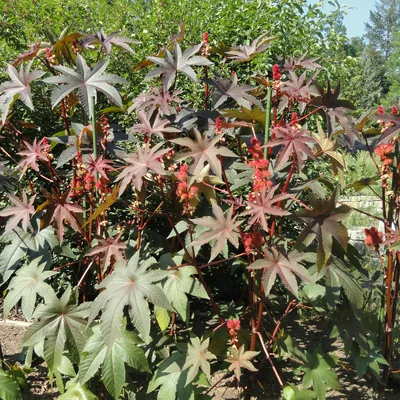
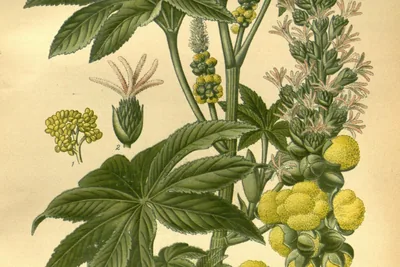
Dioscorides describes a small tree the height of a fig, with leaves like the plane tree's but larger, smoother and darker, and hollow, reed-like stems. The oil pressed from the seed "is not eaten but is useful for candles and plasters." The seed itself was a different matter. Thirty of them, crushed and drunk, made a purge that was "harsh and extremely drastic, overturning the stomach excessively."[1] The leaves, bruised with polenta flour, went on swollen eyes and on breasts swollen with milk. The seed was dangerous. The oil burned in lamps and went on the skin.
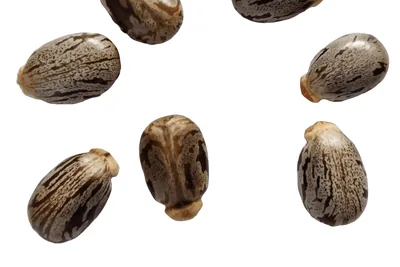
The Greeks named the plant kroton for the tick its seed resembles, and the Romans' ricinus, their word for the same tick, survives in the scientific name.[1]
The Egyptian way.
In a separate chapter on the oil, Dioscorides gives two methods. The Greek one dried the seeds in the sun, pounded the flesh in a mortar, boiled it in water, and skimmed off the oil that floated to the top. The seeds were ripe, he adds, once they had shed the small bladders that enfold them. "Because the Egyptians use it in great abundance they prepare it differently." They ground the seeds in a mill, threw the grounds into baskets, "and squeeze it out with a press."[2]
He lists what the oil was for: ulcers of the head, "parasitical skin diseases", inflammations of the perineum, scars, and earache, and it made plasters more effective.[2] The Egyptian press is the ancestor of the bottle. Cosmetic castor oil is still "produced by cold pressing the seeds", then clarified by heat.[3]
Out of East Africa.
In 2021 a group in Kunming assembled the genome of castor's wild ancestor and resequenced 505 accessions from around the world. The living wild progenitors are in East Africa, and the domestication of the crop dates to about 3,200 years ago. Wild populations in Kenya and Ethiopia split apart around 7,000 years ago, tracking a swing in the climate of the Turkana basin that likely squeezed the wild plant through a genetic bottleneck. The same study mapped genes behind the plant's shape and the size of its seed.[5]
That leaves a small and honest puzzle. The Ebers papyrus is older than that domestication date. The likeliest reading is that people used the plant, and pressed its seed, while it was still being made into a crop.
One unusual fatty acid.
In 2011 the United States Department of Agriculture screened every castor accession in its collection: 1,033 of them, from 48 countries. On average the seeds were 48.2 per cent oil, with a range from 37.2 to 60.6. And the oil was dominated by one fatty acid, ricinoleic acid, at 84.51 per cent. Linoleic, oleic, stearic and palmitic acids made up most of the rest.[6]
Ricinoleic acid carries an extra hydroxyl group partway along its chain, and that one feature makes castor oil unlike almost any other. It is why the oil is so thick, and why it sits on the skin the way it does. Castor is "currently the only commercial source of ricinoleic acid", which goes into some two thousand industrial products.[5] The same structure lets castor oil and ricinoleic acid help other molecules cross the skin, and although ricinoleic acid is built much like the signalling molecule prostaglandin E1, it does not act like one.[3]
The ricin question.
The seed carries ricin, one of the best-known plant toxins. The oil does not. The Cosmetic Ingredient Review's safety assessment says it in one line: "Castor oil does not contain ricin because ricin does not partition into the oil."[3] Ricin stays behind in the seed when the oil is pressed out. That is the whole answer to the first question most people ask about castor.

Like capsaicin, without the burn.
In 2000 a pharmacology group tested ricinoleic acid on the skin of mice and on the eyelids of guinea pigs. A single application made induced swelling worse. Applied daily for eight days, it did the opposite, and the swelling fell along with substance P, a nerve signal that drives it. The pattern resembled capsaicin, the heat in chilli, but ricinoleic acid caused none of capsaicin's redness or scratching. In a longer model, one to three weeks of treatment shrank swelling that was already established, though more so when it was injected into the skin than when it was applied to it. The authors called it a "capsaicin-like, non-pungent" candidate for use on skin.[7] That is animal work, and a clear direction.
Gentle, mostly.
The Cosmetic Ingredient Review's survey of human testing found castor oil "not a significant skin irritant, sensitizer, or photosensitizer." Positive reactions turned up mainly in people who already had occupational skin disease.[3] Castor oil was in 769 cosmetic products in 2002, at up to 81 per cent of a lipstick.[3] The reactions that are reported mostly involve lipstick, and cross-reactions between ricinoleic acid and similar ingredients.[8] Anyone with reactive skin should patch test first, as with any botanical.
"This study provides novel insights of domestication and genome evolution of castor bean, which facilitates genomics-based breeding of this important oilseed crop."
References
- [1] Dioscorides, De materia medica, Book IV, "Kroton e kiki" (named for the tick; the tree; oil for candles and plasters; the drastic purge of the seed). ch. 164, modern version Osbaldeston TA, Wood RPA, Ibidis Press, Johannesburg 2000, pp. 718–719. ↩
- [2] Dioscorides, De materia medica, Book I, "Kikinon elaion" (the Greek boiling method; the Egyptian mill and press; uses on skin). ch. 38, same edition, p. 37. ↩
- [3] Cosmetic Ingredient Review. Final report on the safety assessment of Ricinus communis (castor) seed oil, hydrogenated castor oil, glyceryl ricinoleate… Int J Toxicol. 2007;26 Suppl 3:31–77. PMID 18080873 · doi:10.1080/10915810701663150 ↩
- [4] Bryan CP (tr., from the German of H. Joachim). The Papyrus Ebers. London: Geoffrey Bles, 1930, p. 2 (the 1553–1550 BCE dating) and pp. 15–16 ("Memorandum on the use of the castor oil tree"). ↩
- [5] Xu W, Wu D, Yang T, et al. Genomic insights into the origin, domestication and genetic basis of agronomic traits of castor bean. Genome Biol. 2021;22(1):113. PMID 33874982 · doi:10.1186/s13059-021-02333-y ↩
- [6] Wang ML, Morris JB, Tonnis B, et al. Screening of the entire USDA castor germplasm collection for oil content and fatty acid composition for optimum biodiesel production. J Agric Food Chem. 2011;59(17):9250–9256. PMID 21838261 · doi:10.1021/jf202949v ↩
- [7] Vieira C, Evangelista S, Cirillo R, Lippi A, Maggi CA, Manzini S. Effect of ricinoleic acid in acute and subchronic experimental models of inflammation. Mediators Inflamm. 2000;9(5):223–228. PMID 11200362 · doi:10.1080/09629350020025737 ↩
- [8] Tan BB, Noble AL, Roberts ME, Lear JT, English JS. Allergic contact dermatitis from oleyl alcohol in lipstick cross-reacting with ricinoleic acid in castor oil and lanolin. Contact Dermatitis. 1997;37(1):41–42. PMID 9255492 · doi:10.1111/j.1600-0536.1997.tb00380.x ↩
FAQs
Does castor oil contain ricin?
No. Ricin is a protein that stays in the seed and the pressed seed cake; it does not pass into the oil. The Cosmetic Ingredient Review's safety assessment states it directly.
Why is castor oil so thick?
About 85 per cent of it is ricinoleic acid, an unusual fatty acid with an extra hydroxyl group on its chain. No other common oil is built like it.
How old is the use of castor oil?
The Ebers papyrus, dated to about 1550 BCE, describes pressing the oil from the seeds as an ointment. Dioscorides, in the first century, describes the Egyptian press.
Where does the name Ricinus come from?
The Greek kroton and the Latin ricinus both named the plant after the tick its seed resembles.
Is castor oil gentle on skin?
In human testing reviewed by the Cosmetic Ingredient Review it was not a significant irritant or sensitiser, though reactions do occur, mostly in people with existing skin conditions. Patch test first if your skin is reactive.
Which Rockstar products contain castor oil?
Castor oil is part of the base of Face & Body Entourage and Face & Body Original.