No Stone Unturned | Bone Density at Every Age | GenX Hits Menopause E28

Table of Contents

Spotify

Apple

Audible
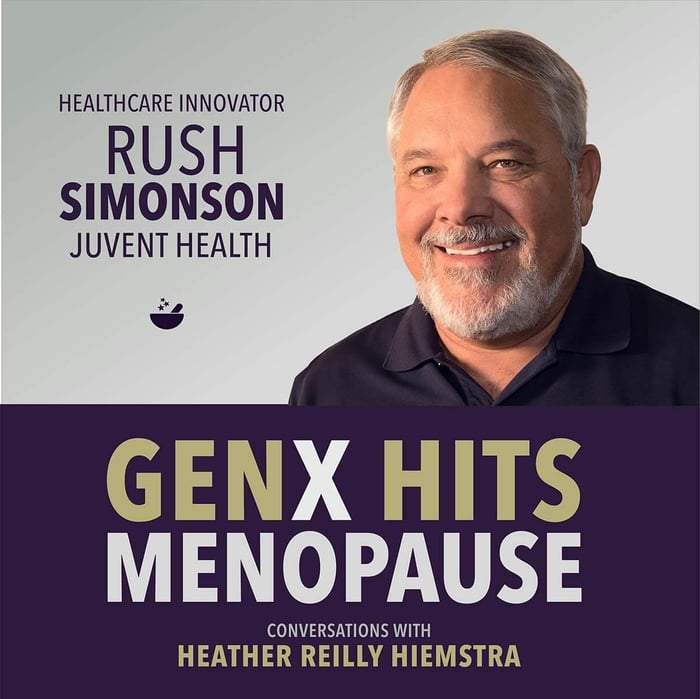 Heather Reilly Hiemstra has always loved rocks — and it turns out the most important ones are the ones you’re built on. In this episode, she sits down with Rush Simonson, founding CEO of Juvent, a 25-year pioneer in regenerative medicine and bone science, to make the case that bone density is not a passive number on a lab report — it’s a living, remodeling biomarker that GenX women can actively rebuild starting today.
If your last doctor’s visit left you with more dread than direction — or if you’ve never been told that your skeleton from 10 years ago is already gone and replaced — this conversation hands you a real program, not a prescription for helplessness.
Conversations include:
- The Bone Bank Why your body treats your skeleton as a strategic calcium reserve — raiding it to keep your heart beating when dietary calcium runs low — and what that slow withdrawal costs you over a perimenopause and menopause transition.
- Mechano-Transduction & the Micro-Impact Gap The field most doctors never mention: how the pressure wave from a barefoot heel-strike signals bone to rebuild itself — and why modern running shoes are quietly turning you into an astronaut losing 1–2% bone mineral density per month.
- Juvent: LMMS vs. the Shake Plate How Juvent’s low-magnitude mechanical stimulation platform delivers the physiologic equivalent of two to five miles of barefoot walking in 10–20 minutes, and why the St. Jude clinical trial showed an 11% improvement in tibial bone mineral density in a single year.
- Estrogen, Bioidentical HRT & the Demonization Problem Rush’s clinical case for why estrogen remains one of the most protective hormones in the female body — for bone, brain, and cardiovascular health — and why women who’ve been scared off bioidentical hormone therapy need a second conversation with a better-informed clinician.
- Calcium, Estrogen Mimics & the Supplement Trap Which forms of calcium are actually bioavailable (hint: not calcium carbonate), why plastics and phthalates hijack your estrogen receptor sites before real estrogen can, and what a “vitamin holiday” can tell you about which supplements you actually need.
Tune in to get your action plan: get your DEXA scan in your 40s, walk barefoot or in minimalist shoes, pull estrogen mimics out of your kitchen and your cosmetics bag — and remember that the skeleton you have today is not the one you had 10 years ago. It is rebuilding right now. Work with it.
About Rush Simonson
Rush Simonson is the founding CEO and Chairman of Juvent, makers of a clinically validated resonant micro-impact platform shown to produce an 11% improvement in bone mineral density in a single year across multiple trials, including research out of St. Jude Children’s Research Hospital. Juvent is a corporate roundtable member of the Bone Health and Osteoporosis Foundation.
Simonson’s career spans regenerative medicine, proteomics, spinal surgery, and finance. He founded one of the first regenerative medicine clinics in the United States and built Cytonics Corporation — drawing scientists from Stanford, the University of Pittsburgh, and Scripps — to identify the protein mechanism behind joint and back pain, work that led to a Johnson & Johnson acquisition and an FDA Phase 2 drug candidate. He also grew a spinal implant company to a Medtronic exit, holds three U.S. patents, and co-founded a hedge fund with Ken Griffin of Citadel before transitioning fully into medical science.
For this conversation, Simonson brings his operating-room perspective — including what surgeons call “jelly spines” — alongside a message of genuine regenerative hope for midlife women navigating menopause-related bone loss.
Episode Highlights
Too Often Diagnosed Too Late
“Too often poor bone health is diagnosed for the first time in the emergency room when there’s a fragility fracture.”
The Skeleton You Have Today
“The skeleton you have today isn’t the one you had 10 years ago — it’s constantly in a state of remodeling. As long as you’re doing the right things, it’s going to get healthy.”
The Astronaut Problem
“A lot of people that are running regularly and even walking regularly think they’re getting enough impact. But if you’re walking in running shoes, then you’re essentially insulating yourself from that critical micro impact. And we like to say you’re turning yourself into an astronaut — and we know what happens to astronauts in space. They lose 1 to 2% of their bone mineral density per month.”
Cold Dead Hands
“I’m a colon cancer survivor. So I have people who I’ll meet with who’ll be like, oh, when they hear that I have kefir or yogurt almost every single day — and you can take it out of my cold dead hands because I know that it works for me.”
Don’t Feel Helpless
“Don’t get this feeling of helplessness and hopelessness. I do talk to a lot of ladies unfortunately that feel helpless because even their doctors haven’t been encouraging — which is really sad. It is absolutely essential that you get that DEXA scan done to know where you are, and then sit down with a practitioner and design a healing program so that you can regenerate your bones.”
Share this episode
Know someone who brushes off bone density as “an old lady problem” — or a friend who walked out of a doctor’s office with more fear than a plan? Send them this episode. The rocks you’re built on are rebuilding right now, and so are theirs.
FAQs
Who is Rush Simonson and what is Juvent?
Rush Simonson is the founding CEO and Chairman of Juvent, a clinically validated resonant micro-impact platform with 25 years of experience in regenerative medicine and bone science. His background spans spinal surgery, proteomics, and regenerative medicine, including founding one of the first regenerative medicine clinics in the U.S. Juvent's low-magnitude mechanical stimulation (LMMS) platform showed an 11% improvement in tibial bone mineral density in a single year in a St. Jude clinical trial. Hear Rush describe what he saw firsthand in operating rooms, including what surgeons call "jelly spines", early in the episode.
Can you actually rebuild bone density after menopause or is the loss permanent?
Bone loss after menopause is not permanent — the skeleton is constantly remodeling and can respond to the right interventions. Simonson states that women managing their endocrine system, diet, and supplementation properly while using micro-impact stimulation can see roughly a 6% improvement in bone density per year. He emphasizes getting a DEXA scan in your 40s as a baseline, then rescanning after menopause to track changes rather than assume the worst. "The skeleton you have today isn't the one you had 10 years ago" so starting action now has real measurable impact.
What is mechano-transduction and why do running shoes hurt your bone density?
Mechano-transduction is the process by which pressure waves – generated when your heel strikes the ground — trigger receptors on cell walls to signal bone to strengthen itself. Simonson explains that cushioned running shoes insulate your bones from this critical micro-impact, essentially putting you in the same situation as an astronaut in space, where bone mineral density drops 1-2% per month. He recommends transitioning gradually to barefoot-style or leather sandal footwear, and practicing heel drops — rising onto the ball of your foot then dropping gently onto your heel — as a simple daily habit to stimulate bone production.
How do plastics and phthalates affect estrogen and bone density in perimenopausal women?
Phthalates, bisphenols, and other estrogen-mimicking compounds found in plastics bind to the same cellular receptor sites as real estrogen, blocking the hormone from doing its protective work on bone, brain, and cardiovascular tissue. Simonson specifically calls out microwaving food in plastic bags, microwave popcorn packaging, and plastic-heavy cosmetics as high-exposure sources. He recommends using the Environmental Working Group (EWG) database to vet personal care products, switching to glass containers for microwave cooking, and prioritizing organic food to reduce overall estrogen-mimic load. The practical next step: check your cosmetics and kitchen habits against EWG.org before your next shopping trip.