
Where it was written down.
Sea buckthorn's firm record is in Asia. It is formally recorded in the rGyud-bzhi, the Four Medical Tantras that found Tibetan medicine, and in other canonical pharmacopoeias of the region.[2] The date of that text is argued over, and this entry leaves it unargued; the use it records is not in doubt.
It ranges from the alpine Himalaya through China and Russia to the boreal north of Europe and America, and it is a hard plant for hard ground. Its roots host Frankia bacteria that fix nitrogen from the air, so it builds the soil it grows in.[2] China plants it on a vast scale against erosion and desert: the plantations at Ordos alone, according to one review, keep four and a half million tons of sediment a year out of the Yellow River.[2]
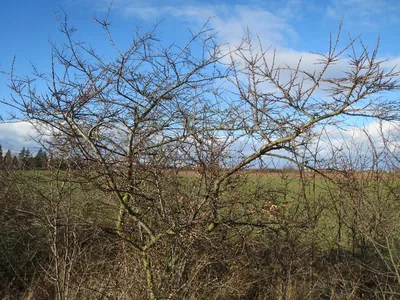
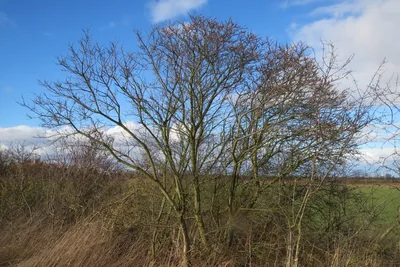
In winter it is a tangle of bare, spined branches; the orange comes in autumn, packed tight along the stems.
On this page
A shrub for the fuller.
Dioscorides has a hippophaes, and part of it fits. It is the plant fullers used in finishing cloth — the one "with which they tread or beat cloth to thicken it" — and it "grows in sandy maritime places": a thick, spriggy shrub spreading on every side, "with long leaves similar to those of the olive, but narrower and softer," its flowers like clusters of berries.[1]
Then the fit breaks. His hippophaes has a thick, soft root full of bitter liquid, dried and given in grains as a violent purge, and in the next chapter he admits that people give the same name to a different, ground-hugging plant as well.[1]
The genus name Linnaeus gave the plant is that Greek word. The silver, olive-narrow leaf on sandy coasts suits sea buckthorn well. The purging root does not. The name is ancient; whether the plant is, in the Greek record, is an open question.
Two oils from one berry.
The berry is two materials, and it gives two oils.
In 2001 two Finnish food chemists compared berries of two subspecies from different origins. The seed oil was dominated by the two polyunsaturated fatty acids, linoleic and α-linolenic, which together made up about seventy per cent of it. The oil from the pulp and peel was something else. Its signature is palmitoleic acid, an omega-7, which made up between twelve and thirty-nine per cent of the pulp oil — and was "practically absent" from the seed.[3]
Their numbers also varied by subspecies. The European rhamnoides berries carried more oil in every part than the Chinese sinensis berries — 11.3 per cent of the seed against 7.3 — and more palmitoleic acid; the Chinese seeds carried a little more linoleic and less α-linolenic.[3] "Sea buckthorn oil", said without qualification, could mean any of these. And the plant's polyphenols sit mostly in its leaves, which carry more of them than the berries do — a third material, and not the one in the bottle.[2]
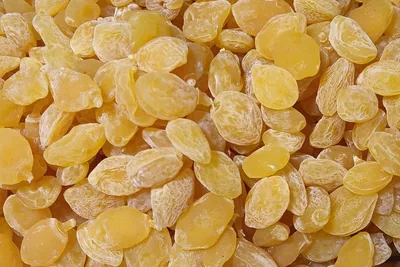
The pulp oil is the orange one, dense with carotenoids. It stains skin and cloth a deep orange, which is part of why it goes into a blend in small measure rather than on its own.
In rats, twice.
The animal work comes largely from one Indian defence research laboratory in Delhi. In 2006 it put a 1 per cent sea buckthorn flavone on full-thickness wounds in rats, against the vehicle alone; the treated wounds closed faster and grew new skin over in 16.3 days against 24.8, with more collagen in the new tissue, more glutathione and less lipid peroxide — the tissue's own antioxidant balance shifted.[4] In 2009 the same group tried a CO2-extracted seed oil on burns, and the oil beat both the untreated control and a standard silver-sulfadiazine dressing on the markers of repair, and oral toxicity tests at the same time found no adverse effects.[5]
The second study gave the oil by mouth and on the skin at once, so it cannot say which route did the work. Both are rats. Neither is a person.
The trial everyone quotes was swallowed.
The strongest sea buckthorn trial is not topical. In 2014 a group in Turku — including the two chemists who had mapped the oil — gave 116 postmenopausal women with vaginal dryness, itching or burning either 3 grams of sea buckthorn oil a day, in capsules, or a placebo oil, for three months. Among everyone randomised, the integrity of the vaginal lining got better at a faster rate on sea buckthorn; among only those who took every dose, the difference was a trend. A gynaecologist scored each woman at the start and end, pH and moisture were measured, and blood was checked for lipids, liver enzymes and C-reactive protein along the way.[6]
It is a real result for women after menopause, and it was a capsule, taken daily. It says nothing about oil on skin.
On skin, a small trial.
In 2014 a pharmacy group in Pakistan gave thirteen healthy young men an oil-in-water emulsion with 5 per cent sea buckthorn extract, or the same base without it, to apply for eighty-four days without being told which they had. Instruments measured the water in their skin and the water escaping through it. Against the base, the extract cream came with more water held and less lost, throughout the course.[7] The second number is the one that speaks to the barrier: water escaping through the skin is how dermatologists read whether the outer layer is holding.
Thirteen men, one laboratory, an extract rather than the oil — and a direction worth following.
"H. rhamnoides has been widely applied in soil erosion control and desertification prevention in China."
References
- [1] Dioscorides, De materia medica, Book IV, "Ippophaes" and "Ippophaiston" (the fuller's shrub of sandy coasts; the purging root; the name shared). chs. 162–163 in Goodyer's English (1655), modern version Osbaldeston TA, Wood RPA, Ibidis Press, Johannesburg 2000, pp. 716–718. ↩
- [2] Liu M, Yu T, Nurlan U, Wu Z, Zhao J. Ethnopharmacology, phytochemistry, and pharmacology of sea buckthorn (Hippophae rhamnoides L.): a comprehensive review. Front Pharmacol. 2026;17:1759697. doi:10.3389/fphar.2026.1759697 ↩
- [3] Yang B, Kallio HP. Fatty acid composition of lipids in sea buckthorn (Hippophaë rhamnoides L.) berries of different origins. J Agric Food Chem. 2001;49(4):1939–1947. PMID 11308350 · doi:10.1021/jf001059s ↩
- [4] Gupta A, Kumar R, Pal K, Singh V, Banerjee PK, Sawhney RC. Influence of sea buckthorn (Hippophae rhamnoides L.) flavone on dermal wound healing in rats. Mol Cell Biochem. 2006;290(1-2):193–198. PMID 16633732 · doi:10.1007/s11010-006-9187-6 ↩
- [5] Upadhyay NK, Kumar R, Mandotra SK, et al. Safety and healing efficacy of Sea buckthorn (Hippophae rhamnoides L.) seed oil on burn wounds in rats. Food Chem Toxicol. 2009;47(6):1146–1153. PMID 19425187 · doi:10.1016/j.fct.2009.02.002 ↩
- [6] Larmo PS, Yang B, Hyssälä J, Kallio HP, Erkkola R. Effects of sea buckthorn oil intake on vaginal atrophy in postmenopausal women: a randomized, double-blind, placebo-controlled study. Maturitas. 2014;79(3):316–321. PMID 25104582 · doi:10.1016/j.maturitas.2014.07.010 ↩
- [7] Khan BA, Akhtar N. Hippophae rhamnoides oil-in-water (O/W) emulsion improves barrier function in healthy human subjects. Pak J Pharm Sci. 2014;27(6):1919–1922. PMID 25362595 ↩
FAQs
What is the difference between sea buckthorn seed oil and berry oil?
They are different oils. Seed oil is mostly linoleic and α-linolenic acids. The oil from the pulp and peel is rich in palmitoleic acid, an omega-7, which is practically absent from the seed.
Why is sea buckthorn oil orange?
The pulp oil is dense with carotenoids, the same family of pigments that colours carrots. It can stain skin and fabric.
Is there research on sea buckthorn and skin?
A small 2014 study had thirteen healthy men use a cream with sea buckthorn extract for twelve weeks. Their skin held more water and lost less than with the plain cream. It is a small study, and of an extract rather than the oil.
Is the sea buckthorn menopause research about oil on skin?
The best-known trial gave sea buckthorn oil capsules by mouth to postmenopausal women for three months and found changes in the vaginal lining compared with placebo. That was oral. No such claim is made for oil applied to skin or for these blends.
How long has sea buckthorn been used?
It is recorded in the Four Medical Tantras, the founding text of Tibetan medicine, and in other traditional pharmacopoeias of Asia.
Which Rockstar products contain sea buckthorn?
It is in the Entourage Roll On in a small measure, and in Face & Body Entourage and Face & Body Original.