
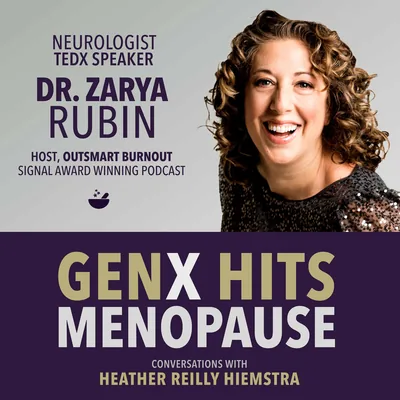
In “No Dress Rehearsal | Burnout, Perimenopause, and the Perfect Storm”, host Heather Reilly Hiemstra sits down with Dr. Zarya Rubin — a Harvard-educated neurologist, certified burnout expert, and TEDx speaker whose work centers on helping high-achieving women lead and thrive without destroying themselves in the process — for a conversation about The Perfect Storm on the HPA Axis, The Check Engine Light We Keep Ignoring, No Dress Rehearsal, Do One Thing Less and Recharge at the Start, Not the End.
On this page
Heather Reilly Hiemstra sits down with Harvard-educated neurologist and burnout expert Dr. Zarya Rubin — a former child actor, Carnegie Hall soprano, and TEDx speaker who burned out of medicine and rebuilt her life from the nervous system up. The central insight lands hard: perimenopause doesn’t just hijack your hormones, it rewires your entire stress axis, lowering the trigger threshold, amplifying the response, and lengthening the recovery window until the smallest stressor feels catastrophic.
If your mood, sleep, or resilience have been quietly unraveling since your mid-thirties — and you’ve been duct-taping over the check engine light — this conversation was made for you.
Conversations include:
- The Perfect Storm on the HPA Axis When estrogen and progesterone start their perimenopause free-fall, the hypothalamic-pituitary-adrenal stress axis pays the price — less of a trigger produces more of a response with a longer recovery. Dr. Rubin maps exactly why midlife women hit burnout harder, faster, and from directions they never saw coming.
- The Check Engine Light We Keep Ignoring Burnout rarely announces itself; it flickers on and off for months before going red and steady. Dr. Rubin’s signature analogy — and the duct-tape move we all make instead of pulling over — reframes every vague symptom from headaches and insomnia to TMJ and acid reflux as data worth reading.
- No Dress Rehearsal A shocking personal loss at 35 cracked Dr. Rubin’s drive-at-all-costs fog wide open. She shares the Turkish proverb that finally helped her leave medicine — no matter how far you’ve gone down the wrong road, turn back — and what it costs when we wait for a catastrophic wake-up call instead of acting on the early flickers.
- Do One Thing Less The deceptively simple center of Dr. Rubin’s TEDx talk: Gen X women are perpetually picking up the last cup on the table until all the dishes crash. She walks through how to delete, delay, and delegate — and why rest is not something we have to earn before we’re allowed to feel it.
- Recharge at the Start, Not the End Waiting to rest until after the holidays, after the deadline, after the kids leave is like charging an electric car at the destination instead of along the route. Dr. Rubin and Heather trade hard-won lessons about presence, the empty-nest reckoning, and what we’ll actually remember.
Tune in to catch your own check engine light before it goes red — and learn to manage your stress axis, your hormonal shifts, and your relentless drive as a single, interconnected system worth protecting.
About Dr. Zarya Rubin
Dr. Zarya Rubin is a Harvard-educated neurologist, certified burnout expert, and TEDx speaker whose work centers on helping high-achieving women lead and thrive without destroying themselves in the process. She is the host of Outsmart Burnout, winner of a Signal Award Gold for Best Self-Help Podcast, and runs coaching programs and a community for women in demanding careers.
Her path to this work is anything but linear. Born into a family of performing artists, she trained as a child actor and opera singer, performing at Carnegie Hall and Lincoln Center before pivoting to medicine — a career she built out of a desire for stability, then ultimately left after burning out during her fellowship. That crisis sent her back to her training in neurology and toward a new mission: helping women recognize the physiological and psychological signs of burnout before a catastrophic wake-up call does it for them.
Dr. Rubin brings a rare combination of clinical rigor and lived experience to this conversation, including her own perimenopause journey, the hormonal science behind why midlife women are uniquely vulnerable to burnout, and her personal framework for rebuilding a life the nervous system can actually sustain. After a 30-year hiatus, she is also relaunching a professional voice acting career — proof that it is never too late to turn back.
Episode Highlights
Perimenopause and the Burnout Perfect Storm
“Something really fascinating happens when we start to go through perimenopause, we have these hormonal fluctuations. You’ve got estrogen and progesterone going up and down crazy and plummeting. And it really does a number on the stress axis, so the HPA axis, which is really what controls our stress response. But when you throw perimenopause into the mix, well, what happens? It takes much less to activate the system. So lower stress stressors, lower thresholds for stress activation. The reaction or the response is exaggerated. So smaller stressor, bigger response. And then the feedback is impaired. So the time that it takes to recover is longer. So you’ve got less of a trigger, more of a response, longer recovery. It’s kind of the perfect storm for burnout.”
The Check Engine Light We Keep Ignoring
“You’re driving in your car and the check engine light comes on, right? And that’s like a little warning and it might just flicker on for a second and you might miss it or you might see it out of the corner of your eye and think, oh, what was that? That was weird. Oh, well, it’s gone now. And then you keep driving. And the check engine light comes on again. This time, maybe it stays on for a little bit longer. And then it flickers off again and you think, oh, well, that was probably nothing. And you keep driving. And then the light comes on. But this time it stays on. And it doesn’t flicker off. It doesn’t flash. It is red and illuminated. And it’s in your field of vision. And you think, Oh, now I need to do something about this. I know. I’ll take some duct tape and tape over there. And that is what we are doing with burnout and we have to pay attention to that check engine light.”
No Dress Rehearsal for Your Life
“This is not a dress rehearsal. This is the show. This is your life. And you might not get more chances. And so how can I continue down a path that is this self-destructive and is making me this miserable? And I think it was finally, finally, the brutal wake up call that I needed to snap out of my burnout fog and my incessant drive to keep going at all costs.”
Catching Burnout Before the Crisis
“Burnout is not your destiny. It’s your wake up call. My goal and my mission is to really try to educate and inform and to help people maybe recognize the signs a bit earlier. So it doesn’t take something as dramatic, as profound, as life changing as this critical catastrophic wake up call. Like maybe we can start paying attention sooner and make the necessary changes.”
The Cost of Achievement Culture
“in order to succeed, in order to achieve, you need to work yourself to the bone, and you need to sacrifice yourself at the altar of achievement. I don’t think that in the end that’s going to serve us. And so hopefully these future generations, I’m going to see my daughters generation change the world in a way that doesn’t burn themselves out in the process.”
Share this episode
Know someone who needs this conversation right now? Send them this episode — and tag us @genxhitsmenopause so we can amplify right back.
FAQs
Who is Dr. Zarya Rubin and what makes her qualified to talk about burnout and perimenopause?
Dr. Zarya Rubin is a Harvard-educated neurologist, certified burnout expert, and TEDx speaker who burned out of medicine during her fellowship and rebuilt her life “from the nervous system up.” She brings both clinical training in neurology and lived perimenopause experience to her work, making her unusually equipped to explain the biological mechanisms behind midlife burnout. She now hosts the Signal Award Gold-winning podcast Outsmart Burnout and runs coaching programs for high-achieving women. Her core message: “Burnout is not your destiny — it’s your wake-up call.”
Why does perimenopause make burnout so much worse for women in their mid-thirties and forties?
When estrogen and progesterone begin their perimenopause decline, they directly disrupt the HPA axis — the hypothalamic-pituitary-adrenal stress system that governs your body’s fight-or-flight response. Dr. Rubin explains the three-part breakdown: the activation threshold drops (smaller stressors trigger the system), the stress response amplifies (a bigger reaction to less), and recovery time lengthens (it takes far longer to calm back down). Combined with peak career pressure and the cultural expectation to push harder, this hormonal shift creates what Dr. Rubin calls “the perfect storm for burnout” — and most women never see it coming because they associate menopause with their fifties.
What are the early physical signs of burnout that women in perimenopause tend to dismiss?
Dr. Rubin describes burnout as a full-body experience that gets mislabeled as ordinary stress — including insomnia, nightmares, migraines, teeth grinding, TMJ, acid reflux, and vague GI complaints that come back with normal labs. In perimenopause the list expands: she lost her singing voice entirely for a period, a symptom she traces directly to estrogen’s role in lubricating vocal cord tissue. Her check-engine-light analogy captures the pattern precisely — the warning flickers on, we ignore it, it stays on, and we reach for the duct tape rather than pull over. If a symptom feels persistent but unexplained, Dr. Rubin’s advice is to treat it as data, not inconvenience.
What does Dr. Zarya Rubin mean by “do one thing less” and how does it help with burnout recovery?
“Do one thing less” is the central framework of Dr. Rubin’s TEDx talk, and it targets the Gen X tendency to pile one more task onto an already overloaded stack until everything crashes. She uses a table-clearing analogy: picking up that last cup is what sends all the dishes to the floor — and now you’ve lost more time than you saved. The practical application is to delete, delay, or delegate one item from your list each day rather than adding to it. It is “simple yet not easy,” as Heather and Dr. Rubin agree, but it trains the nervous system to treat rest as a baseline rather than a reward that must first be earned.
What lifestyle changes does Dr. Zarya Rubin recommend first when a woman is burned out and in perimenopause?
Dr. Rubin starts with sleep — “if you’re not sleeping, all bets are off” — and treats it as a non-negotiable foundation before addressing anything else. She then looks at nutrition and inflammation, noting that alcohol and even coffee can destabilize the hormonal and stress axes during perimenopause; she eliminated both for a period before reintroducing them carefully. On movement, she cautions against high-intensity training that floods the body with cortisol and adrenaline, recommending yoga, walking, and strength work performed at a sustainable intensity instead. Her broader advice is to work all angles simultaneously — see a women’s-health provider about hormonal support, address lifestyle factors, and audit your stress sources — rather than treating any single fix as sufficient.