
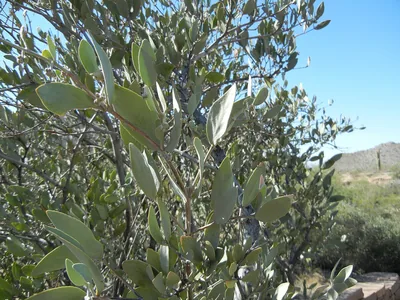
Plant magic by a wrongly written name
In 1822 the German botanist Johann Link misread the handwritten label on a dried specimen as 'China', and recorded the plant as Buxus chinensis.
On this page
The label actually said “Calif.”
Thomas Nuttall, who had collected the shrub himself in 1836, described the genus properly in 1844 and called it Simmondsia californica. That should have ended it. But botanical naming gives priority to the first epithet published, mistake or no, and the correction was overturned by procedure. Two centuries later the plant is still Simmondsia chinensis — named, in the permanent record of science, after a country where it has never grown wild[1].
And it’s a wax — not an oil
Jojoba is sold as an oil even though, in another case of uncorrected mislabeling, it’s actually a liquid wax.
Almost every plant material called an oil is a triglyceride — three fatty acids hung on a glycerol backbone. Olive, coconut, castor, sunflower. Jojoba builds something else: long straight-chain wax esters, C38 to C44, a fatty acid joined directly to a fatty alcohol. They account for 97 to 98 per cent of what comes out of the seed.[2]
The difference is structural and it shows. A triglyceride has three ester bonds around a central carbon and a set of double bonds down its chains, and both are places where oxygen gets in — which is what rancidity is. Jojoba's esters are single-linkage and overwhelmingly monounsaturated, with almost no free fatty acid. There is much less for oxygen to attack, and the wax keeps for years where a seed oil turns in months. It also withstands heat and pressure that break a triglyceride apart, which is the property the twentieth century actually wanted from it.
The plant is the only species in its genus, and its genus the only one in its family. A lone survivor of the Sonoran, Colorado and Baja deserts, making a substance almost nothing else makes.
Something else made it, though — and had been hunted nearly out of existence for it.
The plant that replaced the whales
Sperm whales were not hunted for fat; they were hunted for spermaceti and sperm oil, rich in liquid wax esters. Those esters hold up under heat and pressure where an ordinary oil breaks down. That made them the lubricant of choice for the twentieth century's hardest jobs: automatic transmissions, gear oils, high-pressure industrial machinery. Nothing else worked as well.
In 1970 the sperm whale was listed as endangered. In 1971 the United States banned imports of sperm whale products. The conservation case was overwhelming. The industrial problem was immediate: no plant fat behaves like a whale wax, because plant fats are triglycerides.
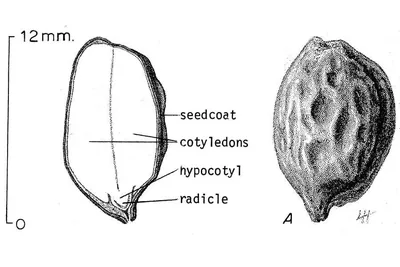
Except in one desert shrub, growing on ground that supports almost nothing else, whose seeds are roughly half liquid wax ester — the closest natural analogue to spermaceti anyone has found.[2]
Jojoba went from a wild plant harvested by hand to a cultivated crop, with plantations in Arizona, Israel, Argentina, Peru and Australia. The uses it inherited were the whale's: transmission fluid, gear oil, industrial lubricant. The cosmetic use came along beside them.
The plant took to being farmed for the reason it survived in the first place. It is built for arid ground — deep-rooted, drought-adapted, productive on land that will not carry a conventional oilseed and on water a conventional oilseed would not tolerate. The places that grow it commercially are deserts, which is not a compromise but the specification.
It is rare for a plant to have a date attached to its importance. This one has two.
The record starts in the twentieth century
Every other entry in this collection opens on an old text. Frankincense has the Incense Route. Castor is in the Ebers Papyrus, 1550 BCE. Copaiba has the sixteenth-century chroniclers. Hemp has Pliny.
Jojoba has none of that.
Its oldest record is ethnographic rather than textual: the O'odham and other peoples of the Sonoran Desert used the seed and its wax on skin and hair, long before anyone else wrote it down. No Greek physician, Roman naturalist or mediaeval herbal ever saw it.
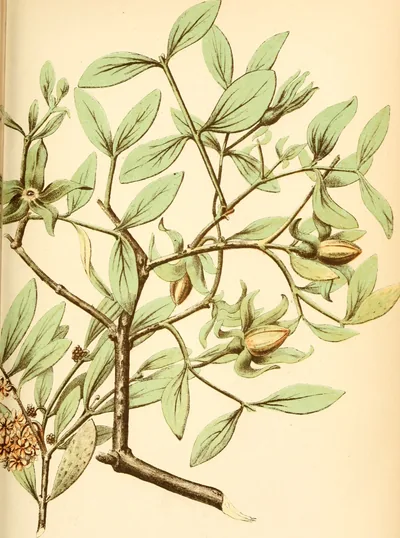
This botanical print of jojoba is from the Bulletin of the California Academy of Sciences, 1884–86.
How it works on skin
Sebum is not one substance but a blend, and a variable one.[5] Break down what the skin lays over its own surface and you get, roughly, a third triglycerides, a quarter free fatty acids, a quarter wax esters, a tenth squalene, and a trace of cholesterol and its esters.[6] It is that middle quarter — the wax esters — that jojoba is made of, almost to the exclusion of everything else. Wax esters are rare in the plant world. Jojoba is very nearly the only botanical source of a molecule the body builds for itself.
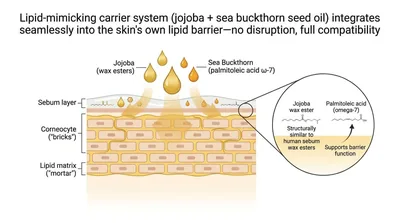
Which is why the precise claim holds and the loose one does not. Jojoba matches one of sebum's parts, not the whole: match the wax esters and you have still matched none of the triglycerides and none of the squalene. Even inside the wax esters the fit is a family resemblance rather than a copy — the chain lengths differ, and so do the proportions. Cousins, not twins. That is the honest reason the finer claims stay open: the class is the same, the exact molecules are not.[7]
It is enough that formulators build on it. Jojoba was one component of a botanically derived skin-surface-lipid mimetic in 2017,[3] and it sits among the nineteen plant oils reviewed that year for topical anti-inflammatory and skin-barrier effects.[4] That is a review across many materials rather than a trial of this one, and a trial of jojoba alone against a defined endpoint has yet to be run. Widely used, lightly tested — as is most of the botanical world.
The closest thing to such a trial is skin kept alive in a dish. In 2024 a group in Israel took skin removed during elective abdominal surgery from healthy women aged 40 to 65, cultured it, and spread cold-pressed jojoba wax on its surface. Where the tissue had been provoked with a bacterial toxin, the wax lowered three inflammatory signals — IL-6, IL-8 and TNFα — by about 30 per cent over two days; mixed with a laboratory emulsifier to help it in, it did about twice as well, matching a steroid control. In tissue left unprovoked, the wax raised pro-collagen III and hyaluronic acid, and doubled the activity of the collagen III gene.[7] The company that supplied the wax also helped fund the work. This is tissue in a dish — no blood supply, no immune system beyond the skin itself, three samples to a group — not people, and not a claim for these blends.
Nearly every other plant oil sits on skin as something the skin has to accommodate. This one arrives as a molecule it already makes.
References
- [1] Link JHF. Enum. Hort. Berol. Alt. 2: 386 (1822), as Buxus chinensis; Nuttall T. London J. Bot. 3: 400 (1844), as Simmondsia californica; Schneider CK. Ill. Handb. Laubholzk. 2: 141 (1907), Simmondsia chinensis. The chinensis epithet stands by priority under the International Code of Nomenclature. ↩
- [2] El Gendy SN, Elmotayam AK, Samir R, Ezzat MI, El Sayed AM. A review of the desert gold jojoba (Simmondsia chinensis) whole plant, oil, and meal: Phytochemical composition, medicinal uses, and detoxification. J Am Oil Chem Soc. 2023;100(8):591–614. doi:10.1002/aocs.12712 ↩
- [3] Addy J, Sherman G, Piechowski A. A botanically derived skin surface lipid mimetic based on the composition of healthy 22-year-old females. J Cosmet Sci. 2017;68(1):59–67. PMID 29465384 ↩
- [4] Lin TK, Zhong L, Santiago JL. Anti-Inflammatory and Skin Barrier Repair Effects of Topical Application of Some Plant Oils. Int J Mol Sci. 2017;19(1):70. PMID 29280987 · doi:10.3390/ijms19010070 ↩
- [5] Mijaljica D, Spada F, Harrison IP, et al. The heterogeneity and complexity of skin surface lipids in human skin health and disease. Prog Lipid Res. 2024;93:101264. PMID 37940006 · doi:10.1016/j.plipres.2023.101264 ↩
- [6] Picardo M, Ottaviani M, Camera E, Mastrofrancesco A. Sebaceous gland lipids. Dermatoendocrinol. 2009;1(2):68–71. PMID 20224686 ↩
- [7] Tietel Z, Melamed S, Ogen-Shtern N, et al. Topical application of jojoba (Simmondsia chinensis L.) wax enhances the synthesis of pro-collagen III and hyaluronic acid and reduces inflammation in the ex-vivo human skin organ culture model. Front Pharmacol. 2024;15:1333085. PMID 38344180 ↩
FAQs
Is jojoba actually an oil?
No, and that is the interesting part. It is a liquid wax. Almost every other plant oil is a triglyceride; jojoba is wax esters, which is why it stays stable and does not turn the way a seed oil does.
Why is it called chinensis if it comes from the Sonoran Desert?
A botanist in 1822 misread a collection label that said "Calif." as "China". Someone corrected it in 1844, and the naming rules overturned the correction. The mistake is permanent.
Did jojoba really replace whale oil?
It did. Sperm whales were hunted for their liquid wax, which lubricated transmissions and gear systems. After the 1971 US import ban, jojoba turned out to be the closest plant equivalent, and it took over those uses.
Is jojoba like my skin's own oil?
It shares a class of molecule with the wax esters in sebum. That is a real similarity and it gets overstated — the profiles are not identical, and the accurate version is the one worth having.
Will it block my pores?
Jojoba is generally well tolerated and sits light. If your skin reacts to things, patch test, the same as with anything else in the collection.
Which Rockstar products contain jojoba?
The Entourage Roll On, Face & Body Entourage and Face & Body Original. It is the base of the Face & Body blends along with castor.