Gold for the statues.
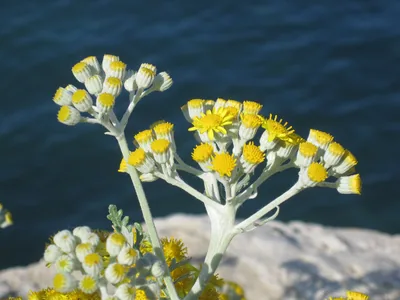
Dioscorides gives it a short entry in the fourth book of De materia medica: a plant with a straight white-green stem, narrow leaves, and a round head of florets "shining like gold" — the one "with which they crown their statues." It grows in rough places near running water. A decoction was drunk for a list of complaints, and the dried plant was packed among clothes to keep the moths off.[1]
One line in it sounds modern. Taken with must, he writes, the decoction "dissolves clots of blood" — in the bladder or the bowels, by mouth. Helichrysum's reputation today is for bruising, applied to the skin, and it has arrived there by tradition and report rather than by trial. The entry comes back to that at the end.
The name is the description. Helios, sun; chrysos, gold. Cut it and the flowers keep their colour and their shape, which is why the rest of Europe calls it the everlasting, or the immortelle.
Which Helichrysum he meant is not settled. The modern English version lists the candidates its editors inherited, from stoechas citrina to Helichrysum arenarium, a plant of sandy ground. A description of a stem and a gold tuft cannot choose between them. The genus is large, and this one entry has been read as several of its species.
On this page
The one on the coast.
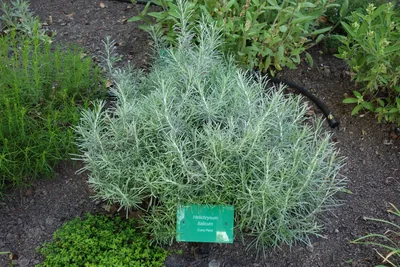
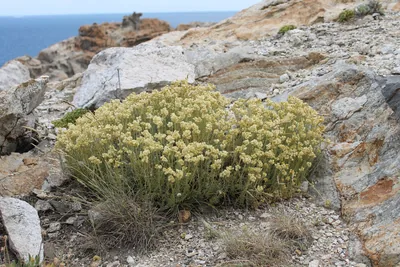
The helichrysum in these blends is Helichrysum italicum, a low silver shrub of the dry, stony ground around the Mediterranean — Corsica, Sardinia, the Dalmatian coast, Spain. Rub a leaf and it smells of curry, which gives it its other common name, curry plant, though it has nothing to do with curry leaf or with the spice.
Its folk medicine is a working tradition rather than an ancient one. A 2014 review gathered the reports from Italy, Spain, Portugal and Bosnia and Herzegovina: the flowers and leaves reached for colds and coughs, for the skin, the liver and gallbladder, for inflammation, for sleeplessness.[2] The same review put the state of it plainly, and it is quoted at the end of this entry.
A molecule named for a village.
In 2007 a group led by Giovanni Appendino made an acetone extract of a Sardinian subspecies of H. italicum and isolated a compound nobody had described: a phloroglucinol α-pyrone they called arzanol.[3] The name comes from Arzana, the Sardinian village where the plants were gathered.[4]
It has since become the most studied of the plant's own molecules. A German–Italian group showed in 2011 that it works on the chain that turns a fatty acid into prostaglandin E2, one of the body's main inflammatory signals. It blocked 5-lipoxygenase and cyclooxygenase-1 in the low micromolar range, but its sharpest effect was on the last enzyme in the chain, mPGES-1, at 0.4 micromolar — cutting prostaglandin E2 in human blood. Thromboxane and prostacyclin, made from the same starting point by the same upstream enzyme, came through untouched. The target sits at the end of one branch, not at the trunk. Rats given arzanol by injection mounted a smaller inflammatory response.[5]
That is a precise mechanism, shown in cells, in blood and in rats — reasonable grounds, and a clear lead for work on skin.
What the still keeps.
Arzanol came out of a solvent extract. A distilled oil is a different material, made of whatever the flowering tops give up to steam.
An Italian group ran oil from plants grown in the Marche through gas chromatography in 2019 and counted seventy-eight compounds. The largest was neryl acetate, at about sixteen per cent, followed by α-pinene, then the italidiones, a pair of β-diketones.[6]
They then tested the oil against collagenase and elastase, the enzymes that take apart collagen and elastin, the two proteins that give skin its structure and its give. The oil inhibited both. Then they tested its components one at a time. Neryl acetate, nerol and linalool — the oil's signature — did nothing to either enzyme on their own. α-Pinene and limonene, which the oil shares with pine and citrus, did.[6]
The most distinctive part of the smell was not doing the work in that dish.
On skin, in surgery and in animals.
The nearest thing to a skin study is in rats. A Serbian group in 2021 made the oil into a 0.5 per cent ointment and a gel and applied them to full-thickness wounds in diabetic rats, whose wounds close slowly. Six groups were compared, including the bare ointment and the bare gel, so the base itself was accounted for. The treated wounds contracted faster than every other group, carried more hydroxyproline — a marker of new collagen — and rebuilt more of the skin's own structures.[7]
That is one animal study at one concentration. The review cited above found one human thread worth naming: flavonoids from the plant showed anti-erythema and photoprotective activity — less reddening after light exposure — in animals and in people.[2] There is still no rigorous human trial of the oil on its own.
The bruise reputation has one clinical source. In 2007 a French plastic surgeon and a general practitioner reported their first results with helichrysum essential oil and rosehip oil in two series of patients, after surgery to the face and neck and to the chest. They looked at bruising and swelling in the days after the operation, and at how the scars remodelled over the months that followed, with the oils applied to the skin; part of their protocol was also systemic, not on the skin.[8] It is a report of the authors' experience with their patients, not a controlled trial, and the systemic part is not how these blends are used.
On safety the same review is reassuring on one count and careful on another. The plant shows no significant cytotoxicity or genotoxicity. It belongs to the daisy family, like chamomile and ragweed, and a case of allergy to its extracts has been reported.[2] Anyone who reacts to that family should patch test first.
Bruising is where the plant's modern reputation sits, and it got there by tradition and report. The laboratory has since given it two leads worth following: a Sardinian molecule that works the prostaglandin chain in cells and in rats, and an oil that held back the enzymes that take skin's structure apart, in a dish. A trial on skin is the obvious next step.
"Helichrysum italicum is a medicinal plant with promising pharmacological activities."
References
- [1] Dioscorides, De materia medica, Book IV, "Elichryson" (the gold florets, the crowning of statues, the moths). ch. 57 in Goodyer's English (1655), modern version Osbaldeston TA, Wood RPA, Ibidis Press, Johannesburg 2000, p. 595. ↩
- [2] Antunes Viegas D, Palmeira-de-Oliveira A, Salgueiro L, Martinez-de-Oliveira J, Palmeira-de-Oliveira R. Helichrysum italicum: from traditional use to scientific data. J Ethnopharmacol. 2014;151(1):54–65. PMID 24239849 · doi:10.1016/j.jep.2013.11.005 ↩
- [3] Appendino G, Ottino M, Marquez N, et al. Arzanol, an anti-inflammatory and anti-HIV-1 phloroglucinol alpha-Pyrone from Helichrysum italicum ssp. microphyllum. J Nat Prod. 2007;70(4):608–612. PMID 17315926 · doi:10.1021/np060581r ↩
- [4] Kothavade PS, Nagmoti DM, Bulani VD, Juvekar AR. Arzanol, a potent mPGES-1 inhibitor: novel anti-inflammatory agent. ScientificWorldJournal. 2013;2013:986429. PMID 24198734 · doi:10.1155/2013/986429 ↩
- [5] Bauer J, Koeberle A, Dehm F, et al. Arzanol, a prenylated heterodimeric phloroglucinyl pyrone, inhibits eicosanoid biosynthesis and exhibits anti-inflammatory efficacy in vivo. Biochem Pharmacol. 2011;81(2):259–268. PMID 20933508 · doi:10.1016/j.bcp.2010.09.025 ↩
- [6] Fraternale D, Flamini G, Ascrizzi R. In Vitro Anticollagenase and Antielastase Activities of Essential Oil of Helichrysum italicum subsp. italicum (Roth) G. Don. J Med Food. 2019;22(10):1041–1046. PMID 31199702 · doi:10.1089/jmf.2019.0054 ↩
- [7] Andjić M, Božin B, Draginić N, et al. Formulation and Evaluation of Helichrysum italicum Essential Oil-Based Topical Formulations for Wound Healing in Diabetic Rats. Pharmaceuticals (Basel). 2021;14(8):813. PMID 34451910 · doi:10.3390/ph14080813 ↩
- [8] Voinchet V, Giraud-Robert A-M. Utilisation de l'huile essentielle d'hélichryse italienne et de l'huile végétale de rose musquée après intervention de chirurgie plastique réparatrice et esthétique. Phytothérapie. 2007;5(2):67–72. ↩
FAQs
Is helichrysum the same as immortelle?
Yes. Helichrysum is the Greek name, sun and gold, and immortelle or everlasting is the common one, because the flowers keep their colour after they are cut.
Why is it called the curry plant?
The leaves smell of curry when they are rubbed. It is not related to curry leaf or to any spice in curry powder.
What is arzanol?
A molecule first isolated from Sardinian helichrysum in 2007 and named after the village of Arzana. In laboratory work it acts on the enzymes that make prostaglandin E2. It was found in a solvent extract of the plant, which is a different material from a distilled oil.
Is there research on helichrysum oil and skin?
In laboratory tests the oil inhibited collagenase and elastase, enzymes that break down collagen and elastin. In a rat study, an ointment with 0.5 per cent of the oil was applied to wounds. There is no rigorous human trial of the oil alone.
Can I use it if I am allergic to ragweed?
Helichrysum is in the daisy family, with ragweed and chamomile, and allergic reactions to it have been reported. Patch test first, and ask your doctor if you know you react to that family.