
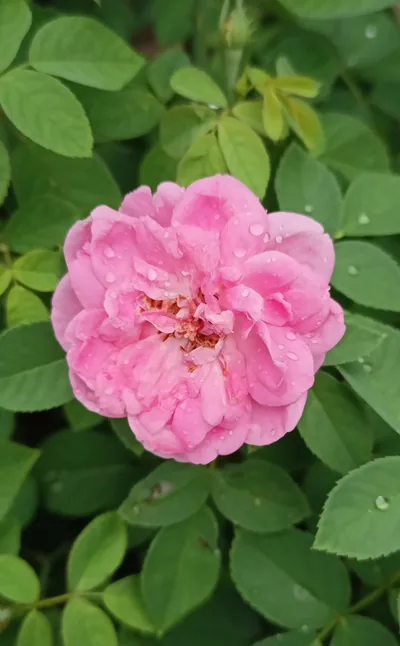
A thousand counted petals.
Dioscorides gives a recipe for oil of roses. Soak and boil sweet rush, strain it into the oil, then put in "a thousand counted dry rose petals", stir them through with hands rubbed in honey, leave them a night and press them out. Do it again with fresh petals, and again, "seven times, but by no means any farther." Some makers added alkanet root for colour and salt so the oil would keep, and every maker had to part the oil from the petals' juice completely, "for if even a little of it is left in there it will corrupt the oil." The result is "astringent and cooling."[1]
The petals had uses of their own. Fresh, with the white base of each one cut away, they were pounded in the shade into a paste for eye salves. Dried, they were turned so they would not grow mouldy. Burnt, they went into preparations "to make the eyelids look pleasing": a cosmetic, recorded in the first century.[1]
His rose is probably not the damask. The modern edition matches it to Rosa gallica, which turns out to be one of the damask's parents. And his oil is not distilled. It is petals steeped in oil and squeezed. But the count is the thing that lasts. Two thousand years later, rose is still measured in how many flowers it takes.
On this page
The rose that never grew from seed.
The damask rose is a hybrid of three wild roses, and it has never been allowed to reproduce sexually. In 2000 a group in Hiroshima compared four of the oldest damask varieties and found them genetically identical: one original cross, propagated ever since by cutting. They also named the parents: Rosa gallica, R. fedtschenkoana and, as the mother, the musk rose R. moschata. Every old damask carries its chloroplasts, which pass down only through the seed parent.[2]
Five years later, Bulgarian and Dutch researchers tested the oil roses themselves. The damasks grown for oil in Bulgaria, Iran and India, and the old garden damasks of Europe, carried identical genetic profiles, and the markers held steady through long propagation by cutting.[3] The industry rests on a very narrow gene pool: one rose, copied by hand across continents.
So "damask rose" names a single plant rather than a population, and every field of it is a cutting of a cutting.
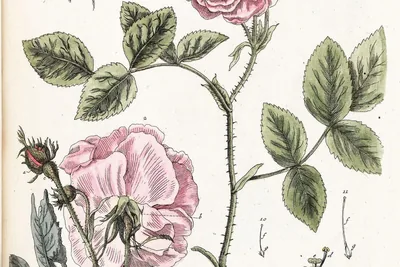
Picked before the sun is high.
In Iran it is Gol-e Mohammadi, the flower of the Prophet. Rose water is used in religious ceremonies, among them the washing of the Kaaba in Mecca. The flowers are picked by hand, early each morning, and distilled at once. Bulgaria and Turkey are now the largest producers, and Bulgarian oil has the longest reputation.[4]
They give up very little: it takes three and a half to four tonnes of flowers to make a single kilogram of oil. Nothing natural or synthetic substitutes for it, and oil that costly invites fakes. The usual trick is to stretch it with the cheaper molecules it already contains, phenylethanol, citronellol and geraniol, bought in natural or synthetic, or to cut it with a cheaper oil such as palmarosa. The international standard, ISO 9842, still judges rose oil mostly by its appearance, colour, smell and a few physical constants. A method from Zurich answers that by measuring the mirror-image forms of rose oil's own molecules, citronellol and rose oxide among them. The plant makes those forms in characteristic proportions, and a blend assembled from parts gets them wrong. The Zurich team tested the method on ten authentic rose oils.[5]
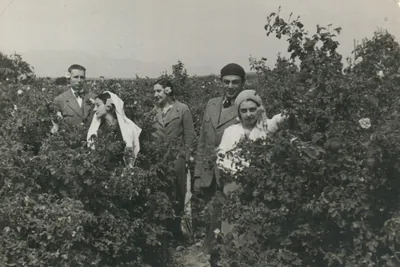
What is in the drop.
Two molecules lead: citronellol and geraniol, both alcohols with a rose scent of their own.[6] Around them sit dozens of minor compounds, between 38 and 132 depending on the study, and they change with the valley, the season and the still.[5] Published ranges vary so widely by origin that no single percentage describes rose otto.
The waxes are part of it too. Rose otto sets soft and cloudy when it is cold, because of the long-chain alkanes that come over from the petals with the scent.
Rose oil against sunburn light.
In 2023 a group in Jeddah distilled Taif rose oil from R. damascena, set it in a gel, and applied it to the skin of rats before exposing them to ultraviolet B. The treated skin kept more of its own antioxidant enzymes, showed fewer inflammatory markers, and lost less collagen, with less MMP-9, the enzyme that breaks it down. A nanoemulsion of the same oil did better still.[7]
In rats, and in a gel, but the direction is plain: steam-distilled rose oil, on skin, against the light damage skin sees every day.
A scent, measured.
Rose is also studied as a scent. A 2023 network meta-analysis pooled forty-four randomised trials of essential oils, 3,419 people in all, and placed damask rose among the oils with a moderate effect on state-anxiety scores, alongside lavender, behind jasmine and bitter orange.[8] The paper labels damask rose Rosa rugosa, a different species; the effect it reports is for the damask.
These are inhaled studies, over single sessions or short courses: they describe what rose does as a scent.
Rose and desire.
Rose's oldest reputation is the one modern trials have tested most directly. In 2015 a psychiatry group in Kermanshah, Iran, randomised sixty-eight men whose antidepressants had dulled their sex lives to rose oil or a placebo, double-blind, taken as drops by mouth every morning for eight weeks. Sexual function improved more on rose than on placebo, and depressive symptoms, which fell in both groups, fell further on rose.[11]
The same group then gave the same daily drops, again by mouth for eight weeks, to fifty men and, in a second trial, fifty women taking methadone for opioid dependence, a treatment that often impairs sexual function. In both, sexual function improved more on rose than on placebo.[12][13] In Mashhad, eighty-two menopausal women took a capsule of rose extract or a placebo every twelve hours for eight weeks; sexual function scores rose more on rose, with desire and orgasm improving by the eighth week.[14]
These are small trials, each run by a single group, and every one of them was rose taken by mouth by patients in a study. None is a claim for oil on skin, and none is a reason to swallow an essential oil.
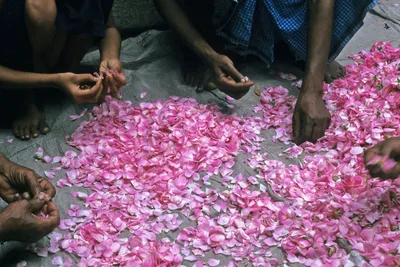
What the literature also says.
Rose has a long association with women's medicine, and some of the modern literature echoes it. A 2022 systematic review listed changes in hormone signalling, including raised oestradiol and progesterone, among the mechanisms proposed for damask rose.[9] That work is in animals and by mouth, not on skin, and no study has tested whether rose oil applied topically does anything of the kind.
Rose's two lead molecules are fragrance allergens by regulation. Among 21,325 patients patch-tested in Germany against the twenty-six fragrances the EU requires on labels, citronellol sensitised 0.5 per cent and geraniol 0.4 per cent. Both sat in the lower band, with mostly weak or doubtful reactions; oak moss and tree moss, at the top, ran four to five times higher.[10]
"The current study provides scientific evidence for the traditional use of rose oil in skin aging."
References
- [1] Dioscorides, De materia medica, Book I, "Rhodinon" (oil of roses: a thousand counted petals, seven additions) and "Rhodon" (astringent and cooling). chs. 53 and 130 in Goodyer's English (1655), modern version Osbaldeston TA, Wood RPA, Ibidis Press, Johannesburg 2000, pp. 47–49 and 129. ↩
- [2] Iwata H, Kato T, Ohno S. Triparental origin of Damask roses. Gene. 2000;259(1-2):53–59. PMID 11163961 · doi:10.1016/s0378-1119(00)00487-x ↩
- [3] Rusanov K, Kovacheva N, Vosman B, et al. Microsatellite analysis of Rosa damascena Mill. accessions reveals genetic similarity between genotypes used for rose oil production and old Damask rose varieties. Theor Appl Genet. 2005;111(4):804–809. PMID 15947904 · doi:10.1007/s00122-005-2066-9 ↩
- [4] Mahboubi M. Rosa damascena as holy ancient herb with novel applications. J Tradit Complement Med. 2016;6(1):10–16. PMID 26870673 · doi:10.1016/j.jtcme.2015.09.005 ↩
- [5] Raeber J, Favrod S, Steuer C. Determination of major, minor and chiral components as quality and authenticity markers of Rosa damascena oil by GC-FID. Plants (Basel). 2023;12(3):506. PMID 36771592 · doi:10.3390/plants12030506 ↩
- [6] Akram M, Riaz M, Munir N, et al. Chemical constituents, experimental and clinical pharmacology of Rosa damascena: a literature review. J Pharm Pharmacol. 2020;72(2):161–174. PMID 31709541 · doi:10.1111/jphp.13185 ↩
- [7] Abdallah HM, Koshak AE, Farag MA, et al. Taif rose oil ameliorates UVB-induced oxidative damage and skin photoaging in rats via modulation of MAPK and MMP signaling pathways. ACS Omega. 2023;8(37):33943–33954. PMID 37744837 · doi:10.1021/acsomega.3c04756 ↩
- [8] Tan L, Liao FF, Long LZ, et al. Essential oils for treating anxiety: a systematic review of randomized controlled trials and network meta-analysis. Front Public Health. 2023;11:1144404. PMID 37325306 · doi:10.3389/fpubh.2023.1144404 ↩
- [9] Mohamadi N, Pourkorrani MHS, Langarizadeh MA, et al. Evidence for Rosa damascena efficacy in mental disorders in preclinical animal studies and clinical trials: a systematic review. Phytother Res. 2022;36(8):3016–3031. PMID 35653142 · doi:10.1002/ptr.7496 ↩
- [10] Schnuch A, Uter W, Geier J, Lessmann H, Frosch PJ. Sensitization to 26 fragrances to be labelled according to current European regulation. Contact Dermatitis. 2007;57(1):1–10. PMID 17577350 · doi:10.1111/j.1600-0536.2007.01088.x ↩
- [11] Farnia V, Shirzadifar M, Shakeri J, et al. Rosa damascena oil improves SSRI-induced sexual dysfunction in male patients suffering from major depressive disorders: results from a double-blind, randomized, and placebo-controlled clinical trial. Neuropsychiatr Dis Treat. 2015;11:625–635. PMID 25834441 ↩
- [12] Farnia V, Tatari F, Alikhani M, et al. Rosa Damascena oil improved sexual function and testosterone in male patients with opium use disorder under methadone maintenance therapy — results from a double-blind, randomized, placebo-controlled clinical trial. Drug Alcohol Depend. 2017;176:117–125. ↩
- [13] Farnia V, Tatari F, Alikhani M, et al. Rosa Damascena oil improved methadone-related sexual dysfunction in females with opioid use disorder under methadone maintenance therapy — results from a double-blind, randomized, and placebo-controlled trial. J Psychiatr Res. 2017;95:260–268. PMID 28923720 ↩
- [14] Gholinezhad Z, Karimi FZ, Rakhshandeh H, Mazloum SR. Impact of Rosa damascena extract capsule on the sexual function of menopausal women: a randomized clinical trial. Explore (NY). 2025;21(1):103082. PMID 39580876 · doi:10.1016/j.explore.2024.103082 ↩
FAQs
What is rose otto?
Rose otto is the essential oil steam-distilled from the petals of the damask rose, Rosa × damascena. It is a different material from rose absolute, which is extracted with solvents.
Why is rose otto so expensive?
The yield is tiny. It takes three and a half to four tonnes of flowers to make one kilogram of oil, and the flowers are picked by hand in the early morning.
Is the damask rose one plant or many?
Genetically, very nearly one. The damask roses grown for oil in Bulgaria, Iran and India share the same genetic profile, propagated by cuttings from a single ancient hybrid.
Does rose otto affect hormones?
A 2022 review listed hormone-signalling changes among the mechanisms proposed for damask rose, from animal and oral studies. No study has shown this for rose oil on skin. It is disclosed here because it is in the literature.
Can rose otto irritate skin?
Its main molecules, citronellol and geraniol, are regulated fragrance allergens, though reactions to them are uncommon. Patch test first if your skin is reactive.
Which Rockstar products contain rose otto?
Rose otto is the lead botanical in Rockstar Man.