
Rome was sure it came from Arabia.
Around 77 CE Pliny the Elder set down the rule: "There is no country in the world that produces frankincense except Arabia" — and not the whole of Arabia either.[1] He put the forests in the country of the Sabaei, in the south of the peninsula, reached by one narrow road and worked by some three thousand families who held the right to the trees by inheritance and kept themselves ritually pure while they worked them — which, he says, is why the price ran so high.
He also admitted that no Latin writer had ever described the tree. Rome burned the resin in its temples, sent expeditions into the region and received its ambassadors, and still could not say what the leaf looked like. The Greek writers he read could not agree either: like a pear's, said some; reddish, like mastic, said others; a kind of terebinth, said King Antigonus, who had been sent a branch.[1]
On this page
The Indian kind.
A Greek physician writing in the same decades knew something Pliny's rule left out. Dioscorides ranks the frankincenses in the first book of De materia medica. The best is Arabian, the "male" drop called stagonias — white, naturally round, fat inside when broken. Then he describes the Indian: yellow-brown, paler on the surface, and "made round by art and industry." Merchants cut it into cubes and tumbled them in clay jars until they took the shape of the drop that was round by nature.[2]
The Indian resin was already in the Mediterranean market, shaped to pass.
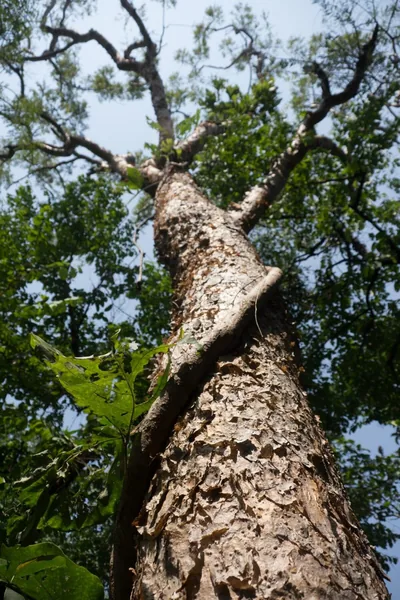
Its tree is Boswellia serrata, and it is the frankincense in these blends. It grows in the dry deciduous forests of India, its bark peeling away in pale papery sheets. Cut that bark and the tree does what it would do for any wound: it bleeds a milky resin to seal it, and the resin hardens in air into tears. The harvest Pliny described for the Arabian tree — an incision, then a foam that "gradually coagulates and thickens" — describes this one too. He adds that the trees were at first cut only once a year, at the height of summer, and that Rome's appetite had since added a second harvest.[1]
The tree at the top of this page was photographed in Chhattisgarh, central India, and appears courtesy of Herbal Reality.
The scent is the light part.
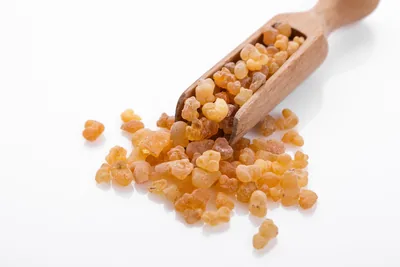
A frankincense tear is two materials. What reaches the nose is the volatile fraction: small terpenes that lift off warm resin and give a church its smell. The rest is heavier — gum, and a family of large triterpenes called boswellic acids, which barely evaporate and contribute nothing to the scent at all.
That second fraction is the one the science is about. In 2016 a group in Turin measured it by liquid chromatography in both trees. Indian resin came out at about 30 per cent boswellic acids by dry weight, Arabian at 49. The single acid most often named, AKBA, was 0.7 per cent of serrata and 7 per cent of sacra — and the authors added that claims of 30 per cent AKBA in resin are "simply unrealistic."[3]
It is why the extraction matters. A still collects what evaporates and leaves the acids behind. We use a CO2 extract of the whole resin rather than a distilled oil, a method not bound by that limit. How much of the acid fraction a given extract carries depends on how it was run, and it is measured, not assumed from the name on the drum.
What the acids do in a dish.
In 1992 a pharmacology group at Tübingen isolated boswellic acids from serrata resin and set them against one enzyme, 5-lipoxygenase — the first step in making leukotrienes, signalling molecules the immune system uses to call up inflammation. The acids inhibited it, AKBA most strongly, at 1.5 micromolar. They did it selectively: in parallel tests on human platelets, the cyclooxygenase that aspirin blocks ran on untouched.[4]
The inhibition was measured in rat cells, in a dish: a named molecule at a named enzyme, and reasonable grounds for the human work that followed. It is also a different pathway from the one hemp and copaiba reach. Nothing in it runs through the endocannabinoid system; frankincense arrives at the same tissue by another door.
On skin, once.
One trial has put the acids on faces. At Brescia in 2010, fifteen women applied a cream with 0.5 per cent boswellic acids to one side of the face and the same cream without them to the other, daily for thirty days, with neither they nor the assessors knowing which side was which. The treated side measured better for tactile roughness and fine lines, with more elasticity and less sebum, and an ultrasound of the treated side suggested the dermis beneath it had begun to change. Nobody reacted to the cream.[5]
Fifteen people, one study, one month — a good first result, and one worth repeating at scale.
Both trees.
The Entourage Roll On, Face & Body Entourage and Face & Body Original carry a second frankincense alongside serrata: carterii, a name since folded into Boswellia sacra. The Arabian tree. Pliny's frankincense — and, on the Turin numbers, the resin with ten times the AKBA of its Indian cousin.[3]
We put both in — the Indian tree leading, the Arabian one beside it — so the two resins the ancient market ranked apart go on skin together.
The test Dioscorides gave for telling real frankincense from pine resin and gum was fire. It asks nothing about where the tree grew.
"the thus is kindled and by its scent proves itself."
References
- [1] Pliny the Elder, Natural History, Book XII, ch. 30–31 ("There is no country in the world that produces frankincense except Arabia"; the Sabaei; the incision and the coagulating foam). Bostock J, Riley HT (tr.), vol. 3, London 1855, pp. 123–126. ↩
- [2] Dioscorides, De materia medica, Book I, "Libanos" (frankincense: the Arabian stagonias, the Indian kind made round by art, the fire test). ch. 81 in Goodyer's English (1655), modern version Osbaldeston TA, Wood RPA, Ibidis Press, Johannesburg 2000, pp. 84–85. ↩
- [3] Mannino G, Occhipinti A, Maffei ME. Quantitative Determination of 3-O-Acetyl-11-Keto-βBoswellic Acid (AKBA) and Other Boswellic Acids in Boswellia sacra Flueck (syn. B. carteri Birdw) and Boswellia serrata Roxb. Molecules. 2016;21(10):1329. PMID 27782055 · doi:10.3390/molecules21101329 ↩
- [4] Safayhi H, Mack T, Sabieraj J, Anazodo MI, Subramanian LR, Ammon HP. Boswellic acids: novel, specific, nonredox inhibitors of 5-lipoxygenase. J Pharmacol Exp Ther. 1992;261(3):1143–1146. PMID 1602379 ↩
- [5] Pedretti A, Capezzera R, Zane C, et al. Effects of topical boswellic acid on photo and age-damaged skin: clinical, biophysical, and echographic evaluations in a double-blind, randomized, split-face study. Planta Med. 2010;76(6):555–560. PMID 19918712 · doi:10.1055/s-0029-1240581 ↩
FAQs
Is frankincense the same thing as olibanum?
Yes. Olibanum is the older trade and pharmacy name for the same resin, from the same genus of trees, Boswellia.
Which frankincense is in Rockstar Blends?
Indian frankincense, Boswellia serrata, is in all six blends. The Entourage Roll On, Face & Body Entourage and Face & Body Original also carry Boswellia carterii, now called Boswellia sacra, the Arabian tree.
Does frankincense essential oil contain boswellic acids?
Largely not. Boswellic acids are heavy molecules that barely evaporate, so distillation collects the scent and leaves them largely behind. A CO2 extract of the whole resin is not limited in the same way; how much of the acids a given extract carries depends on how it was made.
Is there research on frankincense on skin?
One small trial. In 2010, fifteen women used a cream with boswellic acids on one side of the face for a month, and that side measured better for roughness and fine lines. It is a single study with fifteen people, a start rather than a settled answer.
Is frankincense a cannabinoid?
No. Its boswellic acids have been studied at a different target, an enzyme called 5-lipoxygenase, in laboratory cells. The research on it runs through a different pathway from the one studied for hemp and copaiba.
Why does the Indian resin look different from Arabian frankincense?
It is a different tree. Indian resin is more yellow-brown, and in the ancient market it was sometimes rolled into rounded drops to look like the Arabian kind, which was priced higher.